

materials [50]. During the compression using helium as the PTM, they noted that
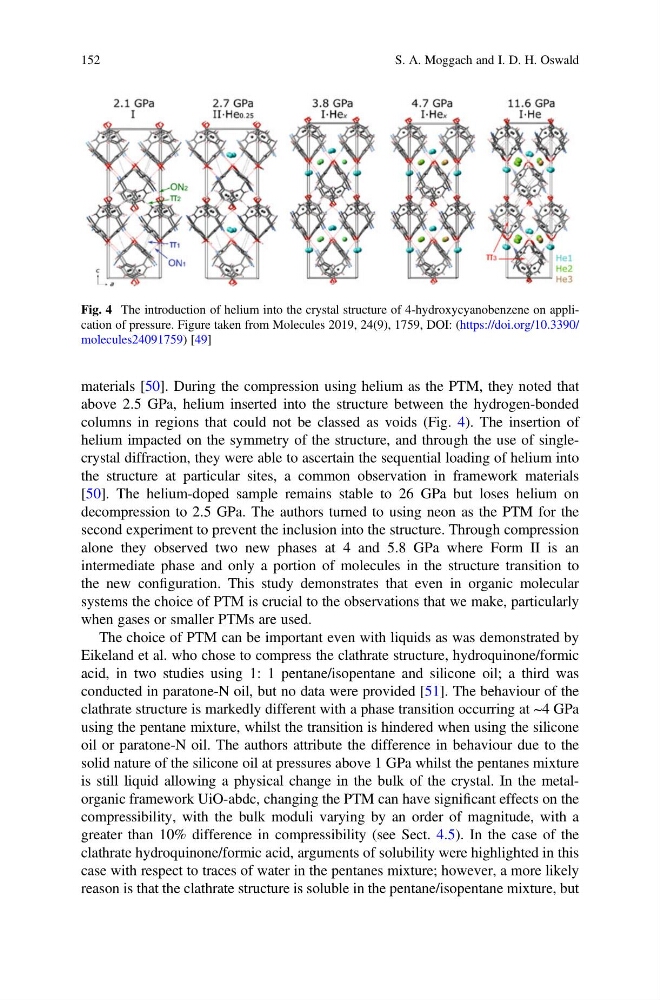
above 2.5 GPa, helium inserted into the structure between the hydrogen-bonded
columns in regions that could not be classed as voids (Fig. 4). The insertion of
helium impacted on the symmetry of the structure, and through the use of singlecrystal diffraction, they were able to ascertain the sequential loading of helium into
the structure at particular sites, a common observation in framework materials
[50]. The helium-doped sample remains stable to 26 GPa but loses helium on
decompression to 2.5 GPa. The authors turned to using neon as the PTM for the
second experiment to prevent the inclusion into the structure. Through compression
alone they observed two new phases at 4 and 5.8 GPa where Form II is an
intermediate phase and only a portion of molecules in the structure transition to
the new configuration. This study demonstrates that even in organic molecular
systems the choice of PTM is crucial to the observations that we make, particularly
when gases or smaller PTMs are used.
The choice of PTM can be important even with liquids as was demonstrated by
Eikeland et al. who chose to compress the clathrate structure, hydroquinone/formic
acid, in two studies using 1: 1 pentane/isopentane and silicone oil; a third was
conducted in paratone-N oil, but no data were provided [51]. The behaviour of the
clathrate structure is markedly different with a phase transition occurring at ~4 GPa
using the pentane mixture, whilst the transition is hindered when using the silicone
oil or paratone-N oil. The authors attribute the difference in behaviour due to the
solid nature of the silicone oil at pressures above 1 GPa whilst the pentanes mixture
is still liquid allowing a physical change in the bulk of the crystal. In the metalorganic framework UiO-abdc, changing the PTM can have significant effects on the
compressibility, with the bulk moduli varying by an order of magnitude, with a
greater than 10% difference in compressibility (see Sect. 4.5). In the case of the
clathrate hydroquinone/formic acid, arguments of solubility were highlighted in this
case with respect to traces of water in the pentanes mixture; however, a more likely
reason is that the clathrate structure is soluble in the pentane/isopentane mixture, but
Fig. 4 The introduction of helium into the crystal structure of 4-hydroxycyanobenzene on application of pressure. Figure taken from Molecules 2019, 24(9), 1759, DOI: (https://doi.org/10.3390/
molecules24091759) [49]
152
S. A. Moggach and I. D. H. Oswald
above 2.5 GPa, helium inserted into the structure between the hydrogen-bonded
columns in regions that could not be classed as voids (Fig. 4). The insertion of
helium impacted on the symmetry of the structure, and through the use of singlecrystal diffraction, they were able to ascertain the sequential loading of helium into
the structure at particular sites, a common observation in framework materials
[50]. The helium-doped sample remains stable to 26 GPa but loses helium on
decompression to 2.5 GPa. The authors turned to using neon as the PTM for the
second experiment to prevent the inclusion into the structure. Through compression
alone they observed two new phases at 4 and 5.8 GPa where Form II is an
intermediate phase and only a portion of molecules in the structure transition to
the new configuration. This study demonstrates that even in organic molecular
systems the choice of PTM is crucial to the observations that we make, particularly
when gases or smaller PTMs are used.
The choice of PTM can be important even with liquids as was demonstrated by
Eikeland et al. who chose to compress the clathrate structure, hydroquinone/formic
acid, in two studies using 1: 1 pentane/isopentane and silicone oil; a third was
conducted in paratone-N oil, but no data were provided [51]. The behaviour of the
clathrate structure is markedly different with a phase transition occurring at ~4 GPa
using the pentane mixture, whilst the transition is hindered when using the silicone
oil or paratone-N oil. The authors attribute the difference in behaviour due to the
solid nature of the silicone oil at pressures above 1 GPa whilst the pentanes mixture
is still liquid allowing a physical change in the bulk of the crystal. In the metalorganic framework UiO-abdc, changing the PTM can have significant effects on the
compressibility, with the bulk moduli varying by an order of magnitude, with a
greater than 10% difference in compressibility (see Sect. 4.5). In the case of the
clathrate hydroquinone/formic acid, arguments of solubility were highlighted in this
case with respect to traces of water in the pentanes mixture; however, a more likely
reason is that the clathrate structure is soluble in the pentane/isopentane mixture, but
Fig. 4 The introduction of helium into the crystal structure of 4-hydroxycyanobenzene on application of pressure. Figure taken from Molecules 2019, 24(9), 1759, DOI: (https://doi.org/10.3390/
molecules24091759) [49]
152
S. A. Moggach and I. D. H. Oswald