

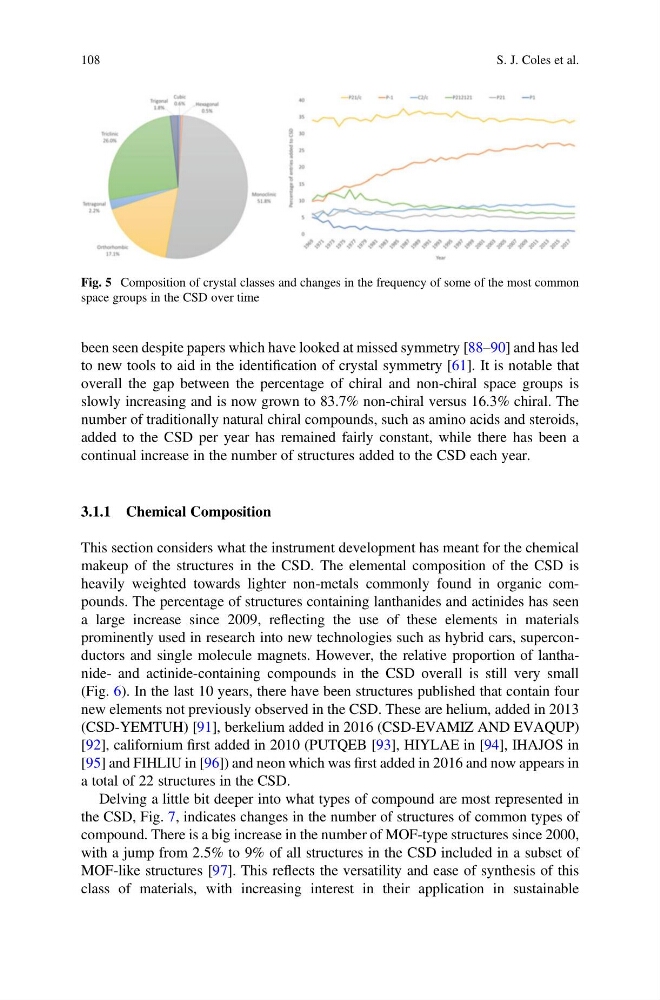
been seen despite papers which have looked at missed symmetry [88–90] and has led
to new tools to aid in the identification of crystal symmetry [61]. It is notable that
overall the gap between the percentage of chiral and non-chiral space groups is
slowly increasing and is now grown to 83.7% non-chiral versus 16.3% chiral. The
number of traditionally natural chiral compounds, such as amino acids and steroids,
added to the CSD per year has remained fairly constant, while there has been a
continual increase in the number of structures added to the CSD each year.
3.1.1 Chemical Composition
This section considers what the instrument development has meant for the chemical
makeup of the structures in the CSD. The elemental composition of the CSD is
heavily weighted towards lighter non-metals commonly found in organic compounds. The percentage of structures containing lanthanides and actinides has seen
a large increase since 2009, reflecting the use of these elements in materials
prominently used in research into new technologies such as hybrid cars, superconductors and single molecule magnets. However, the relative proportion of lanthanide- and actinide-containing compounds in the CSD overall is still very small
(Fig. 6). In the last 10 years, there have been structures published that contain four
new elements not previously observed in the CSD. These are helium, added in 2013
(CSD-YEMTUH) [91], berkelium added in 2016 (CSD-EVAMIZ AND EVAQUP)
[92], californium first added in 2010 (PUTQEB [93], HIYLAE in [94], IHAJOS in
[95] and FIHLIU in [96]) and neon which was first added in 2016 and now appears in
a total of 22 structures in the CSD.
Delving a little bit deeper into what types of compound are most represented in
the CSD, Fig. 7, indicates changes in the number of structures of common types of
compound. There is a big increase in the number of MOF-type structures since 2000,
with a jump from 2.5% to 9% of all structures in the CSD included in a subset of
MOF-like structures [97]. This reflects the versatility and ease of synthesis of this
class of materials, with increasing interest in their application in sustainable
Fig. 5 Composition of crystal classes and changes in the frequency of some of the most common
space groups in the CSD over time
108
S. J. Coles et al.
to new tools to aid in the identification of crystal symmetry [61]. It is notable that
overall the gap between the percentage of chiral and non-chiral space groups is
slowly increasing and is now grown to 83.7% non-chiral versus 16.3% chiral. The
number of traditionally natural chiral compounds, such as amino acids and steroids,
added to the CSD per year has remained fairly constant, while there has been a
continual increase in the number of structures added to the CSD each year.
3.1.1 Chemical Composition
This section considers what the instrument development has meant for the chemical
makeup of the structures in the CSD. The elemental composition of the CSD is
heavily weighted towards lighter non-metals commonly found in organic compounds. The percentage of structures containing lanthanides and actinides has seen
a large increase since 2009, reflecting the use of these elements in materials
prominently used in research into new technologies such as hybrid cars, superconductors and single molecule magnets. However, the relative proportion of lanthanide- and actinide-containing compounds in the CSD overall is still very small
(Fig. 6). In the last 10 years, there have been structures published that contain four
new elements not previously observed in the CSD. These are helium, added in 2013
(CSD-YEMTUH) [91], berkelium added in 2016 (CSD-EVAMIZ AND EVAQUP)
[92], californium first added in 2010 (PUTQEB [93], HIYLAE in [94], IHAJOS in
[95] and FIHLIU in [96]) and neon which was first added in 2016 and now appears in
a total of 22 structures in the CSD.
Delving a little bit deeper into what types of compound are most represented in
the CSD, Fig. 7, indicates changes in the number of structures of common types of
compound. There is a big increase in the number of MOF-type structures since 2000,
with a jump from 2.5% to 9% of all structures in the CSD included in a subset of
MOF-like structures [97]. This reflects the versatility and ease of synthesis of this
class of materials, with increasing interest in their application in sustainable
Fig. 5 Composition of crystal classes and changes in the frequency of some of the most common
space groups in the CSD over time
108
S. J. Coles et al.