

84
5 Quantum Code Constructions
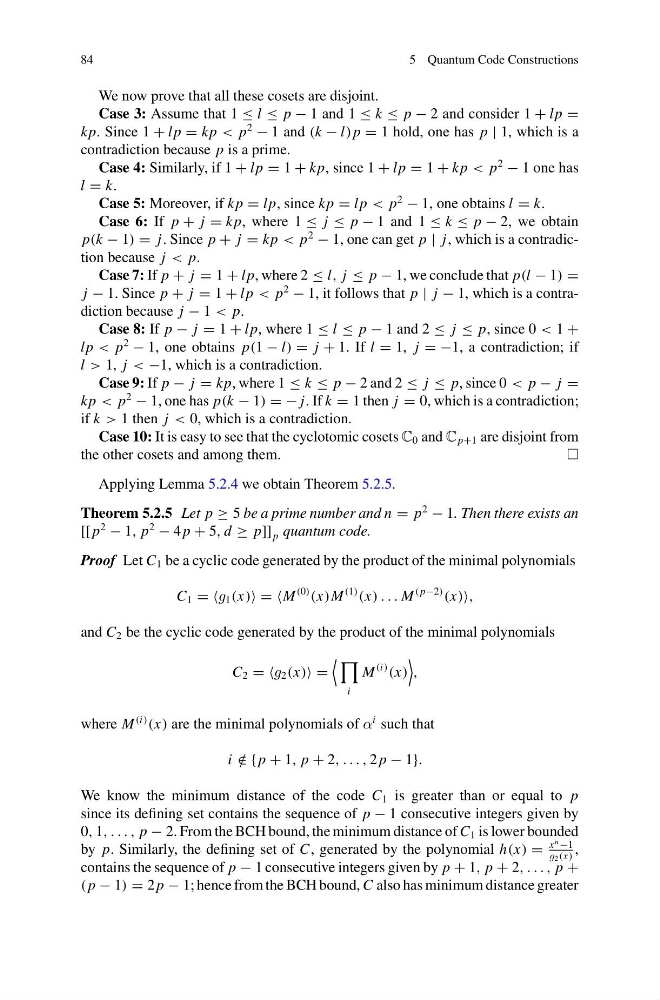
We now prove that all these cosets are disjoint.
Case 3: Assume that 1 ≤ l ≤ p − 1 and 1 ≤ k ≤ p − 2 and consider 1 + lp =
kp. Since 1 + lp = kp < p
2
− 1 and (k − l) p = 1 hold, one has p | 1, which is a
contradiction because p is a prime.
Case 4: Similarly, if 1 + lp = 1 + kp, since 1 + lp = 1 + kp < p
2
− 1 one has
l = k.
Case 5: Moreover, if kp = lp, since kp = lp < p
2
− 1, one obtains l = k.
Case 6: If p + j = kp, where 1 ≤ j ≤ p − 1 and 1 ≤ k ≤ p − 2, we obtain
p(k − 1) = j. Since p + j = kp < p
2
− 1, one can get p | j, which is a contradiction because j < p.
Case 7: If p + j = 1 + lp, where 2 ≤ l, j ≤ p − 1, we conclude that p(l − 1) =
j − 1. Since p + j = 1 + lp < p
2
− 1, it follows that p | j − 1, which is a contradiction because j − 1 < p.
Case 8: If p − j = 1 + lp, where 1 ≤ l ≤ p − 1 and 2 ≤ j ≤ p, since 0 < 1 +
lp < p
2
− 1, one obtains p(1 − l) = j + 1. If l = 1, j = −1, a contradiction; if
l > 1, j < −1, which is a contradiction.
Case 9: If p − j = kp, where 1 ≤ k ≤ p − 2 and 2 ≤ j ≤ p, since 0 < p − j =
kp < p
2
− 1, one has p(k − 1) = − j. If k = 1 then j = 0, which is a contradiction;
if k > 1 then j < 0, which is a contradiction.
Case 10: It is easy to see that the cyclotomic cosets C 0 and C p+1 are disjoint from
the other cosets and among them.
Applying Lemma 5.2.4 we obtain Theorem 5.2.5.
Theorem 5.2.5 Let p ≥ 5 be a prime number and n = p
2
− 1. Then there exists an
[[ p
2
− 1, p
2
− 4 p + 5, d ≥ p]] p quantum code.
Proof Let C 1 be a cyclic code generated by the product of the minimal polynomials
C 1 = =g 1 (x) = =M
(0)
(x)M
(1)
(x) . . . M
( p−2)
(x),
and C 2 be the cyclic code generated by the product of the minimal polynomials
C 2 = =g 2 (x) =
i
M
(i)
(x)
,
where M
(i)
(x) are the minimal polynomials of α
i such that
i /
∈ {p + 1, p + 2, . . . , 2 p − 1}.
We know the minimum distance of the code C 1 is greater than or equal to p
since its defining set contains the sequence of p − 1 consecutive integers given by
0, 1, . . . , p − 2. From the BCH bound, the minimum distance of C 1 is lower bounded
by p. Similarly, the defining set of C, generated by the polynomial h(x) =
x
n −1
g 2 (x)
,
contains the sequence of p − 1 consecutive integers given by p + 1, p + 2, . . . , p +
( p − 1) = 2 p − 1; hence from the BCH bound, C also has minimum distance greater
5 Quantum Code Constructions
We now prove that all these cosets are disjoint.
Case 3: Assume that 1 ≤ l ≤ p − 1 and 1 ≤ k ≤ p − 2 and consider 1 + lp =
kp. Since 1 + lp = kp < p
2
− 1 and (k − l) p = 1 hold, one has p | 1, which is a
contradiction because p is a prime.
Case 4: Similarly, if 1 + lp = 1 + kp, since 1 + lp = 1 + kp < p
2
− 1 one has
l = k.
Case 5: Moreover, if kp = lp, since kp = lp < p
2
− 1, one obtains l = k.
Case 6: If p + j = kp, where 1 ≤ j ≤ p − 1 and 1 ≤ k ≤ p − 2, we obtain
p(k − 1) = j. Since p + j = kp < p
2
− 1, one can get p | j, which is a contradiction because j < p.
Case 7: If p + j = 1 + lp, where 2 ≤ l, j ≤ p − 1, we conclude that p(l − 1) =
j − 1. Since p + j = 1 + lp < p
2
− 1, it follows that p | j − 1, which is a contradiction because j − 1 < p.
Case 8: If p − j = 1 + lp, where 1 ≤ l ≤ p − 1 and 2 ≤ j ≤ p, since 0 < 1 +
lp < p
2
− 1, one obtains p(1 − l) = j + 1. If l = 1, j = −1, a contradiction; if
l > 1, j < −1, which is a contradiction.
Case 9: If p − j = kp, where 1 ≤ k ≤ p − 2 and 2 ≤ j ≤ p, since 0 < p − j =
kp < p
2
− 1, one has p(k − 1) = − j. If k = 1 then j = 0, which is a contradiction;
if k > 1 then j < 0, which is a contradiction.
Case 10: It is easy to see that the cyclotomic cosets C 0 and C p+1 are disjoint from
the other cosets and among them.
Applying Lemma 5.2.4 we obtain Theorem 5.2.5.
Theorem 5.2.5 Let p ≥ 5 be a prime number and n = p
2
− 1. Then there exists an
[[ p
2
− 1, p
2
− 4 p + 5, d ≥ p]] p quantum code.
Proof Let C 1 be a cyclic code generated by the product of the minimal polynomials
C 1 = =g 1 (x) = =M
(0)
(x)M
(1)
(x) . . . M
( p−2)
(x),
and C 2 be the cyclic code generated by the product of the minimal polynomials
C 2 = =g 2 (x) =
i
M
(i)
(x)
,
where M
(i)
(x) are the minimal polynomials of α
i such that
i /
∈ {p + 1, p + 2, . . . , 2 p − 1}.
We know the minimum distance of the code C 1 is greater than or equal to p
since its defining set contains the sequence of p − 1 consecutive integers given by
0, 1, . . . , p − 2. From the BCH bound, the minimum distance of C 1 is lower bounded
by p. Similarly, the defining set of C, generated by the polynomial h(x) =
x
n −1
g 2 (x)
,
contains the sequence of p − 1 consecutive integers given by p + 1, p + 2, . . . , p +
( p − 1) = 2 p − 1; hence from the BCH bound, C also has minimum distance greater