

34
3 Quantum Error-Correcting Codes
stabilizers for binary and nonbinary alphabets by applying Galois theory. In fact, this
paper contains a unified theory of stabilizers and, because of this, we present it here.
We adopt the notation given in [80] to maintain the coherence of the text.
Notation. We first fix some notation. As always, p denotes a prime number, q
denotes a prime power, F q is the finite field with q elements, C
q is the complex
vector space of dimension q (quantum mechanical system scenario), |x i are the
vectors of an orthonormal basis of C
q , where x i range over all elements of F q , and
C
q
n denotes the n-tensor product C
q
n = C
q
⊗ C
q
⊗ · · · C
q .
Let us recall the concept of trace map.
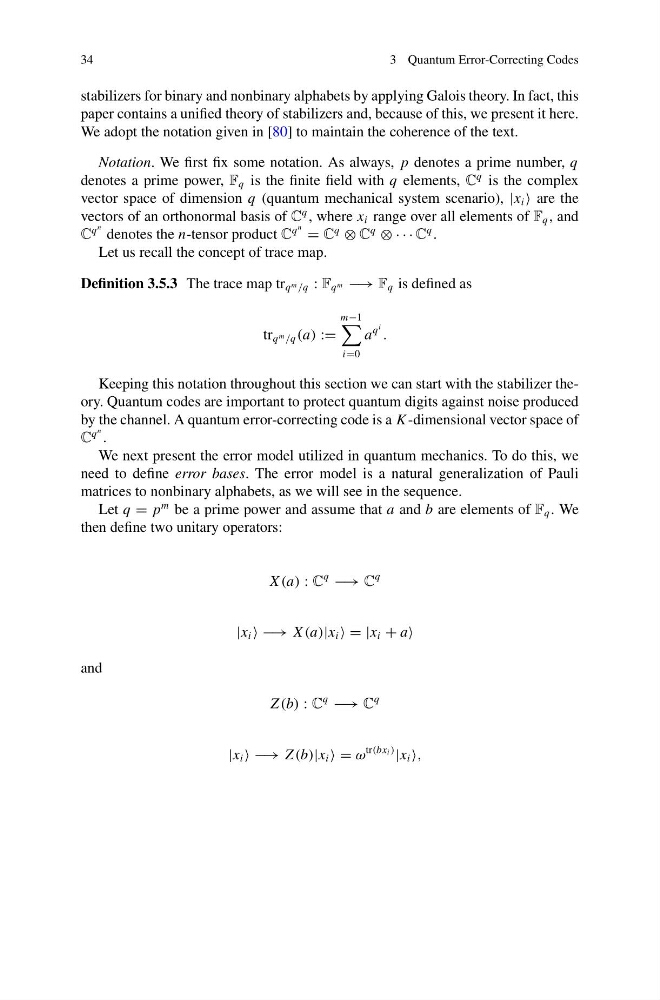
Definition 3.5.3 The trace map tr q m /q : F q m −→ F q is defined as
tr q m /q (a) :=
m−1
i=0
a
q
i .
Keeping this notation throughout this section we can start with the stabilizer theory. Quantum codes are important to protect quantum digits against noise produced
by the channel. A quantum error-correcting code is a K -dimensional vector space of
C
q
n .
We next present the error model utilized in quantum mechanics. To do this, we
need to define error bases. The error model is a natural generalization of Pauli
matrices to nonbinary alphabets, as we will see in the sequence.
Let q = p
m be a prime power and assume that a and b are elements of F q . We
then define two unitary operators:
X (a) : C
q
−→ C
q
|x i −→ X (a)|x i = |x i + a
and
Z (b) : C
q
−→ C
q
|x i −→ Z (b)|x i = ω
tr(bx i )
|x i ,
3 Quantum Error-Correcting Codes
stabilizers for binary and nonbinary alphabets by applying Galois theory. In fact, this
paper contains a unified theory of stabilizers and, because of this, we present it here.
We adopt the notation given in [80] to maintain the coherence of the text.
Notation. We first fix some notation. As always, p denotes a prime number, q
denotes a prime power, F q is the finite field with q elements, C
q is the complex
vector space of dimension q (quantum mechanical system scenario), |x i are the
vectors of an orthonormal basis of C
q , where x i range over all elements of F q , and
C
q
n denotes the n-tensor product C
q
n = C
q
⊗ C
q
⊗ · · · C
q .
Let us recall the concept of trace map.
Definition 3.5.3 The trace map tr q m /q : F q m −→ F q is defined as
tr q m /q (a) :=
m−1
i=0
a
q
i .
Keeping this notation throughout this section we can start with the stabilizer theory. Quantum codes are important to protect quantum digits against noise produced
by the channel. A quantum error-correcting code is a K -dimensional vector space of
C
q
n .
We next present the error model utilized in quantum mechanics. To do this, we
need to define error bases. The error model is a natural generalization of Pauli
matrices to nonbinary alphabets, as we will see in the sequence.
Let q = p
m be a prime power and assume that a and b are elements of F q . We
then define two unitary operators:
X (a) : C
q
−→ C
q
|x i −→ X (a)|x i = |x i + a
and
Z (b) : C
q
−→ C
q
|x i −→ Z (b)|x i = ω
tr(bx i )
|x i ,