

28
3 Quantum Error-Correcting Codes
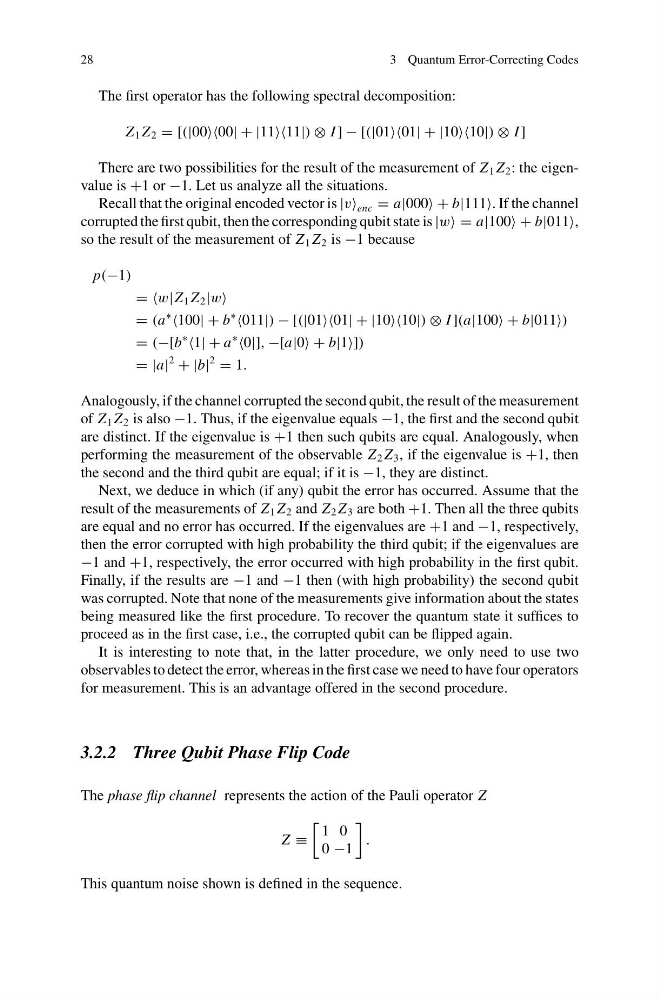
The first operator has the following spectral decomposition:
Z 1 Z 2 = [(|0000| + |1111|) ⊗ I ] − [(|0101| + |1010|) ⊗ I ]
There are two possibilities for the result of the measurement of Z 1 Z 2 : the eigenvalue is +1 or −1. Let us analyze all the situations.
Recall that the original encoded vector is |v enc = a|000 + b|111. If the channel
corrupted the first qubit, then the corresponding qubit state is |w = a|100 + b|011,
so the result of the measurement of Z 1 Z 2 is −1 because
p(−1)
= =w|Z 1 Z 2 |w
= (a
∗
100| + b
∗
011|) − [(|0101| + |1010|) ⊗ I ](a|100 + b|011)
= (−[b
∗
1| + a
∗
0|], −[a|0 + b|1])
= |a|
2
+ |b|
2
= 1.
Analogously, if the channel corrupted the second qubit, the result of the measurement
of Z 1 Z 2 is also −1. Thus, if the eigenvalue equals −1, the first and the second qubit
are distinct. If the eigenvalue is +1 then such qubits are equal. Analogously, when
performing the measurement of the observable Z 2 Z 3 , if the eigenvalue is +1, then
the second and the third qubit are equal; if it is −1, they are distinct.
Next, we deduce in which (if any) qubit the error has occurred. Assume that the
result of the measurements of Z 1 Z 2 and Z 2 Z 3 are both +1. Then all the three qubits
are equal and no error has occurred. If the eigenvalues are +1 and −1, respectively,
then the error corrupted with high probability the third qubit; if the eigenvalues are
−1 and +1, respectively, the error occurred with high probability in the first qubit.
Finally, if the results are −1 and −1 then (with high probability) the second qubit
was corrupted. Note that none of the measurements give information about the states
being measured like the first procedure. To recover the quantum state it suffices to
proceed as in the first case, i.e., the corrupted qubit can be flipped again.
It is interesting to note that, in the latter procedure, we only need to use two
observables to detect the error, whereas in the first case we need to have four operators
for measurement. This is an advantage offered in the second procedure.
3.2.2 Three Qubit Phase Flip Code
The phase flip channel represents the action of the Pauli operator Z
Z ≡
1 0
0 −1
.
This quantum noise shown is defined in the sequence.
3 Quantum Error-Correcting Codes
The first operator has the following spectral decomposition:
Z 1 Z 2 = [(|0000| + |1111|) ⊗ I ] − [(|0101| + |1010|) ⊗ I ]
There are two possibilities for the result of the measurement of Z 1 Z 2 : the eigenvalue is +1 or −1. Let us analyze all the situations.
Recall that the original encoded vector is |v enc = a|000 + b|111. If the channel
corrupted the first qubit, then the corresponding qubit state is |w = a|100 + b|011,
so the result of the measurement of Z 1 Z 2 is −1 because
p(−1)
= =w|Z 1 Z 2 |w
= (a
∗
100| + b
∗
011|) − [(|0101| + |1010|) ⊗ I ](a|100 + b|011)
= (−[b
∗
1| + a
∗
0|], −[a|0 + b|1])
= |a|
2
+ |b|
2
= 1.
Analogously, if the channel corrupted the second qubit, the result of the measurement
of Z 1 Z 2 is also −1. Thus, if the eigenvalue equals −1, the first and the second qubit
are distinct. If the eigenvalue is +1 then such qubits are equal. Analogously, when
performing the measurement of the observable Z 2 Z 3 , if the eigenvalue is +1, then
the second and the third qubit are equal; if it is −1, they are distinct.
Next, we deduce in which (if any) qubit the error has occurred. Assume that the
result of the measurements of Z 1 Z 2 and Z 2 Z 3 are both +1. Then all the three qubits
are equal and no error has occurred. If the eigenvalues are +1 and −1, respectively,
then the error corrupted with high probability the third qubit; if the eigenvalues are
−1 and +1, respectively, the error occurred with high probability in the first qubit.
Finally, if the results are −1 and −1 then (with high probability) the second qubit
was corrupted. Note that none of the measurements give information about the states
being measured like the first procedure. To recover the quantum state it suffices to
proceed as in the first case, i.e., the corrupted qubit can be flipped again.
It is interesting to note that, in the latter procedure, we only need to use two
observables to detect the error, whereas in the first case we need to have four operators
for measurement. This is an advantage offered in the second procedure.
3.2.2 Three Qubit Phase Flip Code
The phase flip channel represents the action of the Pauli operator Z
Z ≡
1 0
0 −1
.
This quantum noise shown is defined in the sequence.