

26
3 Quantum Error-Correcting Codes
3.2 The Shor Code
In this subsection we describe the construction of the Shor code. In order to proceed
further, we must construct first the three qubit bit flip code and after, the three qubit
phase flip code. For more details about the encoding–decoding process, we refer the
reader to [121].
3.2.1 Three Qubit Bit Flip Code
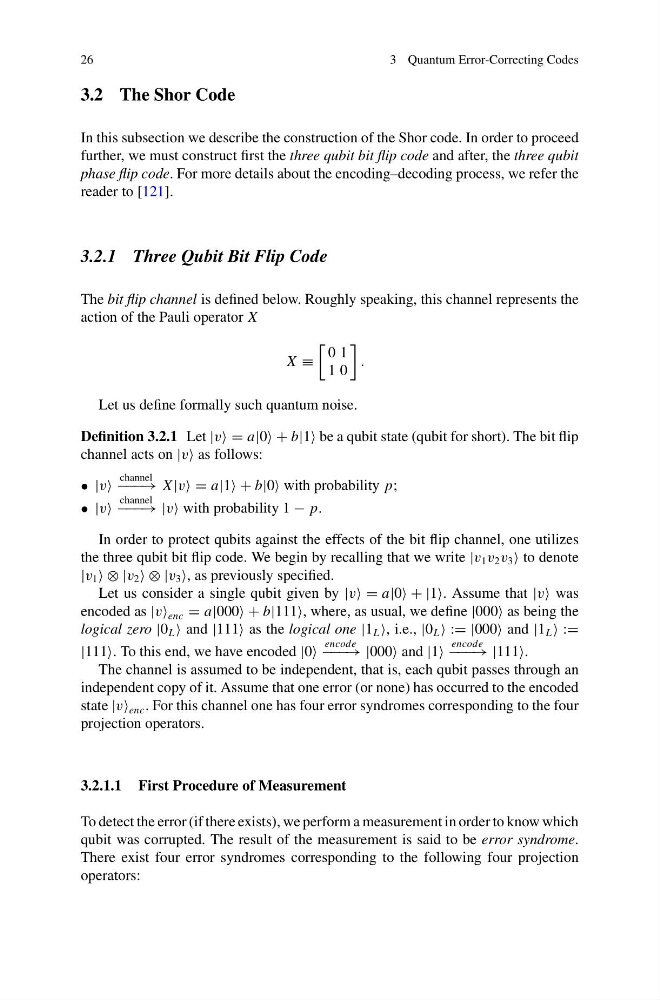
The bit flip channel is defined below. Roughly speaking, this channel represents the
action of the Pauli operator X
X ≡
0 1
1 0
.
Let us define formally such quantum noise.
Definition 3.2.1 Let |v = a|0 + b|1 be a qubit state (qubit for short). The bit flip
channel acts on |v as follows:
• |v
channel
−−−→ X |v = a|1 + b|0 with probability p;
• |v
channel
−−−→ |v with probability 1 − p.
In order to protect qubits against the effects of the bit flip channel, one utilizes
the three qubit bit flip code. We begin by recalling that we write |v 1 v 2 v 3 to denote
|v 1 ⊗ |v 2 ⊗ |v 3 , as previously specified.
Let us consider a single qubit given by |v = a|0 + |1. Assume that |v was
encoded as |v enc = a|000 + b|111, where, as usual, we define |000 as being the
logical zero |0 L and |111 as the logical one |1 L , i.e., |0 L := |000 and |1 L :=
|111. To this end, we have encoded |0
encode
−−−→ |000 and |1
encode
−−−→ |111.
The channel is assumed to be independent, that is, each qubit passes through an
independent copy of it. Assume that one error (or none) has occurred to the encoded
state |v enc . For this channel one has four error syndromes corresponding to the four
projection operators.
3.2.1.1 First Procedure of Measurement
To detect the error (if there exists), we perform a measurement in order to know which
qubit was corrupted. The result of the measurement is said to be error syndrome.
There exist four error syndromes corresponding to the following four projection
operators:
3 Quantum Error-Correcting Codes
3.2 The Shor Code
In this subsection we describe the construction of the Shor code. In order to proceed
further, we must construct first the three qubit bit flip code and after, the three qubit
phase flip code. For more details about the encoding–decoding process, we refer the
reader to [121].
3.2.1 Three Qubit Bit Flip Code
The bit flip channel is defined below. Roughly speaking, this channel represents the
action of the Pauli operator X
X ≡
0 1
1 0
.
Let us define formally such quantum noise.
Definition 3.2.1 Let |v = a|0 + b|1 be a qubit state (qubit for short). The bit flip
channel acts on |v as follows:
• |v
channel
−−−→ X |v = a|1 + b|0 with probability p;
• |v
channel
−−−→ |v with probability 1 − p.
In order to protect qubits against the effects of the bit flip channel, one utilizes
the three qubit bit flip code. We begin by recalling that we write |v 1 v 2 v 3 to denote
|v 1 ⊗ |v 2 ⊗ |v 3 , as previously specified.
Let us consider a single qubit given by |v = a|0 + |1. Assume that |v was
encoded as |v enc = a|000 + b|111, where, as usual, we define |000 as being the
logical zero |0 L and |111 as the logical one |1 L , i.e., |0 L := |000 and |1 L :=
|111. To this end, we have encoded |0
encode
−−−→ |000 and |1
encode
−−−→ |111.
The channel is assumed to be independent, that is, each qubit passes through an
independent copy of it. Assume that one error (or none) has occurred to the encoded
state |v enc . For this channel one has four error syndromes corresponding to the four
projection operators.
3.2.1.1 First Procedure of Measurement
To detect the error (if there exists), we perform a measurement in order to know which
qubit was corrupted. The result of the measurement is said to be error syndrome.
There exist four error syndromes corresponding to the following four projection
operators: