

18
2 A Little Bit of Quantum Mechanics
A special case of Postulate 2.1.3 is a suitable type of measurement, that is, the
projective measurements [121, p. 87]: A projective measurement is described by an
observable, M, which is a Hermitian operator on the state space of the system being
observed. The observable has a spectral decomposition, M =
m
m P m , where P m
is the projector onto the eigenspace of M with eigenvalue m. The possible outcomes
of the measurement correspond to the eigenvalues, m, of the observable. After the
measurement of the qubit |v, the probability to have m is equal to p(m) = =v|P m |v.
If m occurred, the state of the quantum system after the measurement is
P m |v
√
p(m)
.
Postulate 2.1.4 The state space of a composite physical system is the tensor product
of the state spaces of the component physical systems. Moreover, if the number of
systems is finite, say S 1 , S 2 , . . . , S r , and S i is prepared in the state |v i , then the joint
state of the total system is |v 1 ⊗ |v 2 ⊗ · · · ⊗ |v r .
2.2 Ensemble of Quantum States
We next introduce the concepts of density operator, after writing the postulates of
quantum mechanics in terms of these operators.
There exist mainly two types of developments of quantum mechanics: based on
state vectors or by means of density operator or density matrix. Until now we have
formulated quantum mechanics using the language of state vectors. In the sequence,
we will introduce the concept of density operator. The density operator formalism
is convenient for a description of quantum systems whose state is not completely
known.
Definition 2.2.1 Assume that a quantum system is in one of the states |φ i , with
probability p i , where i is an index. Then the set { p i , |φ i } is said to be an ensemble
of pure states. The density operator (or density matrix) for the system is defined as
ρ ≡
i
p i |φ i φ i |.
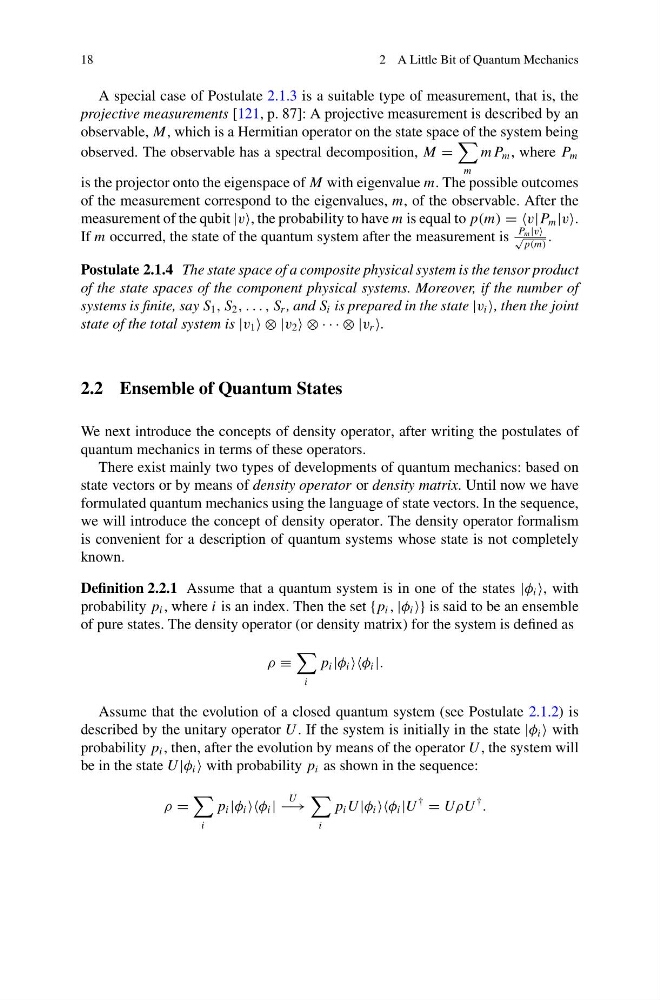
Assume that the evolution of a closed quantum system (see Postulate 2.1.2) is
described by the unitary operator U . If the system is initially in the state |φ i with
probability p i , then, after the evolution by means of the operator U , the system will
be in the state U |φ i with probability p i as shown in the sequence:
ρ =
i
p i |φ i φ i |
U
−→
i
p i U |φ i φ i |U
†
= UρU
†
.
2 A Little Bit of Quantum Mechanics
A special case of Postulate 2.1.3 is a suitable type of measurement, that is, the
projective measurements [121, p. 87]: A projective measurement is described by an
observable, M, which is a Hermitian operator on the state space of the system being
observed. The observable has a spectral decomposition, M =
m
m P m , where P m
is the projector onto the eigenspace of M with eigenvalue m. The possible outcomes
of the measurement correspond to the eigenvalues, m, of the observable. After the
measurement of the qubit |v, the probability to have m is equal to p(m) = =v|P m |v.
If m occurred, the state of the quantum system after the measurement is
P m |v
√
p(m)
.
Postulate 2.1.4 The state space of a composite physical system is the tensor product
of the state spaces of the component physical systems. Moreover, if the number of
systems is finite, say S 1 , S 2 , . . . , S r , and S i is prepared in the state |v i , then the joint
state of the total system is |v 1 ⊗ |v 2 ⊗ · · · ⊗ |v r .
2.2 Ensemble of Quantum States
We next introduce the concepts of density operator, after writing the postulates of
quantum mechanics in terms of these operators.
There exist mainly two types of developments of quantum mechanics: based on
state vectors or by means of density operator or density matrix. Until now we have
formulated quantum mechanics using the language of state vectors. In the sequence,
we will introduce the concept of density operator. The density operator formalism
is convenient for a description of quantum systems whose state is not completely
known.
Definition 2.2.1 Assume that a quantum system is in one of the states |φ i , with
probability p i , where i is an index. Then the set { p i , |φ i } is said to be an ensemble
of pure states. The density operator (or density matrix) for the system is defined as
ρ ≡
i
p i |φ i φ i |.
Assume that the evolution of a closed quantum system (see Postulate 2.1.2) is
described by the unitary operator U . If the system is initially in the state |φ i with
probability p i , then, after the evolution by means of the operator U , the system will
be in the state U |φ i with probability p i as shown in the sequence:
ρ =
i
p i |φ i φ i |
U
−→
i
p i U |φ i φ i |U
†
= UρU
†
.