

1.7 Inner Product Spaces
11
(2) If (·, ·) : V × V −→ C is an inner product on V , and |v, |w ∈ V we denote
(|v, |w) ≡ ≡v|w. This notation (the same as [121]) is convenient since (|v, |w)
can be viewed as the matrix product of the dual vector v| by the vector |w.
Definition 1.7.3 Given an inner product (·, ·) on the complex vector space V , the
norm of a vector |v ∈ V with respect to (·, ·) is defined by
|v =
(|v, |v).
If |v ∈ V is such that |v = 1 then |v is called a unit vector.
Example 1.7.1 As an example, we can define the following inner product in C
n : if
|z ≡
⎡
⎢
⎢
⎢
⎣
z 1
z 2
. . .
z n
⎤
⎥
⎥
⎥
⎦
and |w ≡
⎡
⎢
⎢
⎢
⎣
w 1
w 2
. . .
w n
⎤
⎥
⎥
⎥
⎦
are vectors in C
n , then (z, w) :=
n
i=1
z
∗
i w i . It is easy to see that this definition satisfies
the conditions of Definition 1.7.1.
In the sequence, we define the concept of quantum bit (qubit for short). This is a
fundamental concept for quantum mechanics.
Definition 1.7.4 A quantum bit (qubit or qubit’s state) is a unit vector in a twodimensional complex vector space. Mathematically, a qubit is a vector |ψ = α|0 +
β|1 with |α|
2
+ |β|
2
= 1. The states |0 and |1 are called computational basis states;
they form an orthonormal basis for such space.
Since, from Theorem 1.2.2, the matrix representation M = [T ]
B W
B V
(here with
complex entries) is equivalent to the operator T , sometimes we utilize the matrix
representation and sometimes we utilize the operator form.
There exist some matrices that play a fundamental role in quantum mechanics:
the Pauli matrices.
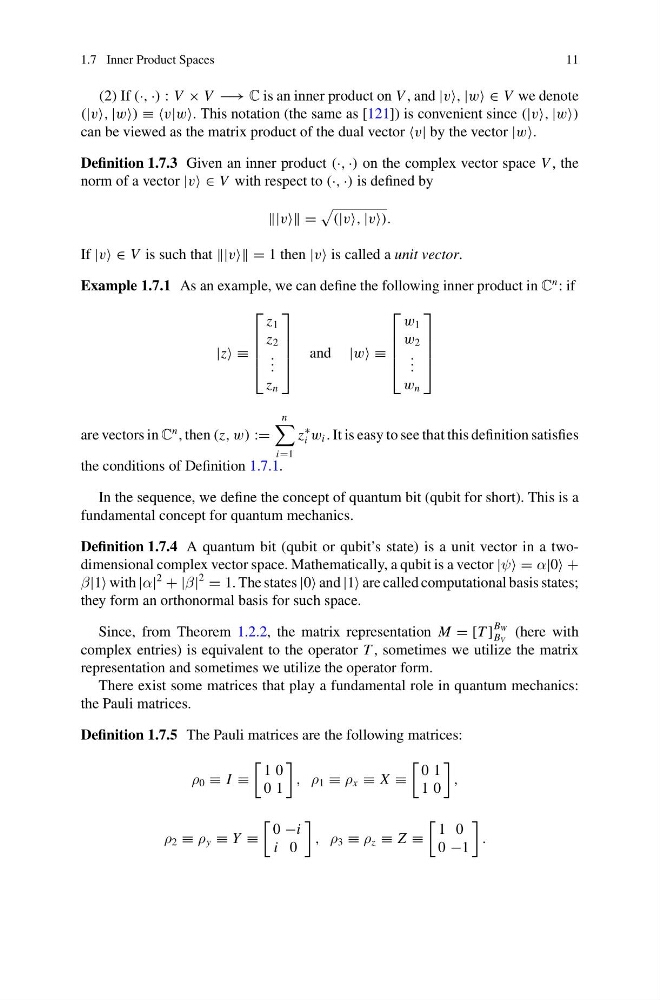
Definition 1.7.5 The Pauli matrices are the following matrices:
ρ 0 ≡ I ≡
1 0
0 1
, ρ 1 ≡ ρ x ≡ X ≡
0 1
1 0
,
ρ 2 ≡ ρ y ≡ Y ≡
0 −i
i 0
, ρ 3 ≡ ρ z ≡ Z ≡
1 0
0 −1
.
11
(2) If (·, ·) : V × V −→ C is an inner product on V , and |v, |w ∈ V we denote
(|v, |w) ≡ ≡v|w. This notation (the same as [121]) is convenient since (|v, |w)
can be viewed as the matrix product of the dual vector v| by the vector |w.
Definition 1.7.3 Given an inner product (·, ·) on the complex vector space V , the
norm of a vector |v ∈ V with respect to (·, ·) is defined by
|v =
(|v, |v).
If |v ∈ V is such that |v = 1 then |v is called a unit vector.
Example 1.7.1 As an example, we can define the following inner product in C
n : if
|z ≡
⎡
⎢
⎢
⎢
⎣
z 1
z 2
. . .
z n
⎤
⎥
⎥
⎥
⎦
and |w ≡
⎡
⎢
⎢
⎢
⎣
w 1
w 2
. . .
w n
⎤
⎥
⎥
⎥
⎦
are vectors in C
n , then (z, w) :=
n
i=1
z
∗
i w i . It is easy to see that this definition satisfies
the conditions of Definition 1.7.1.
In the sequence, we define the concept of quantum bit (qubit for short). This is a
fundamental concept for quantum mechanics.
Definition 1.7.4 A quantum bit (qubit or qubit’s state) is a unit vector in a twodimensional complex vector space. Mathematically, a qubit is a vector |ψ = α|0 +
β|1 with |α|
2
+ |β|
2
= 1. The states |0 and |1 are called computational basis states;
they form an orthonormal basis for such space.
Since, from Theorem 1.2.2, the matrix representation M = [T ]
B W
B V
(here with
complex entries) is equivalent to the operator T , sometimes we utilize the matrix
representation and sometimes we utilize the operator form.
There exist some matrices that play a fundamental role in quantum mechanics:
the Pauli matrices.
Definition 1.7.5 The Pauli matrices are the following matrices:
ρ 0 ≡ I ≡
1 0
0 1
, ρ 1 ≡ ρ x ≡ X ≡
0 1
1 0
,
ρ 2 ≡ ρ y ≡ Y ≡
0 −i
i 0
, ρ 3 ≡ ρ z ≡ Z ≡
1 0
0 −1
.