

7.7 AQCCs
207
(b) [(q − 1, i − t, μ
∗
; 2, [d z ] f /[d x ] f )] q , where (d z ) f ≥ q − i − 1, (d x ) f ≥ t + 2,
for all 1 ≤ t ≤ i − 1, where 2 ≤ i ≤ q − 3.
Proof We only show Item (a) (Item (b) is similar). The construction is the same as
in the proof of Theorem 7.7.4, although the codes have distinct parameters. More
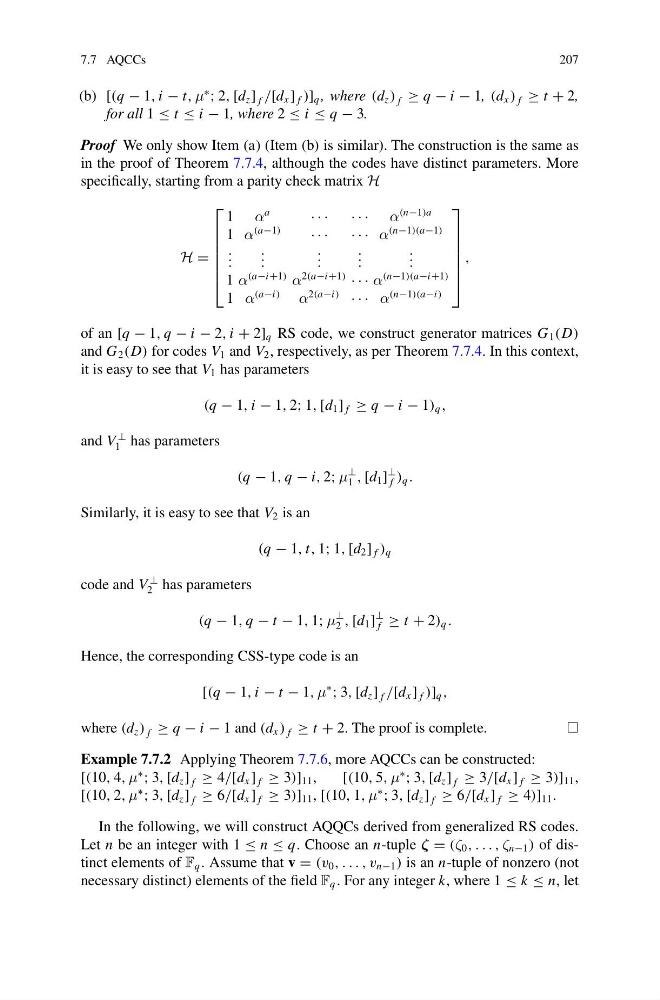
specifically, starting from a parity check matrix H
H =
⎡
⎢
⎢
⎢
⎢
⎢
⎣
1 α
a
· · ·
· · · α
(n−1)a
1 α
(a−1)
· · ·
· · · α
(n−1)(a−1)
. . .
. . .
. . .
. . .
. . .
1 α
(a−i+1)
α
2(a−i+1)
· · · α
(n−1)(a−i+1)
1 α
(a−i)
α
2(a−i)
· · · α
(n−1)(a−i)
⎤
⎥
⎥
⎥
⎥
⎥
⎦
,
of an [q − 1, q − i − 2, i + 2] q RS code, we construct generator matrices G 1 (D)
and G 2 (D) for codes V 1 and V 2 , respectively, as per Theorem 7.7.4. In this context,
it is easy to see that V 1 has parameters
(q − 1, i − 1, 2; 1, [d 1 ] f ≥ q − i − 1) q ,
and V
⊥
1 has parameters
(q − 1, q − i, 2; μ
⊥
1 , [d 1 ]
⊥
f ) q .
Similarly, it is easy to see that V 2 is an
(q − 1, t, 1; 1, [d 2 ] f ) q
code and V
⊥
2 has parameters
(q − 1, q − t − 1, 1; μ
⊥
2 , [d 1 ]
⊥
f ≥ t + 2) q .
Hence, the corresponding CSS-type code is an
[(q − 1, i − t − 1, μ
∗
; 3, [d z ] f /[d x ] f )] q ,
where (d z ) f ≥ q − i − 1 and (d x ) f ≥ t + 2. The proof is complete.
Example 7.7.2 Applying Theorem 7.7.6, more AQCCs can be constructed:
[(10, 4, μ
∗
; 3, [d z ] f ≥ 4/[d x ] f ≥ 3)] 11 ,
[(10, 5, μ
∗
; 3, [d z ] f ≥ 3/[d x ] f ≥ 3)] 11 ,
[(10, 2, μ
∗
; 3, [d z ] f ≥ 6/[d x ] f ≥ 3)] 11 , [(10, 1, μ
∗
; 3, [d z ] f ≥ 6/[d x ] f ≥ 4)] 11 .
In the following, we will construct AQQCs derived from generalized RS codes.
Let n be an integer with 1 ≤ n ≤ q. Choose an n-tuple ζ = (ζ 0 , . . . , ζ n−1 ) of distinct elements of F q . Assume that v = (v 0 , . . . , v n−1 ) is an n-tuple of nonzero (not
necessary distinct) elements of the field F q . For any integer k, where 1 ≤ k ≤ n, let
207
(b) [(q − 1, i − t, μ
∗
; 2, [d z ] f /[d x ] f )] q , where (d z ) f ≥ q − i − 1, (d x ) f ≥ t + 2,
for all 1 ≤ t ≤ i − 1, where 2 ≤ i ≤ q − 3.
Proof We only show Item (a) (Item (b) is similar). The construction is the same as
in the proof of Theorem 7.7.4, although the codes have distinct parameters. More
specifically, starting from a parity check matrix H
H =
⎡
⎢
⎢
⎢
⎢
⎢
⎣
1 α
a
· · ·
· · · α
(n−1)a
1 α
(a−1)
· · ·
· · · α
(n−1)(a−1)
. . .
. . .
. . .
. . .
. . .
1 α
(a−i+1)
α
2(a−i+1)
· · · α
(n−1)(a−i+1)
1 α
(a−i)
α
2(a−i)
· · · α
(n−1)(a−i)
⎤
⎥
⎥
⎥
⎥
⎥
⎦
,
of an [q − 1, q − i − 2, i + 2] q RS code, we construct generator matrices G 1 (D)
and G 2 (D) for codes V 1 and V 2 , respectively, as per Theorem 7.7.4. In this context,
it is easy to see that V 1 has parameters
(q − 1, i − 1, 2; 1, [d 1 ] f ≥ q − i − 1) q ,
and V
⊥
1 has parameters
(q − 1, q − i, 2; μ
⊥
1 , [d 1 ]
⊥
f ) q .
Similarly, it is easy to see that V 2 is an
(q − 1, t, 1; 1, [d 2 ] f ) q
code and V
⊥
2 has parameters
(q − 1, q − t − 1, 1; μ
⊥
2 , [d 1 ]
⊥
f ≥ t + 2) q .
Hence, the corresponding CSS-type code is an
[(q − 1, i − t − 1, μ
∗
; 3, [d z ] f /[d x ] f )] q ,
where (d z ) f ≥ q − i − 1 and (d x ) f ≥ t + 2. The proof is complete.
Example 7.7.2 Applying Theorem 7.7.6, more AQCCs can be constructed:
[(10, 4, μ
∗
; 3, [d z ] f ≥ 4/[d x ] f ≥ 3)] 11 ,
[(10, 5, μ
∗
; 3, [d z ] f ≥ 3/[d x ] f ≥ 3)] 11 ,
[(10, 2, μ
∗
; 3, [d z ] f ≥ 6/[d x ] f ≥ 3)] 11 , [(10, 1, μ
∗
; 3, [d z ] f ≥ 6/[d x ] f ≥ 4)] 11 .
In the following, we will construct AQQCs derived from generalized RS codes.
Let n be an integer with 1 ≤ n ≤ q. Choose an n-tuple ζ = (ζ 0 , . . . , ζ n−1 ) of distinct elements of F q . Assume that v = (v 0 , . . . , v n−1 ) is an n-tuple of nonzero (not
necessary distinct) elements of the field F q . For any integer k, where 1 ≤ k ≤ n, let