

7.7 AQCCs
201
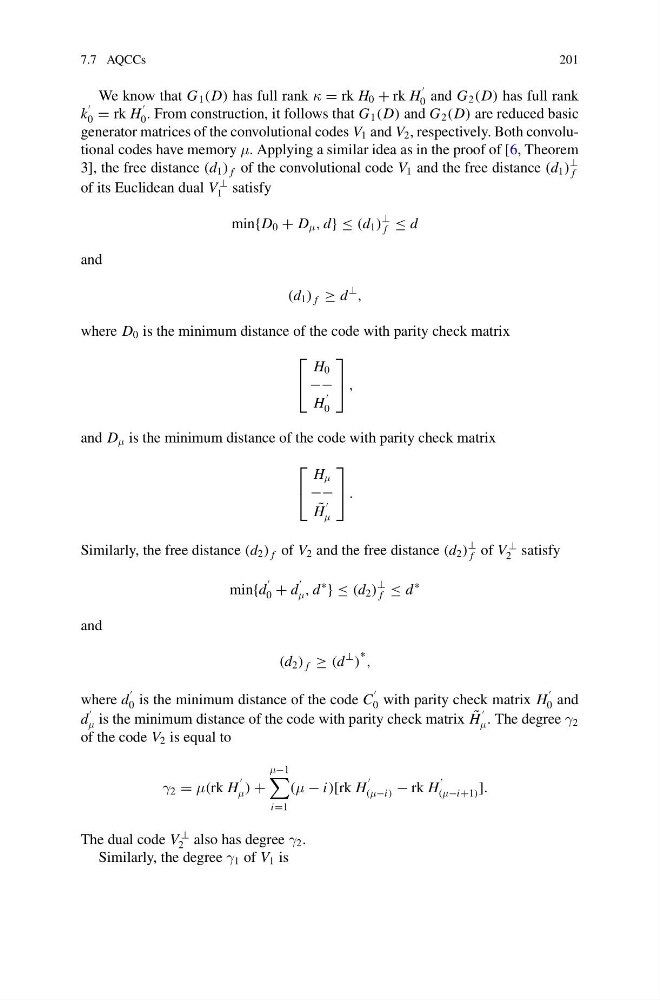
We know that G 1 (D) has full rank κ = rk H 0 + rk H
0 and G 2 (D) has full rank
k
0 = rk H
0 . From construction, it follows that G 1 (D) and G 2 (D) are reduced basic
generator matrices of the convolutional codes V 1 and V 2 , respectively. Both convolutional codes have memory μ. Applying a similar idea as in the proof of [6, Theorem
3], the free distance (d 1 ) f of the convolutional code V 1 and the free distance (d 1 )
⊥
f
of its Euclidean dual V
⊥
1 satisfy
min{D 0 + D μ , d} ≤ (d 1 )
⊥
f ≤ d
and
(d 1 ) f ≥ d
⊥
,
where D 0 is the minimum distance of the code with parity check matrix
⎡
⎣
H 0
−−
H
0
⎤
⎦ ,
and D μ is the minimum distance of the code with parity check matrix
⎡
⎣
H μ
−−
˜
H
μ
⎤
⎦ .
Similarly, the free distance (d 2 ) f of V 2 and the free distance (d 2 )
⊥
f of V
⊥
2 satisfy
min{d
0 + d
μ , d
∗
} ≤ (d 2 )
⊥
f ≤ d
∗
and
(d 2 ) f ≥ (d
⊥
)
∗ ,
where d
0 is the minimum distance of the code C
0 with parity check matrix H
0 and
d
μ is the minimum distance of the code with parity check matrix ˜
H
μ . The degree γ 2
of the code V 2 is equal to
γ 2 = μ(rk H
μ ) +
μ−1
i=1
(μ − i)[rk H
(μ−i) − rk H
(μ−i+1) ].
The dual code V
⊥
2 also has degree γ 2 .
Similarly, the degree γ 1 of V 1 is
201
We know that G 1 (D) has full rank κ = rk H 0 + rk H
0 and G 2 (D) has full rank
k
0 = rk H
0 . From construction, it follows that G 1 (D) and G 2 (D) are reduced basic
generator matrices of the convolutional codes V 1 and V 2 , respectively. Both convolutional codes have memory μ. Applying a similar idea as in the proof of [6, Theorem
3], the free distance (d 1 ) f of the convolutional code V 1 and the free distance (d 1 )
⊥
f
of its Euclidean dual V
⊥
1 satisfy
min{D 0 + D μ , d} ≤ (d 1 )
⊥
f ≤ d
and
(d 1 ) f ≥ d
⊥
,
where D 0 is the minimum distance of the code with parity check matrix
⎡
⎣
H 0
−−
H
0
⎤
⎦ ,
and D μ is the minimum distance of the code with parity check matrix
⎡
⎣
H μ
−−
˜
H
μ
⎤
⎦ .
Similarly, the free distance (d 2 ) f of V 2 and the free distance (d 2 )
⊥
f of V
⊥
2 satisfy
min{d
0 + d
μ , d
∗
} ≤ (d 2 )
⊥
f ≤ d
∗
and
(d 2 ) f ≥ (d
⊥
)
∗ ,
where d
0 is the minimum distance of the code C
0 with parity check matrix H
0 and
d
μ is the minimum distance of the code with parity check matrix ˜
H
μ . The degree γ 2
of the code V 2 is equal to
γ 2 = μ(rk H
μ ) +
μ−1
i=1
(μ − i)[rk H
(μ−i) − rk H
(μ−i+1) ].
The dual code V
⊥
2 also has degree γ 2 .
Similarly, the degree γ 1 of V 1 is