

7.6 QCCs from AG Codes
193
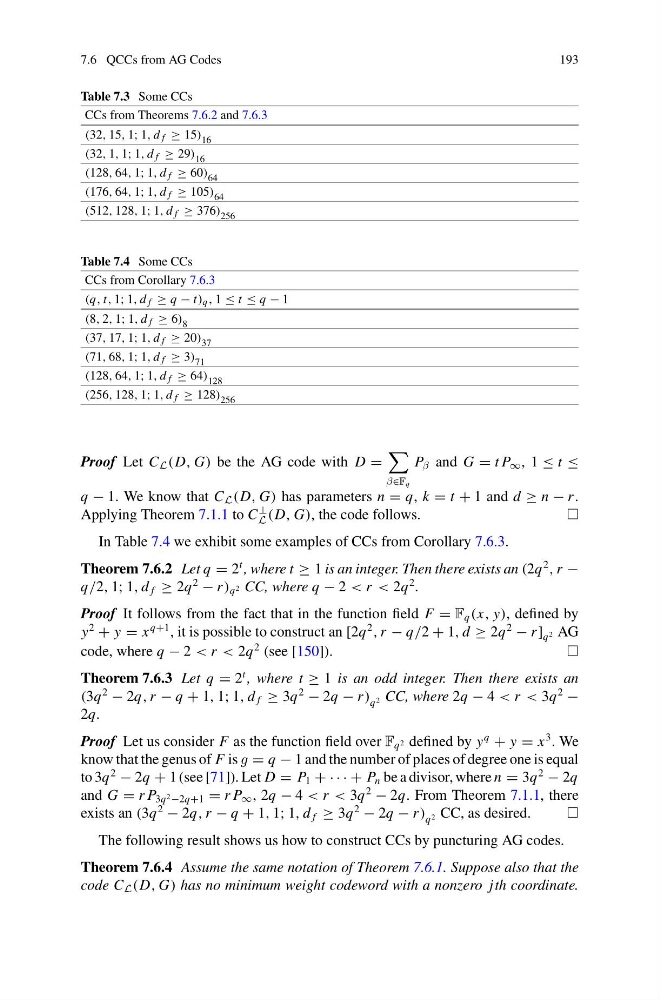
Table 7.3 Some CCs
CCs from Theorems 7.6.2 and 7.6.3
(32, 15, 1; 1, d f ≥ 15) 16
(32, 1, 1; 1, d f ≥ 29) 16
(128, 64, 1; 1, d f ≥ 60) 64
(176, 64, 1; 1, d f ≥ 105) 64
(512, 128, 1; 1, d f ≥ 376) 256
Table 7.4 Some CCs
CCs from Corollary 7.6.3
(q, t, 1; 1, d f ≥ q − t) q , 1 ≤ t ≤ q − 1
(8, 2, 1; 1, d f ≥ 6) 8
(37, 17, 1; 1, d f ≥ 20) 37
(71, 68, 1; 1, d f ≥ 3) 71
(128, 64, 1; 1, d f ≥ 64) 128
(256, 128, 1; 1, d f ≥ 128) 256
Proof Let C L (D, G) be the AG code with D =
β∈F q
P β and G = t P ∞ , 1 ≤ t ≤
q − 1. We know that C L (D, G) has parameters n = q, k = t + 1 and d ≥ n − r .
Applying Theorem 7.1.1 to C
⊥
L (D, G), the code follows.
In Table 7.4 we exhibit some examples of CCs from Corollary 7.6.3.
Theorem 7.6.2 Let q = 2
t , where t ≥ 1 is an integer. Then there exists an (2q
2
, r −
q/2, 1; 1, d f ≥ 2q
2
− r ) q 2 CC, where q − 2 < r < 2q
2 .
Proof It follows from the fact that in the function field F = F q (x, y), defined by
y
2
+ y = x
q+1 , it is possible to construct an [2q
2
, r − q/2 + 1, d ≥ 2q
2
− r ] q 2 AG
code, where q − 2 < r < 2q
2 (see [150]).
Theorem 7.6.3 Let q = 2
t , where t ≥ 1 is an odd integer. Then there exists an
(3q
2
− 2q, r − q + 1, 1; 1, d f ≥ 3q
2
− 2q − r ) q 2 CC, where 2q − 4 < r < 3q
2
−
2q.
Proof Let us consider F as the function field over F q 2 defined by y
q
+ y = x
3 . We
know that the genus of F is g = q − 1 and the number of places of degree one is equal
to 3q
2
− 2q + 1 (see [71]). Let D = P 1 + · · · + P n be a divisor, where n = 3q
2
− 2q
and G = r P 3q 2 −2q+1 = r P ∞ , 2q − 4 < r < 3q
2
− 2q. From Theorem 7.1.1, there
exists an (3q
2
− 2q, r − q + 1, 1; 1, d f ≥ 3q
2
− 2q − r ) q 2 CC, as desired.
The following result shows us how to construct CCs by puncturing AG codes.
Theorem 7.6.4 Assume the same notation of Theorem 7.6.1. Suppose also that the
code C L (D, G) has no minimum weight codeword with a nonzero jth coordinate.
193
Table 7.3 Some CCs
CCs from Theorems 7.6.2 and 7.6.3
(32, 15, 1; 1, d f ≥ 15) 16
(32, 1, 1; 1, d f ≥ 29) 16
(128, 64, 1; 1, d f ≥ 60) 64
(176, 64, 1; 1, d f ≥ 105) 64
(512, 128, 1; 1, d f ≥ 376) 256
Table 7.4 Some CCs
CCs from Corollary 7.6.3
(q, t, 1; 1, d f ≥ q − t) q , 1 ≤ t ≤ q − 1
(8, 2, 1; 1, d f ≥ 6) 8
(37, 17, 1; 1, d f ≥ 20) 37
(71, 68, 1; 1, d f ≥ 3) 71
(128, 64, 1; 1, d f ≥ 64) 128
(256, 128, 1; 1, d f ≥ 128) 256
Proof Let C L (D, G) be the AG code with D =
β∈F q
P β and G = t P ∞ , 1 ≤ t ≤
q − 1. We know that C L (D, G) has parameters n = q, k = t + 1 and d ≥ n − r .
Applying Theorem 7.1.1 to C
⊥
L (D, G), the code follows.
In Table 7.4 we exhibit some examples of CCs from Corollary 7.6.3.
Theorem 7.6.2 Let q = 2
t , where t ≥ 1 is an integer. Then there exists an (2q
2
, r −
q/2, 1; 1, d f ≥ 2q
2
− r ) q 2 CC, where q − 2 < r < 2q
2 .
Proof It follows from the fact that in the function field F = F q (x, y), defined by
y
2
+ y = x
q+1 , it is possible to construct an [2q
2
, r − q/2 + 1, d ≥ 2q
2
− r ] q 2 AG
code, where q − 2 < r < 2q
2 (see [150]).
Theorem 7.6.3 Let q = 2
t , where t ≥ 1 is an odd integer. Then there exists an
(3q
2
− 2q, r − q + 1, 1; 1, d f ≥ 3q
2
− 2q − r ) q 2 CC, where 2q − 4 < r < 3q
2
−
2q.
Proof Let us consider F as the function field over F q 2 defined by y
q
+ y = x
3 . We
know that the genus of F is g = q − 1 and the number of places of degree one is equal
to 3q
2
− 2q + 1 (see [71]). Let D = P 1 + · · · + P n be a divisor, where n = 3q
2
− 2q
and G = r P 3q 2 −2q+1 = r P ∞ , 2q − 4 < r < 3q
2
− 2q. From Theorem 7.1.1, there
exists an (3q
2
− 2q, r − q + 1, 1; 1, d f ≥ 3q
2
− 2q − r ) q 2 CC, as desired.
The following result shows us how to construct CCs by puncturing AG codes.
Theorem 7.6.4 Assume the same notation of Theorem 7.6.1. Suppose also that the
code C L (D, G) has no minimum weight codeword with a nonzero jth coordinate.