

7.6 QCCs from AG Codes
191
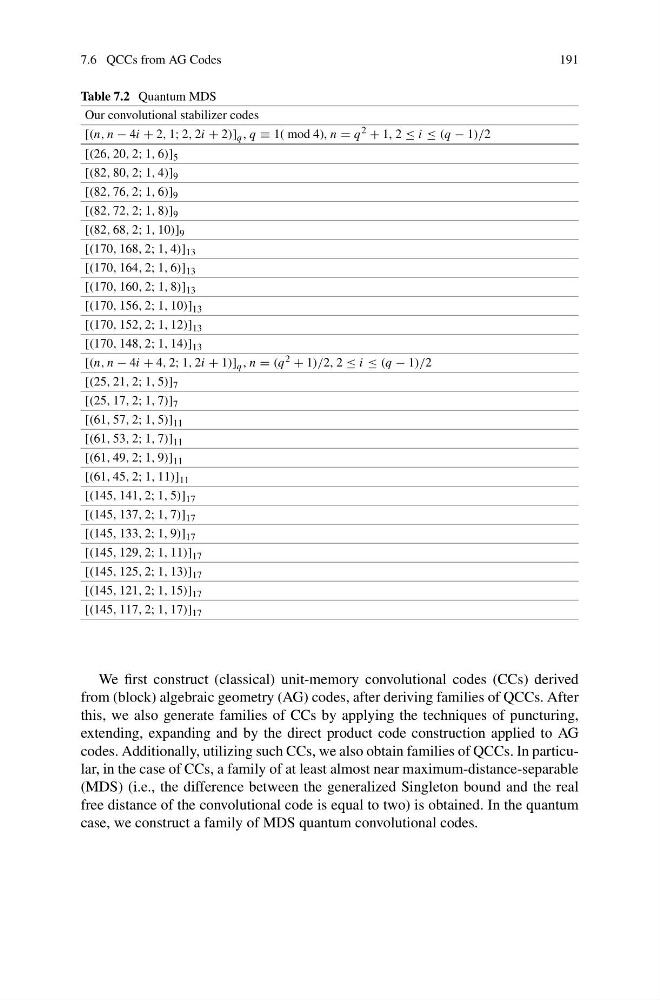
Table 7.2 Quantum MDS
Our convolutional stabilizer codes
[(n, n − 4i + 2, 1; 2, 2i + 2)] q , q ≡ 1( mod 4), n = q 2 + 1, 2 ≤ i ≤ (q − 1)/2
[(26, 20, 2; 1, 6)] 5
[(82, 80, 2; 1, 4)] 9
[(82, 76, 2; 1, 6)] 9
[(82, 72, 2; 1, 8)] 9
[(82, 68, 2; 1, 10)] 9
[(170, 168, 2; 1, 4)] 13
[(170, 164, 2; 1, 6)] 13
[(170, 160, 2; 1, 8)] 13
[(170, 156, 2; 1, 10)] 13
[(170, 152, 2; 1, 12)] 13
[(170, 148, 2; 1, 14)] 13
[(n, n − 4i + 4, 2; 1, 2i + 1)] q , n = (q 2 + 1)/2, 2 ≤ i ≤ (q − 1)/2
[(25, 21, 2; 1, 5)] 7
[(25, 17, 2; 1, 7)] 7
[(61, 57, 2; 1, 5)] 11
[(61, 53, 2; 1, 7)] 11
[(61, 49, 2; 1, 9)] 11
[(61, 45, 2; 1, 11)] 11
[(145, 141, 2; 1, 5)] 17
[(145, 137, 2; 1, 7)] 17
[(145, 133, 2; 1, 9)] 17
[(145, 129, 2; 1, 11)] 17
[(145, 125, 2; 1, 13)] 17
[(145, 121, 2; 1, 15)] 17
[(145, 117, 2; 1, 17)] 17
We first construct (classical) unit-memory convolutional codes (CCs) derived
from (block) algebraic geometry (AG) codes, after deriving families of QCCs. After
this, we also generate families of CCs by applying the techniques of puncturing,
extending, expanding and by the direct product code construction applied to AG
codes. Additionally, utilizing such CCs, we also obtain families of QCCs. In particular, in the case of CCs, a family of at least almost near maximum-distance-separable
(MDS) (i.e., the difference between the generalized Singleton bound and the real
free distance of the convolutional code is equal to two) is obtained. In the quantum
case, we construct a family of MDS quantum convolutional codes.
191
Table 7.2 Quantum MDS
Our convolutional stabilizer codes
[(n, n − 4i + 2, 1; 2, 2i + 2)] q , q ≡ 1( mod 4), n = q 2 + 1, 2 ≤ i ≤ (q − 1)/2
[(26, 20, 2; 1, 6)] 5
[(82, 80, 2; 1, 4)] 9
[(82, 76, 2; 1, 6)] 9
[(82, 72, 2; 1, 8)] 9
[(82, 68, 2; 1, 10)] 9
[(170, 168, 2; 1, 4)] 13
[(170, 164, 2; 1, 6)] 13
[(170, 160, 2; 1, 8)] 13
[(170, 156, 2; 1, 10)] 13
[(170, 152, 2; 1, 12)] 13
[(170, 148, 2; 1, 14)] 13
[(n, n − 4i + 4, 2; 1, 2i + 1)] q , n = (q 2 + 1)/2, 2 ≤ i ≤ (q − 1)/2
[(25, 21, 2; 1, 5)] 7
[(25, 17, 2; 1, 7)] 7
[(61, 57, 2; 1, 5)] 11
[(61, 53, 2; 1, 7)] 11
[(61, 49, 2; 1, 9)] 11
[(61, 45, 2; 1, 11)] 11
[(145, 141, 2; 1, 5)] 17
[(145, 137, 2; 1, 7)] 17
[(145, 133, 2; 1, 9)] 17
[(145, 129, 2; 1, 11)] 17
[(145, 125, 2; 1, 13)] 17
[(145, 121, 2; 1, 15)] 17
[(145, 117, 2; 1, 17)] 17
We first construct (classical) unit-memory convolutional codes (CCs) derived
from (block) algebraic geometry (AG) codes, after deriving families of QCCs. After
this, we also generate families of CCs by applying the techniques of puncturing,
extending, expanding and by the direct product code construction applied to AG
codes. Additionally, utilizing such CCs, we also obtain families of QCCs. In particular, in the case of CCs, a family of at least almost near maximum-distance-separable
(MDS) (i.e., the difference between the generalized Singleton bound and the real
free distance of the convolutional code is equal to two) is obtained. In the quantum
case, we construct a family of MDS quantum convolutional codes.