

7.4 More QCCs from BCH Codes
179
H 2q 2 +2,s−q 2 +1 =
⎡
⎢
⎢
⎢
⎢
⎢
⎢
⎢
⎢
⎢
⎢
⎢
⎢
⎢
⎢
⎢
⎣
1 α
(s−q
2 +1)
α
2(s−q
2 +1)
· · · α
(n−1)(s−q
2 +1)
1 α
(s−q
2 +2)
α
2(s−q
2 +2)
· · · α
(n−1)(s−q
2 +2)
. . .
. . .
. . .
. . .
. . .
1 α
(s−1)
· · ·
· · · α
(n−1)(s−1)
1 α
(s)
· · ·
· · · α
(n−1)(s)
1 α
(s+1)
· · ·
· · · α
(n−1)(s+1)
. . .
. . .
. . .
. . .
. . .
1 α
(s+q
2 −2)
· · ·
· · · α
(n−1)(s+q
2 −2)
1 α
(s+q
2 −1)
· · ·
· · · α
(n−1)(s+q
2 −1)
⎤
⎥
⎥
⎥
⎥
⎥
⎥
⎥
⎥
⎥
⎥
⎥
⎥
⎥
⎥
⎥
⎦
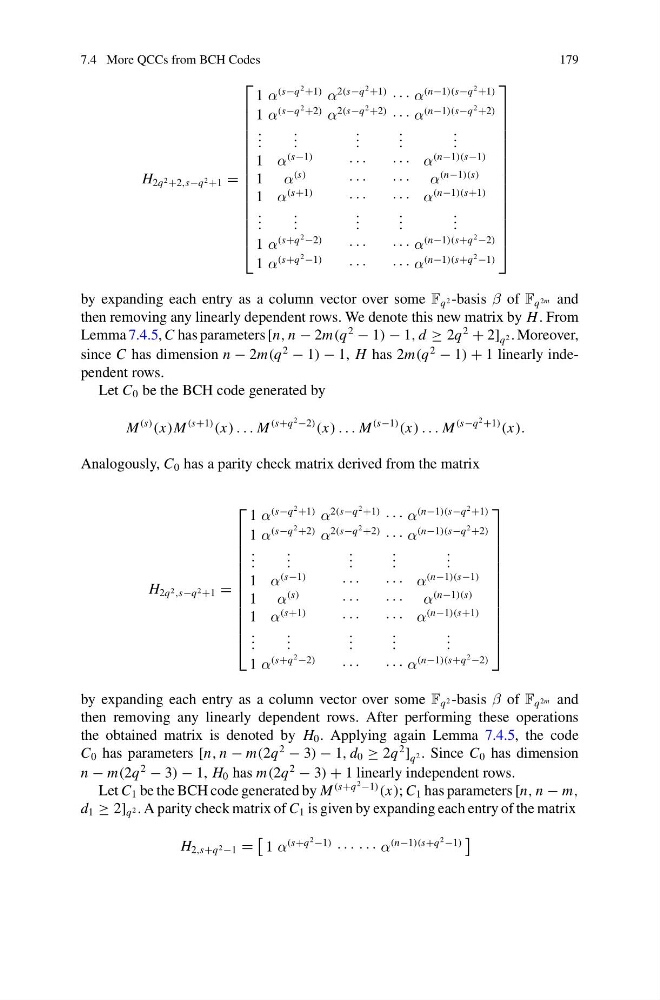
by expanding each entry as a column vector over some F q 2 -basis β of F q 2m and
then removing any linearly dependent rows. We denote this new matrix by H . From
Lemma 7.4.5, C has parameters [n, n − 2m(q
2
− 1) − 1, d ≥ 2q
2
+ 2] q 2 . Moreover,
since C has dimension n − 2m(q
2
− 1) − 1, H has 2m(q
2
− 1) + 1 linearly independent rows.
Let C 0 be the BCH code generated by
M
(s)
(x)M
(s+1)
(x) . . . M
(s+q
2 −2)
(x) . . . M
(s−1)
(x) . . . M
(s−q
2 +1)
(x).
Analogously, C 0 has a parity check matrix derived from the matrix
H 2q 2 ,s−q 2 +1 =
⎡
⎢
⎢
⎢
⎢
⎢
⎢
⎢
⎢
⎢
⎢
⎢
⎢
⎣
1 α
(s−q
2 +1)
α
2(s−q
2 +1)
· · · α
(n−1)(s−q
2 +1)
1 α
(s−q
2 +2)
α
2(s−q
2 +2)
· · · α
(n−1)(s−q
2 +2)
. . .
. . .
. . .
. . .
. . .
1 α
(s−1)
· · ·
· · · α
(n−1)(s−1)
1 α
(s)
· · ·
· · · α
(n−1)(s)
1 α
(s+1)
· · ·
· · · α
(n−1)(s+1)
. . .
. . .
. . .
. . .
. . .
1 α
(s+q
2 −2)
· · ·
· · · α
(n−1)(s+q
2 −2)
⎤
⎥
⎥
⎥
⎥
⎥
⎥
⎥
⎥
⎥
⎥
⎥
⎥
⎦
by expanding each entry as a column vector over some F q 2 -basis β of F q 2m and
then removing any linearly dependent rows. After performing these operations
the obtained matrix is denoted by H 0 . Applying again Lemma 7.4.5, the code
C 0 has parameters [n, n − m(2q
2
− 3) − 1, d 0 ≥ 2q
2
] q 2 . Since C 0 has dimension
n − m(2q
2
− 3) − 1, H 0 has m(2q
2
− 3) + 1 linearly independent rows.
Let C 1 be the BCH code generated by M
(s+q
2 −1)
(x); C 1 has parameters [n, n − m,
d 1 ≥ 2] q 2 . A parity check matrix of C 1 is given by expanding each entry of the matrix
H 2,s+q 2 −1 =
1 α
(s+q
2 −1)
· · · · · · α
(n−1)(s+q
2 −1)
179
H 2q 2 +2,s−q 2 +1 =
⎡
⎢
⎢
⎢
⎢
⎢
⎢
⎢
⎢
⎢
⎢
⎢
⎢
⎢
⎢
⎢
⎣
1 α
(s−q
2 +1)
α
2(s−q
2 +1)
· · · α
(n−1)(s−q
2 +1)
1 α
(s−q
2 +2)
α
2(s−q
2 +2)
· · · α
(n−1)(s−q
2 +2)
. . .
. . .
. . .
. . .
. . .
1 α
(s−1)
· · ·
· · · α
(n−1)(s−1)
1 α
(s)
· · ·
· · · α
(n−1)(s)
1 α
(s+1)
· · ·
· · · α
(n−1)(s+1)
. . .
. . .
. . .
. . .
. . .
1 α
(s+q
2 −2)
· · ·
· · · α
(n−1)(s+q
2 −2)
1 α
(s+q
2 −1)
· · ·
· · · α
(n−1)(s+q
2 −1)
⎤
⎥
⎥
⎥
⎥
⎥
⎥
⎥
⎥
⎥
⎥
⎥
⎥
⎥
⎥
⎥
⎦
by expanding each entry as a column vector over some F q 2 -basis β of F q 2m and
then removing any linearly dependent rows. We denote this new matrix by H . From
Lemma 7.4.5, C has parameters [n, n − 2m(q
2
− 1) − 1, d ≥ 2q
2
+ 2] q 2 . Moreover,
since C has dimension n − 2m(q
2
− 1) − 1, H has 2m(q
2
− 1) + 1 linearly independent rows.
Let C 0 be the BCH code generated by
M
(s)
(x)M
(s+1)
(x) . . . M
(s+q
2 −2)
(x) . . . M
(s−1)
(x) . . . M
(s−q
2 +1)
(x).
Analogously, C 0 has a parity check matrix derived from the matrix
H 2q 2 ,s−q 2 +1 =
⎡
⎢
⎢
⎢
⎢
⎢
⎢
⎢
⎢
⎢
⎢
⎢
⎢
⎣
1 α
(s−q
2 +1)
α
2(s−q
2 +1)
· · · α
(n−1)(s−q
2 +1)
1 α
(s−q
2 +2)
α
2(s−q
2 +2)
· · · α
(n−1)(s−q
2 +2)
. . .
. . .
. . .
. . .
. . .
1 α
(s−1)
· · ·
· · · α
(n−1)(s−1)
1 α
(s)
· · ·
· · · α
(n−1)(s)
1 α
(s+1)
· · ·
· · · α
(n−1)(s+1)
. . .
. . .
. . .
. . .
. . .
1 α
(s+q
2 −2)
· · ·
· · · α
(n−1)(s+q
2 −2)
⎤
⎥
⎥
⎥
⎥
⎥
⎥
⎥
⎥
⎥
⎥
⎥
⎥
⎦
by expanding each entry as a column vector over some F q 2 -basis β of F q 2m and
then removing any linearly dependent rows. After performing these operations
the obtained matrix is denoted by H 0 . Applying again Lemma 7.4.5, the code
C 0 has parameters [n, n − m(2q
2
− 3) − 1, d 0 ≥ 2q
2
] q 2 . Since C 0 has dimension
n − m(2q
2
− 3) − 1, H 0 has m(2q
2
− 3) + 1 linearly independent rows.
Let C 1 be the BCH code generated by M
(s+q
2 −1)
(x); C 1 has parameters [n, n − m,
d 1 ≥ 2] q 2 . A parity check matrix of C 1 is given by expanding each entry of the matrix
H 2,s+q 2 −1 =
1 α
(s+q
2 −1)
· · · · · · α
(n−1)(s+q
2 −1)