

7.2 Defining QCCs
167
If γ has the smallest value among all basic generator matrices, then γ is the called
degree of the code.
The memory of QCCs is defined in the sequence.
Definition 7.2.3 The memory μ of Q is defined as
μ = max 1≤i≤n−k,1≤ j≤n {max{deg X i j (D), deg Z i j (D)}},
and the free distance is defined analogously as to classical convolutional codes, i.e.,
the minimum of the weights of nonzero codewords in Q.
The parameters of a quantum convolutional code is denoted by
[(n, k, μ; γ, d f )] q ,
where n is the frame size, k is the number of logical qudits per frame, μ is the memory,
γ is the degree and d f is the free distance of the code.
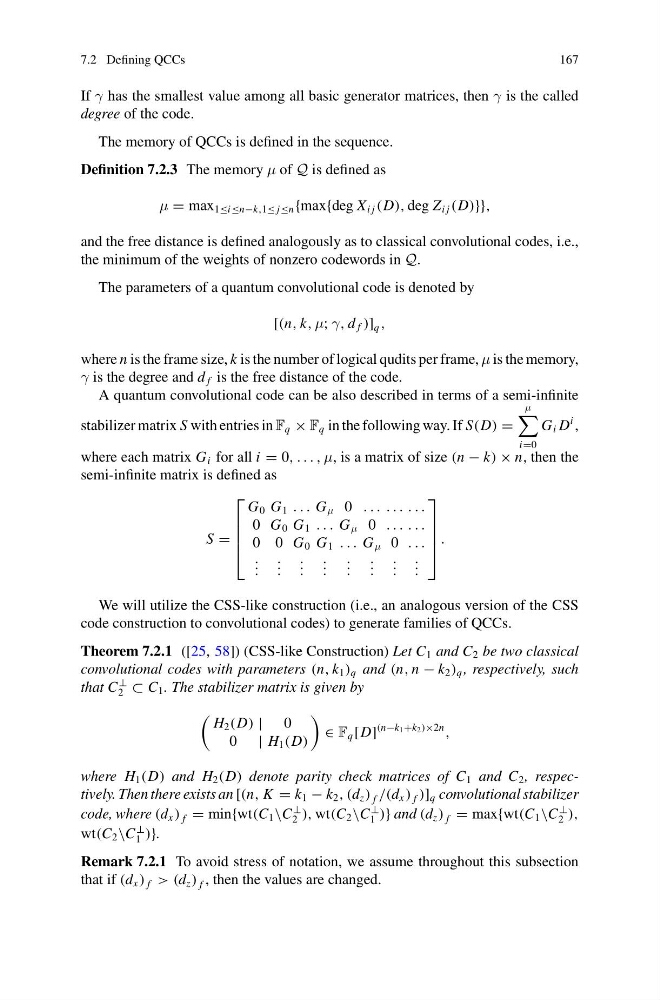
A quantum convolutional code can be also described in terms of a semi-infinite
stabilizer matrix S with entries in F q × F q in the following way. If S(D) =
μ
i=0
G i D
i ,
where each matrix G i for all i = 0, . . . , μ, is a matrix of size (n − k) × n, then the
semi-infinite matrix is defined as
S =
⎡
⎢
⎢
⎢
⎣
G 0 G 1 . . . G μ 0 . . . . . . . . .
0 G 0 G 1 . . . G μ 0 . . . . . .
0 0 G 0 G 1 . . . G μ 0 . . .
. . .
. . .
. . .
. . .
. . .
. . .
. . .
. . .
⎤
⎥
⎥
⎥
⎦
.
We will utilize the CSS-like construction (i.e., an analogous version of the CSS
code construction to convolutional codes) to generate families of QCCs.
Theorem 7.2.1 ([25, 58]) (CSS-like Construction) Let C 1 and C 2 be two classical
convolutional codes with parameters (n, k 1 ) q and (n, n − k 2 ) q , respectively, such
that C
⊥
2 ⊂ C 1 . The stabilizer matrix is given by
H 2 (D) | 0
0 | H 1 (D)
∈ F q [D]
(n−k 1 +k 2 )×2n
,
where H 1 (D) and H 2 (D) denote parity check matrices of C 1 and C 2 , respectively. Then there exists an [(n, K = k 1 − k 2 , (d z ) f /(d x ) f )] q convolutional stabilizer
code, where (d x ) f = min{wt(C 1 \C
⊥
2 ), wt(C 2 \C
⊥
1 )} and (d z ) f = max{wt(C 1 \C
⊥
2 ),
wt(C 2 \C
⊥
1 )}.
Remark 7.2.1 To avoid stress of notation, we assume throughout this subsection
that if (d x ) f > (d z ) f , then the values are changed.
167
If γ has the smallest value among all basic generator matrices, then γ is the called
degree of the code.
The memory of QCCs is defined in the sequence.
Definition 7.2.3 The memory μ of Q is defined as
μ = max 1≤i≤n−k,1≤ j≤n {max{deg X i j (D), deg Z i j (D)}},
and the free distance is defined analogously as to classical convolutional codes, i.e.,
the minimum of the weights of nonzero codewords in Q.
The parameters of a quantum convolutional code is denoted by
[(n, k, μ; γ, d f )] q ,
where n is the frame size, k is the number of logical qudits per frame, μ is the memory,
γ is the degree and d f is the free distance of the code.
A quantum convolutional code can be also described in terms of a semi-infinite
stabilizer matrix S with entries in F q × F q in the following way. If S(D) =
μ
i=0
G i D
i ,
where each matrix G i for all i = 0, . . . , μ, is a matrix of size (n − k) × n, then the
semi-infinite matrix is defined as
S =
⎡
⎢
⎢
⎢
⎣
G 0 G 1 . . . G μ 0 . . . . . . . . .
0 G 0 G 1 . . . G μ 0 . . . . . .
0 0 G 0 G 1 . . . G μ 0 . . .
. . .
. . .
. . .
. . .
. . .
. . .
. . .
. . .
⎤
⎥
⎥
⎥
⎦
.
We will utilize the CSS-like construction (i.e., an analogous version of the CSS
code construction to convolutional codes) to generate families of QCCs.
Theorem 7.2.1 ([25, 58]) (CSS-like Construction) Let C 1 and C 2 be two classical
convolutional codes with parameters (n, k 1 ) q and (n, n − k 2 ) q , respectively, such
that C
⊥
2 ⊂ C 1 . The stabilizer matrix is given by
H 2 (D) | 0
0 | H 1 (D)
∈ F q [D]
(n−k 1 +k 2 )×2n
,
where H 1 (D) and H 2 (D) denote parity check matrices of C 1 and C 2 , respectively. Then there exists an [(n, K = k 1 − k 2 , (d z ) f /(d x ) f )] q convolutional stabilizer
code, where (d x ) f = min{wt(C 1 \C
⊥
2 ), wt(C 2 \C
⊥
1 )} and (d z ) f = max{wt(C 1 \C
⊥
2 ),
wt(C 2 \C
⊥
1 )}.
Remark 7.2.1 To avoid stress of notation, we assume throughout this subsection
that if (d x ) f > (d z ) f , then the values are changed.