

6.7 New Codes from Old
147
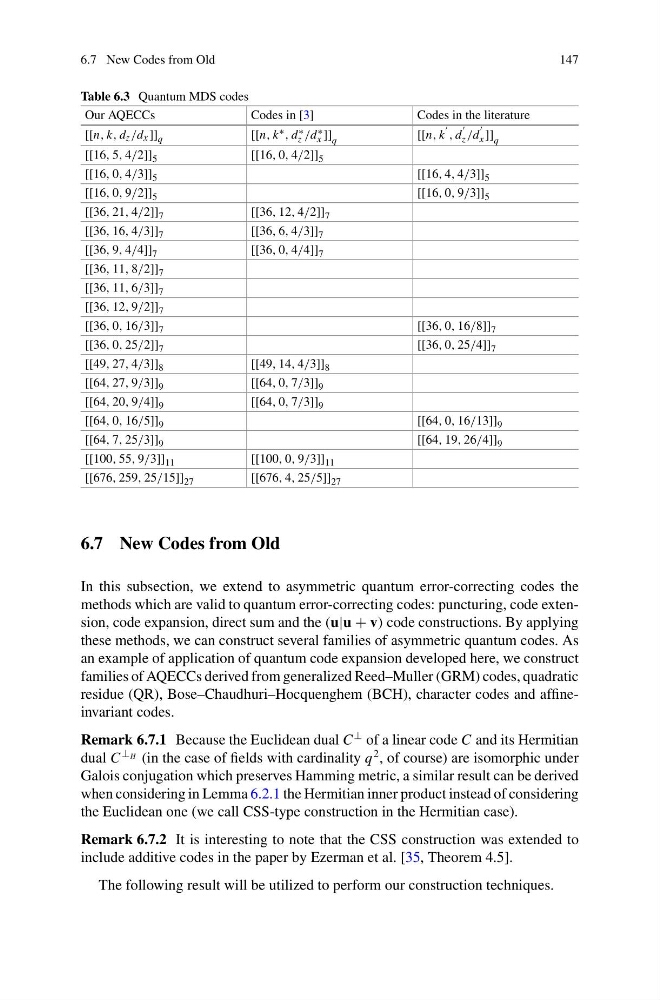
Table 6.3 Quantum MDS codes
Our AQECCs
Codes in [3]
Codes in the literature
[[n, k, d z /d x ]] q
[[n, k ∗ , d ∗
z /d ∗
x ]] q
[[n, k
, d
z /d
x ]] q
[[16, 5, 4/2]] 5
[[16, 0, 4/2]] 5
[[16, 0, 4/3]] 5
[[16, 4, 4/3]] 5
[[16, 0, 9/2]] 5
[[16, 0, 9/3]] 5
[[36, 21, 4/2]] 7
[[36, 12, 4/2]] 7
[[36, 16, 4/3]] 7
[[36, 6, 4/3]] 7
[[36, 9, 4/4]] 7
[[36, 0, 4/4]] 7
[[36, 11, 8/2]] 7
[[36, 11, 6/3]] 7
[[36, 12, 9/2]] 7
[[36, 0, 16/3]] 7
[[36, 0, 16/8]] 7
[[36, 0, 25/2]] 7
[[36, 0, 25/4]] 7
[[49, 27, 4/3]] 8
[[49, 14, 4/3]] 8
[[64, 27, 9/3]] 9
[[64, 0, 7/3]] 9
[[64, 20, 9/4]] 9
[[64, 0, 7/3]] 9
[[64, 0, 16/5]] 9
[[64, 0, 16/13]] 9
[[64, 7, 25/3]] 9
[[64, 19, 26/4]] 9
[[100, 55, 9/3]] 11
[[100, 0, 9/3]] 11
[[676, 259, 25/15]] 27
[[676, 4, 25/5]] 27
6.7 New Codes from Old
In this subsection, we extend to asymmetric quantum error-correcting codes the
methods which are valid to quantum error-correcting codes: puncturing, code extension, code expansion, direct sum and the (u|u + v) code constructions. By applying
these methods, we can construct several families of asymmetric quantum codes. As
an example of application of quantum code expansion developed here, we construct
families of AQECCs derived from generalized Reed–Muller (GRM) codes, quadratic
residue (QR), Bose–Chaudhuri–Hocquenghem (BCH), character codes and affineinvariant codes.
Remark 6.7.1 Because the Euclidean dual C
⊥ of a linear code C and its Hermitian
dual C
⊥ H (in the case of fields with cardinality q
2 , of course) are isomorphic under
Galois conjugation which preserves Hamming metric, a similar result can be derived
when considering in Lemma 6.2.1 the Hermitian inner product instead of considering
the Euclidean one (we call CSS-type construction in the Hermitian case).
Remark 6.7.2 It is interesting to note that the CSS construction was extended to
include additive codes in the paper by Ezerman et al. [35, Theorem 4.5].
The following result will be utilized to perform our construction techniques.
147
Table 6.3 Quantum MDS codes
Our AQECCs
Codes in [3]
Codes in the literature
[[n, k, d z /d x ]] q
[[n, k ∗ , d ∗
z /d ∗
x ]] q
[[n, k
, d
z /d
x ]] q
[[16, 5, 4/2]] 5
[[16, 0, 4/2]] 5
[[16, 0, 4/3]] 5
[[16, 4, 4/3]] 5
[[16, 0, 9/2]] 5
[[16, 0, 9/3]] 5
[[36, 21, 4/2]] 7
[[36, 12, 4/2]] 7
[[36, 16, 4/3]] 7
[[36, 6, 4/3]] 7
[[36, 9, 4/4]] 7
[[36, 0, 4/4]] 7
[[36, 11, 8/2]] 7
[[36, 11, 6/3]] 7
[[36, 12, 9/2]] 7
[[36, 0, 16/3]] 7
[[36, 0, 16/8]] 7
[[36, 0, 25/2]] 7
[[36, 0, 25/4]] 7
[[49, 27, 4/3]] 8
[[49, 14, 4/3]] 8
[[64, 27, 9/3]] 9
[[64, 0, 7/3]] 9
[[64, 20, 9/4]] 9
[[64, 0, 7/3]] 9
[[64, 0, 16/5]] 9
[[64, 0, 16/13]] 9
[[64, 7, 25/3]] 9
[[64, 19, 26/4]] 9
[[100, 55, 9/3]] 11
[[100, 0, 9/3]] 11
[[676, 259, 25/15]] 27
[[676, 4, 25/5]] 27
6.7 New Codes from Old
In this subsection, we extend to asymmetric quantum error-correcting codes the
methods which are valid to quantum error-correcting codes: puncturing, code extension, code expansion, direct sum and the (u|u + v) code constructions. By applying
these methods, we can construct several families of asymmetric quantum codes. As
an example of application of quantum code expansion developed here, we construct
families of AQECCs derived from generalized Reed–Muller (GRM) codes, quadratic
residue (QR), Bose–Chaudhuri–Hocquenghem (BCH), character codes and affineinvariant codes.
Remark 6.7.1 Because the Euclidean dual C
⊥ of a linear code C and its Hermitian
dual C
⊥ H (in the case of fields with cardinality q
2 , of course) are isomorphic under
Galois conjugation which preserves Hamming metric, a similar result can be derived
when considering in Lemma 6.2.1 the Hermitian inner product instead of considering
the Euclidean one (we call CSS-type construction in the Hermitian case).
Remark 6.7.2 It is interesting to note that the CSS construction was extended to
include additive codes in the paper by Ezerman et al. [35, Theorem 4.5].
The following result will be utilized to perform our construction techniques.