

5.3 BCH Codes—Part III
103
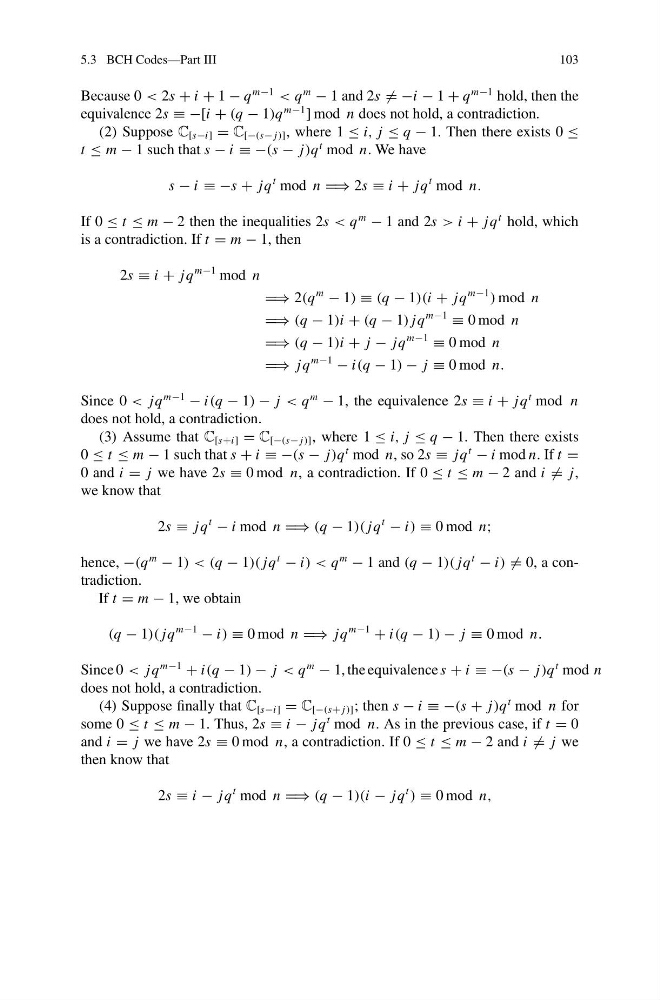
Because 0 < 2s + i + 1 − q
m−1
< q
m
− 1 and 2s = −i − 1 + q
m−1 hold, then the
equivalence 2s ≡ −[i + (q − 1)q
m−1
] mod n does not hold, a contradiction.
(2) Suppose C [s−i] = C [−(s− j)] , where 1 ≤ i, j ≤ q − 1. Then there exists 0 ≤
t ≤ m − 1 such that s − i ≡ −(s − j)q
t mod n. We have
s − i ≡ −s + jq
t mod n =⇒ 2s ≡ i + jq
t mod n.
If 0 ≤ t ≤ m − 2 then the inequalities 2s < q
m
− 1 and 2s > i + jq
t hold, which
is a contradiction. If t = m − 1, then
2s ≡ i + jq
m−1 mod n
=⇒ 2(q
m
− 1) ≡ (q − 1)(i + jq
m−1
) mod n
=⇒ (q − 1)i + (q − 1) jq
m−1
≡ 0 mod n
=⇒ (q − 1)i + j − jq
m−1
≡ 0 mod n
=⇒ jq
m−1
− i(q − 1) − j ≡ 0 mod n.
Since 0 < jq
m−1
− i(q − 1) − j < q
m
− 1, the equivalence 2s ≡ i + jq
t mod n
does not hold, a contradiction.
(3) Assume that C [s+i] = C [−(s− j)] , where 1 ≤ i, j ≤ q − 1. Then there exists
0 ≤ t ≤ m − 1 such that s + i ≡ −(s − j)q
t mod n, so 2s ≡ jq
t
− i mod n. If t =
0 and i = j we have 2s ≡ 0 mod n, a contradiction. If 0 ≤ t ≤ m − 2 and i = j,
we know that
2s ≡ jq
t
− i mod n =⇒ (q − 1)( jq
t
− i) ≡ 0 mod n;
hence, −(q
m
− 1) < (q − 1)( jq
t
− i) < q
m
− 1 and (q − 1)( jq
t
− i) = 0, a contradiction.
If t = m − 1, we obtain
(q − 1)( jq
m−1
− i) ≡ 0 mod n =⇒ jq
m−1
+ i(q − 1) − j ≡ 0 mod n.
Since 0 < jq
m−1
+ i(q − 1) − j < q
m
− 1, the equivalence s + i ≡ −(s − j)q
t mod n
does not hold, a contradiction.
(4) Suppose finally that C [s−i] = C [−(s+ j)] ; then s − i ≡ −(s + j)q
t mod n for
some 0 ≤ t ≤ m − 1. Thus, 2s ≡ i − jq
t mod n. As in the previous case, if t = 0
and i = j we have 2s ≡ 0 mod n, a contradiction. If 0 ≤ t ≤ m − 2 and i = j we
then know that
2s ≡ i − jq
t mod n =⇒ (q − 1)(i − jq
t
) ≡ 0 mod n,
103
Because 0 < 2s + i + 1 − q
m−1
< q
m
− 1 and 2s = −i − 1 + q
m−1 hold, then the
equivalence 2s ≡ −[i + (q − 1)q
m−1
] mod n does not hold, a contradiction.
(2) Suppose C [s−i] = C [−(s− j)] , where 1 ≤ i, j ≤ q − 1. Then there exists 0 ≤
t ≤ m − 1 such that s − i ≡ −(s − j)q
t mod n. We have
s − i ≡ −s + jq
t mod n =⇒ 2s ≡ i + jq
t mod n.
If 0 ≤ t ≤ m − 2 then the inequalities 2s < q
m
− 1 and 2s > i + jq
t hold, which
is a contradiction. If t = m − 1, then
2s ≡ i + jq
m−1 mod n
=⇒ 2(q
m
− 1) ≡ (q − 1)(i + jq
m−1
) mod n
=⇒ (q − 1)i + (q − 1) jq
m−1
≡ 0 mod n
=⇒ (q − 1)i + j − jq
m−1
≡ 0 mod n
=⇒ jq
m−1
− i(q − 1) − j ≡ 0 mod n.
Since 0 < jq
m−1
− i(q − 1) − j < q
m
− 1, the equivalence 2s ≡ i + jq
t mod n
does not hold, a contradiction.
(3) Assume that C [s+i] = C [−(s− j)] , where 1 ≤ i, j ≤ q − 1. Then there exists
0 ≤ t ≤ m − 1 such that s + i ≡ −(s − j)q
t mod n, so 2s ≡ jq
t
− i mod n. If t =
0 and i = j we have 2s ≡ 0 mod n, a contradiction. If 0 ≤ t ≤ m − 2 and i = j,
we know that
2s ≡ jq
t
− i mod n =⇒ (q − 1)( jq
t
− i) ≡ 0 mod n;
hence, −(q
m
− 1) < (q − 1)( jq
t
− i) < q
m
− 1 and (q − 1)( jq
t
− i) = 0, a contradiction.
If t = m − 1, we obtain
(q − 1)( jq
m−1
− i) ≡ 0 mod n =⇒ jq
m−1
+ i(q − 1) − j ≡ 0 mod n.
Since 0 < jq
m−1
+ i(q − 1) − j < q
m
− 1, the equivalence s + i ≡ −(s − j)q
t mod n
does not hold, a contradiction.
(4) Suppose finally that C [s−i] = C [−(s+ j)] ; then s − i ≡ −(s + j)q
t mod n for
some 0 ≤ t ≤ m − 1. Thus, 2s ≡ i − jq
t mod n. As in the previous case, if t = 0
and i = j we have 2s ≡ 0 mod n, a contradiction. If 0 ≤ t ≤ m − 2 and i = j we
then know that
2s ≡ i − jq
t mod n =⇒ (q − 1)(i − jq
t
) ≡ 0 mod n,