

5 ELimination Et Choix Traduisant La REalité (ELECTRE)
35
For illustration, from the contrast of the components of the first and second traces
of the Y matrix, for calculation of the d 12 (where in k = 1 and l = 2) wherein the values
j = 2, 4, 5 ought to be taken into consideration from the components of the discordance
set D 23 = {2, 4, 5} and the greatest supreme esteem of |y 12 −y 22 |, |y 14 −y 24 | and
|y 15 −y 25 | ought to be selected for the nominator and for the denominator of the
equation, the maximum extreme supreme distinction of the 1-th and 2-nd line of the
framework Y is selected.
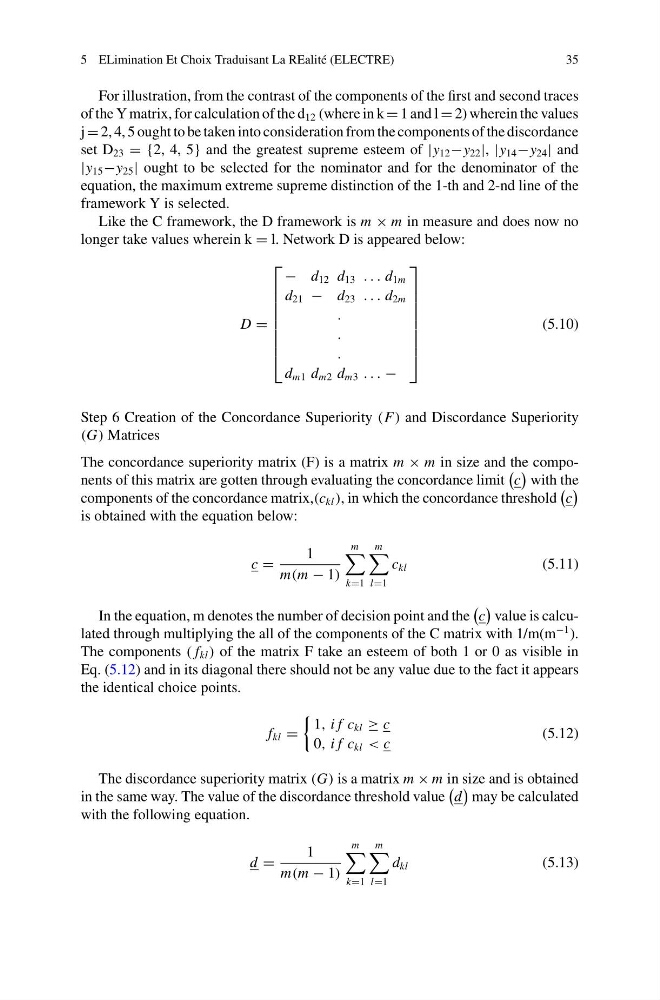
Like the C framework, the D framework is m × m in measure and does now no
longer take values wherein k = l. Network D is appeared below:
D =
⎡
⎢
⎢
⎢
⎢
⎢
⎢
⎢
⎣
− d 12 d 13 . . . d 1m
d 21 − d 23 . . . d 2m
.
.
.
d m1 d m2 d m3 . . . −
⎤
⎥
⎥
⎥
⎥
⎥
⎥
⎥
⎦
(5.10)
Step 6 Creation of the Concordance Superiority (F) and Discordance Superiority
(G) Matrices
The concordance superiority matrix (F) is a matrix m × m in size and the components of this matrix are gotten through evaluating the concordance limit
c
with the
components of the concordance matrix,(c kl ), in which the concordance threshold
c
is obtained with the equation below:
c =
1
m(m − 1)
m
k=1
m
l=1
c kl
(5.11)
In the equation, m denotes the number of decision point and the
c
value is calculated through multiplying the all of the components of the C matrix with 1/m(m
−1 ).
The components ( f kl ) of the matrix F take an esteem of both 1 or 0 as visible in
Eq. (5.12) and in its diagonal there should not be any value due to the fact it appears
the identical choice points.
f kl =
1, i f c kl ≥ c
0, i f c kl < c
(5.12)
The discordance superiority matrix (G) is a matrix m × m in size and is obtained
in the same way. The value of the discordance threshold value
d
may be calculated
with the following equation.
d =
1
m(m − 1)
m
k=1
m
l=1
d kl
(5.13)
35
For illustration, from the contrast of the components of the first and second traces
of the Y matrix, for calculation of the d 12 (where in k = 1 and l = 2) wherein the values
j = 2, 4, 5 ought to be taken into consideration from the components of the discordance
set D 23 = {2, 4, 5} and the greatest supreme esteem of |y 12 −y 22 |, |y 14 −y 24 | and
|y 15 −y 25 | ought to be selected for the nominator and for the denominator of the
equation, the maximum extreme supreme distinction of the 1-th and 2-nd line of the
framework Y is selected.
Like the C framework, the D framework is m × m in measure and does now no
longer take values wherein k = l. Network D is appeared below:
D =
⎡
⎢
⎢
⎢
⎢
⎢
⎢
⎢
⎣
− d 12 d 13 . . . d 1m
d 21 − d 23 . . . d 2m
.
.
.
d m1 d m2 d m3 . . . −
⎤
⎥
⎥
⎥
⎥
⎥
⎥
⎥
⎦
(5.10)
Step 6 Creation of the Concordance Superiority (F) and Discordance Superiority
(G) Matrices
The concordance superiority matrix (F) is a matrix m × m in size and the components of this matrix are gotten through evaluating the concordance limit
c
with the
components of the concordance matrix,(c kl ), in which the concordance threshold
c
is obtained with the equation below:
c =
1
m(m − 1)
m
k=1
m
l=1
c kl
(5.11)
In the equation, m denotes the number of decision point and the
c
value is calculated through multiplying the all of the components of the C matrix with 1/m(m
−1 ).
The components ( f kl ) of the matrix F take an esteem of both 1 or 0 as visible in
Eq. (5.12) and in its diagonal there should not be any value due to the fact it appears
the identical choice points.
f kl =
1, i f c kl ≥ c
0, i f c kl < c
(5.12)
The discordance superiority matrix (G) is a matrix m × m in size and is obtained
in the same way. The value of the discordance threshold value
d
may be calculated
with the following equation.
d =
1
m(m − 1)
m
k=1
m
l=1
d kl
(5.13)