

20
D. Uzun Ozsahin et al.
In this chapter, we will dissect the mathematical computation of AHP with two
simplified examples to help clarify the methodology. The Eigenvalue method is used
is used for decision makers that have consistency in their preferences. Consistency
is a pivotal concept in AHP as it determines the method to be used. In the case of an
inconsistent decision maker, the Eigenvalue method is inapplicable and so the quantification is made through a matrix solution (2). The identification of inconsistency
as opposed to consistency in decision making will also be extensively discussed.
For example, how can we tell if the decision maker is consistent with their preferences? This will be discussed thoroughly and elaborated with worked examples
giving relevance to the distributive and ideal modes of AHP (Saaty 2001).
3.2 Mathematical Computation of AHP
As previously mentioned, the first step in AHP is setting clear objectives and goals.
The different criteria are considered along with their sub-criteria and are combined
with the alternatives to form the hierarchy tree network. Then, the different qualities
of each alternative, the criteria, are assessed in a pairwise comparison with respect
to the set objectives to derive their priority as a numerical value using a ratio. The
ratio scale or scale of relative importance developed by Saaty (1987) ranges from
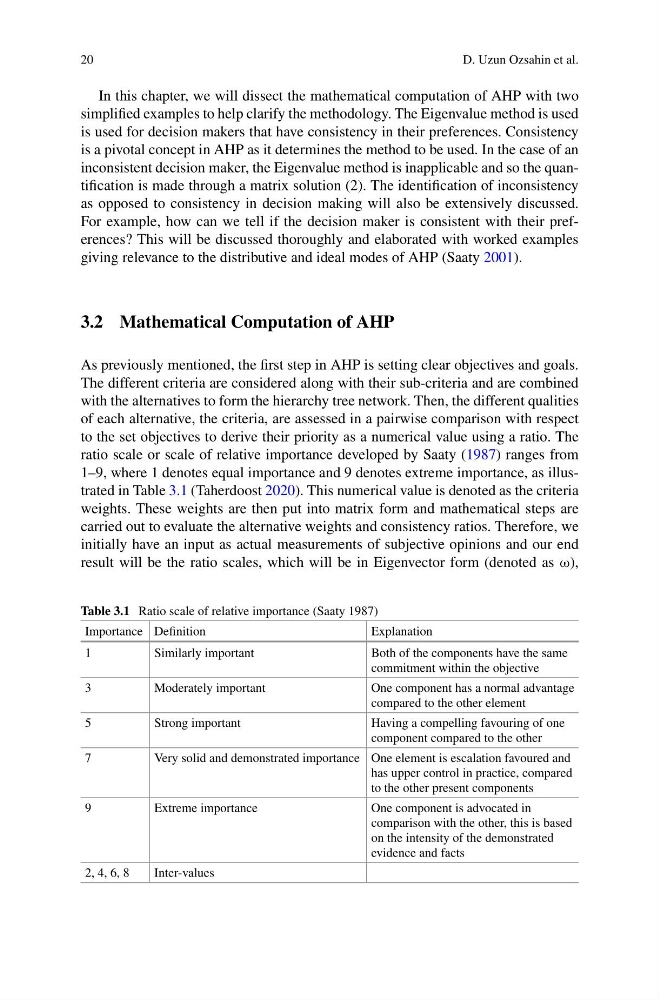
1–9, where 1 denotes equal importance and 9 denotes extreme importance, as illustrated in Table 3.1 (Taherdoost 2020). This numerical value is denoted as the criteria
weights. These weights are then put into matrix form and mathematical steps are
carried out to evaluate the alternative weights and consistency ratios. Therefore, we
initially have an input as actual measurements of subjective opinions and our end
result will be the ratio scales, which will be in Eigenvector form (denoted as ω),
Table 3.1 Ratio scale of relative importance (Saaty 1987)
Importance Definition
Explanation
1
Similarly important
Both of the components have the same
commitment within the objective
3
Moderately important
One component has a normal advantage
compared to the other element
5
Strong important
Having a compelling favouring of one
component compared to the other
7
Very solid and demonstrated importance One element is escalation favoured and
has upper control in practice, compared
to the other present components
9
Extreme importance
One component is advocated in
comparison with the other, this is based
on the intensity of the demonstrated
evidence and facts
2, 4, 6, 8
Inter-values
D. Uzun Ozsahin et al.
In this chapter, we will dissect the mathematical computation of AHP with two
simplified examples to help clarify the methodology. The Eigenvalue method is used
is used for decision makers that have consistency in their preferences. Consistency
is a pivotal concept in AHP as it determines the method to be used. In the case of an
inconsistent decision maker, the Eigenvalue method is inapplicable and so the quantification is made through a matrix solution (2). The identification of inconsistency
as opposed to consistency in decision making will also be extensively discussed.
For example, how can we tell if the decision maker is consistent with their preferences? This will be discussed thoroughly and elaborated with worked examples
giving relevance to the distributive and ideal modes of AHP (Saaty 2001).
3.2 Mathematical Computation of AHP
As previously mentioned, the first step in AHP is setting clear objectives and goals.
The different criteria are considered along with their sub-criteria and are combined
with the alternatives to form the hierarchy tree network. Then, the different qualities
of each alternative, the criteria, are assessed in a pairwise comparison with respect
to the set objectives to derive their priority as a numerical value using a ratio. The
ratio scale or scale of relative importance developed by Saaty (1987) ranges from
1–9, where 1 denotes equal importance and 9 denotes extreme importance, as illustrated in Table 3.1 (Taherdoost 2020). This numerical value is denoted as the criteria
weights. These weights are then put into matrix form and mathematical steps are
carried out to evaluate the alternative weights and consistency ratios. Therefore, we
initially have an input as actual measurements of subjective opinions and our end
result will be the ratio scales, which will be in Eigenvector form (denoted as ω),
Table 3.1 Ratio scale of relative importance (Saaty 1987)
Importance Definition
Explanation
1
Similarly important
Both of the components have the same
commitment within the objective
3
Moderately important
One component has a normal advantage
compared to the other element
5
Strong important
Having a compelling favouring of one
component compared to the other
7
Very solid and demonstrated importance One element is escalation favoured and
has upper control in practice, compared
to the other present components
9
Extreme importance
One component is advocated in
comparison with the other, this is based
on the intensity of the demonstrated
evidence and facts
2, 4, 6, 8
Inter-values