

202
S. Sözen et al.
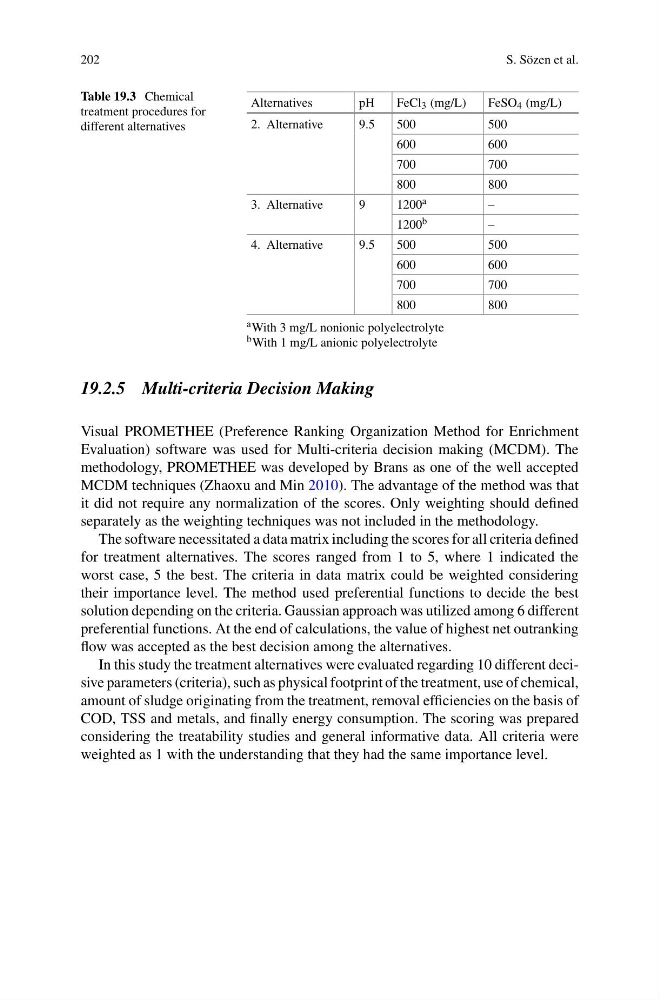
Table 19.3 Chemical
treatment procedures for
different alternatives
Alternatives
pH
FeCl 3 (mg/L)
FeSO 4 (mg/L)
2. Alternative
9.5
500
500
600
600
700
700
800
800
3. Alternative
9
1200 a
–
1200 b
–
4. Alternative
9.5
500
500
600
600
700
700
800
800
a With 3 mg/L nonionic polyelectrolyte
b With 1 mg/L anionic polyelectrolyte
19.2.5 Multi-criteria Decision Making
Visual PROMETHEE (Preference Ranking Organization Method for Enrichment
Evaluation) software was used for Multi-criteria decision making (MCDM). The
methodology, PROMETHEE was developed by Brans as one of the well accepted
MCDM techniques (Zhaoxu and Min 2010). The advantage of the method was that
it did not require any normalization of the scores. Only weighting should defined
separately as the weighting techniques was not included in the methodology.
The software necessitated a data matrix including the scores for all criteria defined
for treatment alternatives. The scores ranged from 1 to 5, where 1 indicated the
worst case, 5 the best. The criteria in data matrix could be weighted considering
their importance level. The method used preferential functions to decide the best
solution depending on the criteria. Gaussian approach was utilized among 6 different
preferential functions. At the end of calculations, the value of highest net outranking
flow was accepted as the best decision among the alternatives.
In this study the treatment alternatives were evaluated regarding 10 different decisive parameters (criteria), such as physical footprint of the treatment, use of chemical,
amount of sludge originating from the treatment, removal efficiencies on the basis of
COD, TSS and metals, and finally energy consumption. The scoring was prepared
considering the treatability studies and general informative data. All criteria were
weighted as 1 with the understanding that they had the same importance level.
S. Sözen et al.
Table 19.3 Chemical
treatment procedures for
different alternatives
Alternatives
pH
FeCl 3 (mg/L)
FeSO 4 (mg/L)
2. Alternative
9.5
500
500
600
600
700
700
800
800
3. Alternative
9
1200 a
–
1200 b
–
4. Alternative
9.5
500
500
600
600
700
700
800
800
a With 3 mg/L nonionic polyelectrolyte
b With 1 mg/L anionic polyelectrolyte
19.2.5 Multi-criteria Decision Making
Visual PROMETHEE (Preference Ranking Organization Method for Enrichment
Evaluation) software was used for Multi-criteria decision making (MCDM). The
methodology, PROMETHEE was developed by Brans as one of the well accepted
MCDM techniques (Zhaoxu and Min 2010). The advantage of the method was that
it did not require any normalization of the scores. Only weighting should defined
separately as the weighting techniques was not included in the methodology.
The software necessitated a data matrix including the scores for all criteria defined
for treatment alternatives. The scores ranged from 1 to 5, where 1 indicated the
worst case, 5 the best. The criteria in data matrix could be weighted considering
their importance level. The method used preferential functions to decide the best
solution depending on the criteria. Gaussian approach was utilized among 6 different
preferential functions. At the end of calculations, the value of highest net outranking
flow was accepted as the best decision among the alternatives.
In this study the treatment alternatives were evaluated regarding 10 different decisive parameters (criteria), such as physical footprint of the treatment, use of chemical,
amount of sludge originating from the treatment, removal efficiencies on the basis of
COD, TSS and metals, and finally energy consumption. The scoring was prepared
considering the treatability studies and general informative data. All criteria were
weighted as 1 with the understanding that they had the same importance level.