

200
S. Sözen et al.
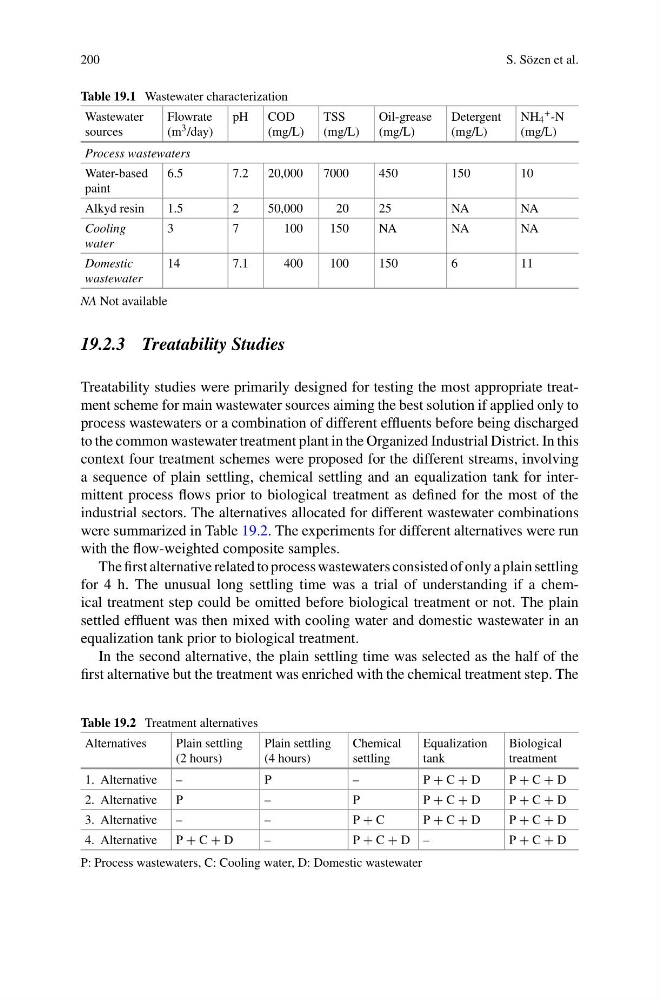
Table 19.1 Wastewater characterization
Wastewater
sources
Flowrate
(m 3 /day)
pH
COD
(mg/L)
TSS
(mg/L)
Oil-grease
(mg/L)
Detergent
(mg/L)
NH 4
+ -N
(mg/L)
Process wastewaters
Water-based
paint
6.5
7.2
20,000
7000
450
150
10
Alkyd resin
1.5
2
50,000
20
25
NA
NA
Cooling
water
3
7
100
150
NA
NA
NA
Domestic
wastewater
14
7.1
400
100
150
6
11
NA Not available
19.2.3 Treatability Studies
Treatability studies were primarily designed for testing the most appropriate treatment scheme for main wastewater sources aiming the best solution if applied only to
process wastewaters or a combination of different effluents before being discharged
to the common wastewater treatment plant in the Organized Industrial District. In this
context four treatment schemes were proposed for the different streams, involving
a sequence of plain settling, chemical settling and an equalization tank for intermittent process flows prior to biological treatment as defined for the most of the
industrial sectors. The alternatives allocated for different wastewater combinations
were summarized in Table 19.2. The experiments for different alternatives were run
with the flow-weighted composite samples.
The first alternative related to process wastewaters consisted of only a plain settling
for 4 h. The unusual long settling time was a trial of understanding if a chemical treatment step could be omitted before biological treatment or not. The plain
settled effluent was then mixed with cooling water and domestic wastewater in an
equalization tank prior to biological treatment.
In the second alternative, the plain settling time was selected as the half of the
first alternative but the treatment was enriched with the chemical treatment step. The
Table 19.2 Treatment alternatives
Alternatives
Plain settling
(2 hours)
Plain settling
(4 hours)
Chemical
settling
Equalization
tank
Biological
treatment
1. Alternative –
P
–
P + C + D
P + C + D
2. Alternative P
–
P
P + C + D
P + C + D
3. Alternative –
–
P + C
P + C + D
P + C + D
4. Alternative P + C + D
–
P + C + D –
P + C + D
P: Process wastewaters, C: Cooling water, D: Domestic wastewater
S. Sözen et al.
Table 19.1 Wastewater characterization
Wastewater
sources
Flowrate
(m 3 /day)
pH
COD
(mg/L)
TSS
(mg/L)
Oil-grease
(mg/L)
Detergent
(mg/L)
NH 4
+ -N
(mg/L)
Process wastewaters
Water-based
paint
6.5
7.2
20,000
7000
450
150
10
Alkyd resin
1.5
2
50,000
20
25
NA
NA
Cooling
water
3
7
100
150
NA
NA
NA
Domestic
wastewater
14
7.1
400
100
150
6
11
NA Not available
19.2.3 Treatability Studies
Treatability studies were primarily designed for testing the most appropriate treatment scheme for main wastewater sources aiming the best solution if applied only to
process wastewaters or a combination of different effluents before being discharged
to the common wastewater treatment plant in the Organized Industrial District. In this
context four treatment schemes were proposed for the different streams, involving
a sequence of plain settling, chemical settling and an equalization tank for intermittent process flows prior to biological treatment as defined for the most of the
industrial sectors. The alternatives allocated for different wastewater combinations
were summarized in Table 19.2. The experiments for different alternatives were run
with the flow-weighted composite samples.
The first alternative related to process wastewaters consisted of only a plain settling
for 4 h. The unusual long settling time was a trial of understanding if a chemical treatment step could be omitted before biological treatment or not. The plain
settled effluent was then mixed with cooling water and domestic wastewater in an
equalization tank prior to biological treatment.
In the second alternative, the plain settling time was selected as the half of the
first alternative but the treatment was enriched with the chemical treatment step. The
Table 19.2 Treatment alternatives
Alternatives
Plain settling
(2 hours)
Plain settling
(4 hours)
Chemical
settling
Equalization
tank
Biological
treatment
1. Alternative –
P
–
P + C + D
P + C + D
2. Alternative P
–
P
P + C + D
P + C + D
3. Alternative –
–
P + C
P + C + D
P + C + D
4. Alternative P + C + D
–
P + C + D –
P + C + D
P: Process wastewaters, C: Cooling water, D: Domestic wastewater