

176
I. K. Umar et al.
constituent materials. The higher the CBR value the thinner the layer thickness and
vice versa (Kumar and Pavithra 2016). The procedure for determining pavement
thickness in this method involved determination of Base Year Traffic Counts, Design
Life and Traffic Growth Rates, CBR value of subgrade, base and subbase materials,
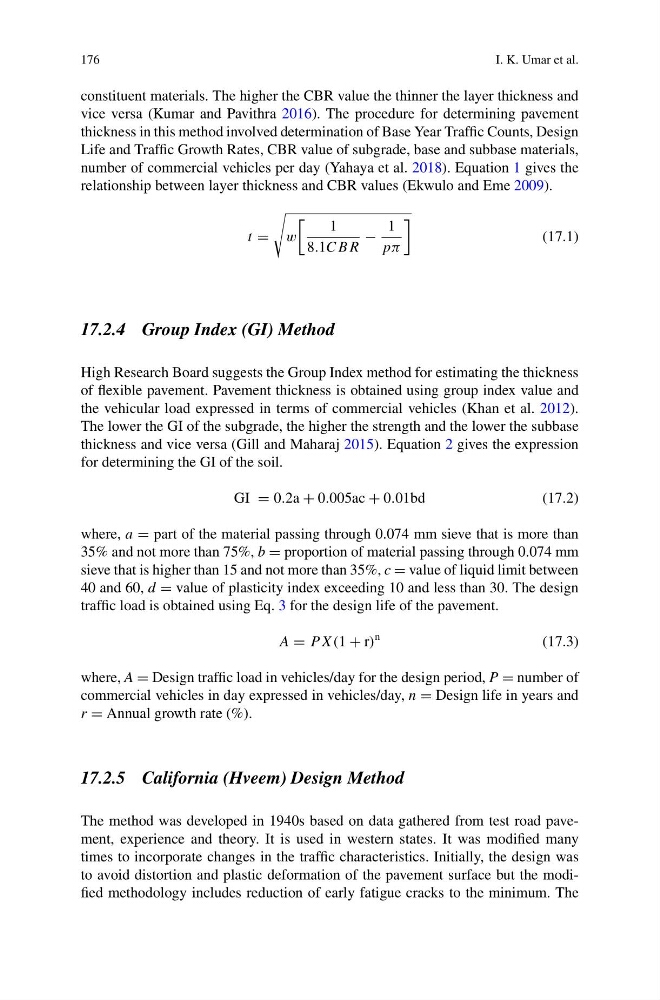
number of commercial vehicles per day (Yahaya et al. 2018). Equation 1 gives the
relationship between layer thickness and CBR values (Ekwulo and Eme 2009).
t =
w
1
8.1C B R
−
1
pπ
(17.1)
17.2.4 Group Index (GI) Method
High Research Board suggests the Group Index method for estimating the thickness
of flexible pavement. Pavement thickness is obtained using group index value and
the vehicular load expressed in terms of commercial vehicles (Khan et al. 2012).
The lower the GI of the subgrade, the higher the strength and the lower the subbase
thickness and vice versa (Gill and Maharaj 2015). Equation 2 gives the expression
for determining the GI of the soil.
GI = 0.2a + 0.005ac + 0.01bd
(17.2)
where, a = part of the material passing through 0.074 mm sieve that is more than
35% and not more than 75%, b = proportion of material passing through 0.074 mm
sieve that is higher than 15 and not more than 35%, c = value of liquid limit between
40 and 60, d = value of plasticity index exceeding 10 and less than 30. The design
traffic load is obtained using Eq. 3 for the design life of the pavement.
A = P X(1 + r)
n
(17.3)
where, A = Design traffic load in vehicles/day for the design period, P = number of
commercial vehicles in day expressed in vehicles/day, n = Design life in years and
r = Annual growth rate (%).
17.2.5 California (Hveem) Design Method
The method was developed in 1940s based on data gathered from test road pavement, experience and theory. It is used in western states. It was modified many
times to incorporate changes in the traffic characteristics. Initially, the design was
to avoid distortion and plastic deformation of the pavement surface but the modified methodology includes reduction of early fatigue cracks to the minimum. The
I. K. Umar et al.
constituent materials. The higher the CBR value the thinner the layer thickness and
vice versa (Kumar and Pavithra 2016). The procedure for determining pavement
thickness in this method involved determination of Base Year Traffic Counts, Design
Life and Traffic Growth Rates, CBR value of subgrade, base and subbase materials,
number of commercial vehicles per day (Yahaya et al. 2018). Equation 1 gives the
relationship between layer thickness and CBR values (Ekwulo and Eme 2009).
t =
w
1
8.1C B R
−
1
pπ
(17.1)
17.2.4 Group Index (GI) Method
High Research Board suggests the Group Index method for estimating the thickness
of flexible pavement. Pavement thickness is obtained using group index value and
the vehicular load expressed in terms of commercial vehicles (Khan et al. 2012).
The lower the GI of the subgrade, the higher the strength and the lower the subbase
thickness and vice versa (Gill and Maharaj 2015). Equation 2 gives the expression
for determining the GI of the soil.
GI = 0.2a + 0.005ac + 0.01bd
(17.2)
where, a = part of the material passing through 0.074 mm sieve that is more than
35% and not more than 75%, b = proportion of material passing through 0.074 mm
sieve that is higher than 15 and not more than 35%, c = value of liquid limit between
40 and 60, d = value of plasticity index exceeding 10 and less than 30. The design
traffic load is obtained using Eq. 3 for the design life of the pavement.
A = P X(1 + r)
n
(17.3)
where, A = Design traffic load in vehicles/day for the design period, P = number of
commercial vehicles in day expressed in vehicles/day, n = Design life in years and
r = Annual growth rate (%).
17.2.5 California (Hveem) Design Method
The method was developed in 1940s based on data gathered from test road pavement, experience and theory. It is used in western states. It was modified many
times to incorporate changes in the traffic characteristics. Initially, the design was
to avoid distortion and plastic deformation of the pavement surface but the modified methodology includes reduction of early fatigue cracks to the minimum. The