

16 Comparative Analysis for Irrigation Water Application Methods …
169
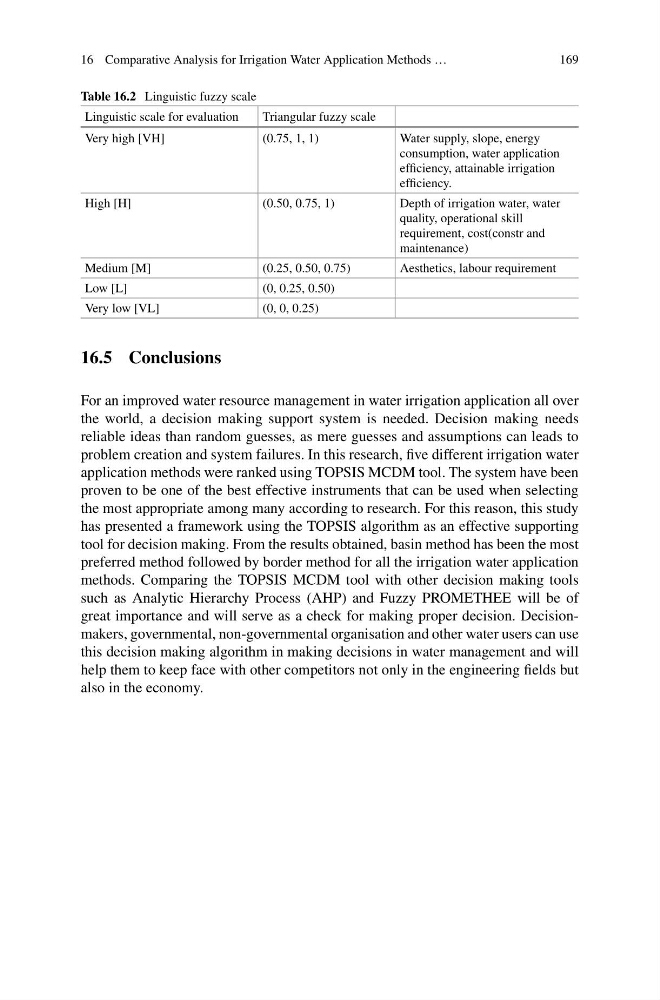
Table 16.2 Linguistic fuzzy scale
Linguistic scale for evaluation
Triangular fuzzy scale
Very high [VH]
(0.75, 1, 1)
Water supply, slope, energy
consumption, water application
efficiency, attainable irrigation
efficiency.
High [H]
(0.50, 0.75, 1)
Depth of irrigation water, water
quality, operational skill
requirement, cost(constr and
maintenance)
Medium [M]
(0.25, 0.50, 0.75)
Aesthetics, labour requirement
Low [L]
(0, 0.25, 0.50)
Very low [VL]
(0, 0, 0.25)
16.5 Conclusions
For an improved water resource management in water irrigation application all over
the world, a decision making support system is needed. Decision making needs
reliable ideas than random guesses, as mere guesses and assumptions can leads to
problem creation and system failures. In this research, five different irrigation water
application methods were ranked using TOPSIS MCDM tool. The system have been
proven to be one of the best effective instruments that can be used when selecting
the most appropriate among many according to research. For this reason, this study
has presented a framework using the TOPSIS algorithm as an effective supporting
tool for decision making. From the results obtained, basin method has been the most
preferred method followed by border method for all the irrigation water application
methods. Comparing the TOPSIS MCDM tool with other decision making tools
such as Analytic Hierarchy Process (AHP) and Fuzzy PROMETHEE will be of
great importance and will serve as a check for making proper decision. Decisionmakers, governmental, non-governmental organisation and other water users can use
this decision making algorithm in making decisions in water management and will
help them to keep face with other competitors not only in the engineering fields but
also in the economy.
169
Table 16.2 Linguistic fuzzy scale
Linguistic scale for evaluation
Triangular fuzzy scale
Very high [VH]
(0.75, 1, 1)
Water supply, slope, energy
consumption, water application
efficiency, attainable irrigation
efficiency.
High [H]
(0.50, 0.75, 1)
Depth of irrigation water, water
quality, operational skill
requirement, cost(constr and
maintenance)
Medium [M]
(0.25, 0.50, 0.75)
Aesthetics, labour requirement
Low [L]
(0, 0.25, 0.50)
Very low [VL]
(0, 0, 0.25)
16.5 Conclusions
For an improved water resource management in water irrigation application all over
the world, a decision making support system is needed. Decision making needs
reliable ideas than random guesses, as mere guesses and assumptions can leads to
problem creation and system failures. In this research, five different irrigation water
application methods were ranked using TOPSIS MCDM tool. The system have been
proven to be one of the best effective instruments that can be used when selecting
the most appropriate among many according to research. For this reason, this study
has presented a framework using the TOPSIS algorithm as an effective supporting
tool for decision making. From the results obtained, basin method has been the most
preferred method followed by border method for all the irrigation water application
methods. Comparing the TOPSIS MCDM tool with other decision making tools
such as Analytic Hierarchy Process (AHP) and Fuzzy PROMETHEE will be of
great importance and will serve as a check for making proper decision. Decisionmakers, governmental, non-governmental organisation and other water users can use
this decision making algorithm in making decisions in water management and will
help them to keep face with other competitors not only in the engineering fields but
also in the economy.