

136
M. Al Muhisen et al.
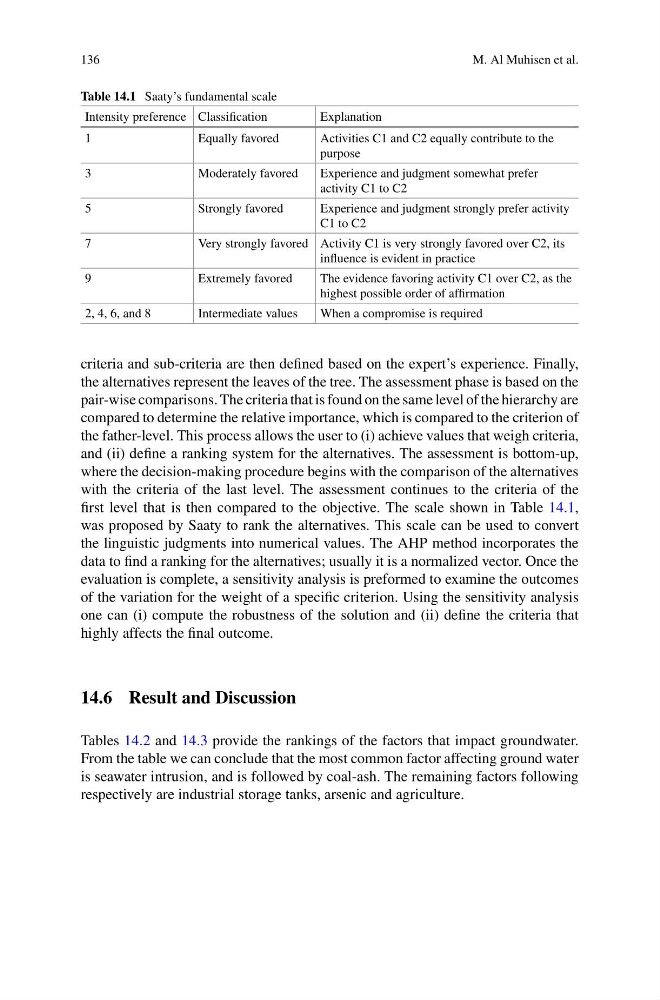
Table 14.1 Saaty’s fundamental scale
Intensity preference Classification
Explanation
1
Equally favored
Activities C1 and C2 equally contribute to the
purpose
3
Moderately favored
Experience and judgment somewhat prefer
activity C1 to C2
5
Strongly favored
Experience and judgment strongly prefer activity
C1 to C2
7
Very strongly favored Activity C1 is very strongly favored over C2, its
influence is evident in practice
9
Extremely favored
The evidence favoring activity C1 over C2, as the
highest possible order of affirmation
2, 4, 6, and 8
Intermediate values
When a compromise is required
criteria and sub-criteria are then defined based on the expert’s experience. Finally,
the alternatives represent the leaves of the tree. The assessment phase is based on the
pair-wise comparisons. The criteria that is found on the same level of the hierarchy are
compared to determine the relative importance, which is compared to the criterion of
the father-level. This process allows the user to (i) achieve values that weigh criteria,
and (ii) define a ranking system for the alternatives. The assessment is bottom-up,
where the decision-making procedure begins with the comparison of the alternatives
with the criteria of the last level. The assessment continues to the criteria of the
first level that is then compared to the objective. The scale shown in Table 14.1,
was proposed by Saaty to rank the alternatives. This scale can be used to convert
the linguistic judgments into numerical values. The AHP method incorporates the
data to find a ranking for the alternatives; usually it is a normalized vector. Once the
evaluation is complete, a sensitivity analysis is preformed to examine the outcomes
of the variation for the weight of a specific criterion. Using the sensitivity analysis
one can (i) compute the robustness of the solution and (ii) define the criteria that
highly affects the final outcome.
14.6 Result and Discussion
Tables 14.2 and 14.3 provide the rankings of the factors that impact groundwater.
From the table we can conclude that the most common factor affecting ground water
is seawater intrusion, and is followed by coal-ash. The remaining factors following
respectively are industrial storage tanks, arsenic and agriculture.
M. Al Muhisen et al.
Table 14.1 Saaty’s fundamental scale
Intensity preference Classification
Explanation
1
Equally favored
Activities C1 and C2 equally contribute to the
purpose
3
Moderately favored
Experience and judgment somewhat prefer
activity C1 to C2
5
Strongly favored
Experience and judgment strongly prefer activity
C1 to C2
7
Very strongly favored Activity C1 is very strongly favored over C2, its
influence is evident in practice
9
Extremely favored
The evidence favoring activity C1 over C2, as the
highest possible order of affirmation
2, 4, 6, and 8
Intermediate values
When a compromise is required
criteria and sub-criteria are then defined based on the expert’s experience. Finally,
the alternatives represent the leaves of the tree. The assessment phase is based on the
pair-wise comparisons. The criteria that is found on the same level of the hierarchy are
compared to determine the relative importance, which is compared to the criterion of
the father-level. This process allows the user to (i) achieve values that weigh criteria,
and (ii) define a ranking system for the alternatives. The assessment is bottom-up,
where the decision-making procedure begins with the comparison of the alternatives
with the criteria of the last level. The assessment continues to the criteria of the
first level that is then compared to the objective. The scale shown in Table 14.1,
was proposed by Saaty to rank the alternatives. This scale can be used to convert
the linguistic judgments into numerical values. The AHP method incorporates the
data to find a ranking for the alternatives; usually it is a normalized vector. Once the
evaluation is complete, a sensitivity analysis is preformed to examine the outcomes
of the variation for the weight of a specific criterion. Using the sensitivity analysis
one can (i) compute the robustness of the solution and (ii) define the criteria that
highly affects the final outcome.
14.6 Result and Discussion
Tables 14.2 and 14.3 provide the rankings of the factors that impact groundwater.
From the table we can conclude that the most common factor affecting ground water
is seawater intrusion, and is followed by coal-ash. The remaining factors following
respectively are industrial storage tanks, arsenic and agriculture.