

120
G. A¸ sıksoy et al.
learners’ diverse needs and interests can be better understood (Samimy 1994). The
affective dimension of learning is important, not only because achieving a certain
level of affective skills is important by itself, but it is sometimes critical in the
process of acquiring the desired cognitive learning outcomes of education (Flake
and Petway 2019; Lashari et al. 2012). Additionally, factors such as student-teacher
relationships, use of technology, and student characteristics are variables that affect
learning. Therefore, in our study, we considered both cognitive and affective features
in the evaluation of learning methods.
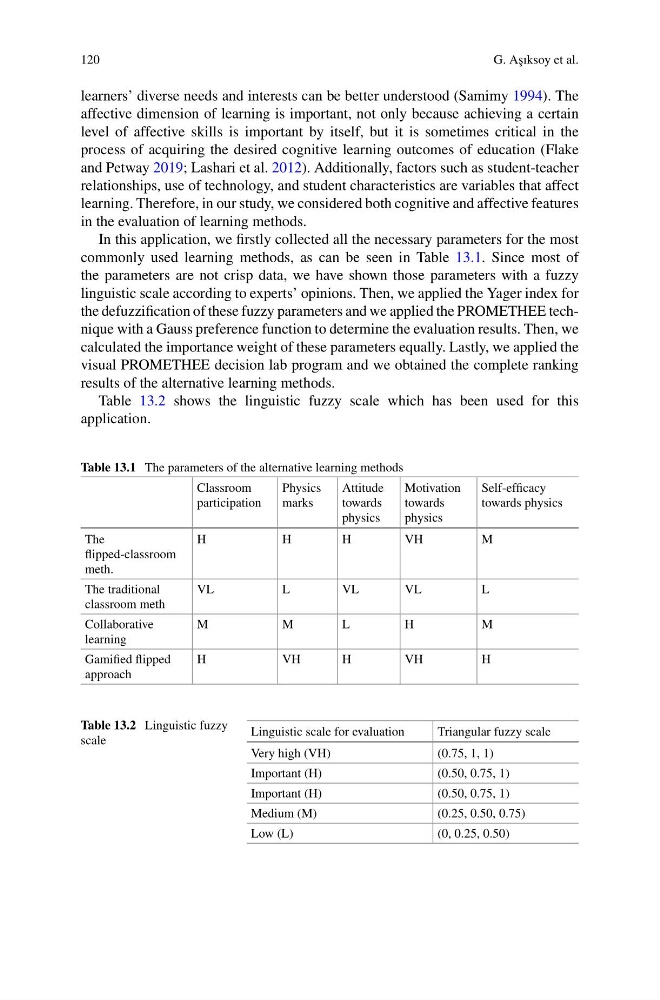
In this application, we firstly collected all the necessary parameters for the most
commonly used learning methods, as can be seen in Table 13.1. Since most of
the parameters are not crisp data, we have shown those parameters with a fuzzy
linguistic scale according to experts’ opinions. Then, we applied the Yager index for
the defuzzification of these fuzzy parameters and we applied the PROMETHEE technique with a Gauss preference function to determine the evaluation results. Then, we
calculated the importance weight of these parameters equally. Lastly, we applied the
visual PROMETHEE decision lab program and we obtained the complete ranking
results of the alternative learning methods.
Table 13.2 shows the linguistic fuzzy scale which has been used for this
application.
Table 13.1 The parameters of the alternative learning methods
Classroom
participation
Physics
marks
Attitude
towards
physics
Motivation
towards
physics
Self-efficacy
towards physics
The
flipped-classroom
meth.
H
H
H
VH
M
The traditional
classroom meth
VL
L
VL
VL
L
Collaborative
learning
M
M
L
H
M
Gamified flipped
approach
H
VH
H
VH
H
Table 13.2 Linguistic fuzzy
scale
Linguistic scale for evaluation
Triangular fuzzy scale
Very high (VH)
(0.75, 1, 1)
Important (H)
(0.50, 0.75, 1)
Important (H)
(0.50, 0.75, 1)
Medium (M)
(0.25, 0.50, 0.75)
Low (L)
(0, 0.25, 0.50)
G. A¸ sıksoy et al.
learners’ diverse needs and interests can be better understood (Samimy 1994). The
affective dimension of learning is important, not only because achieving a certain
level of affective skills is important by itself, but it is sometimes critical in the
process of acquiring the desired cognitive learning outcomes of education (Flake
and Petway 2019; Lashari et al. 2012). Additionally, factors such as student-teacher
relationships, use of technology, and student characteristics are variables that affect
learning. Therefore, in our study, we considered both cognitive and affective features
in the evaluation of learning methods.
In this application, we firstly collected all the necessary parameters for the most
commonly used learning methods, as can be seen in Table 13.1. Since most of
the parameters are not crisp data, we have shown those parameters with a fuzzy
linguistic scale according to experts’ opinions. Then, we applied the Yager index for
the defuzzification of these fuzzy parameters and we applied the PROMETHEE technique with a Gauss preference function to determine the evaluation results. Then, we
calculated the importance weight of these parameters equally. Lastly, we applied the
visual PROMETHEE decision lab program and we obtained the complete ranking
results of the alternative learning methods.
Table 13.2 shows the linguistic fuzzy scale which has been used for this
application.
Table 13.1 The parameters of the alternative learning methods
Classroom
participation
Physics
marks
Attitude
towards
physics
Motivation
towards
physics
Self-efficacy
towards physics
The
flipped-classroom
meth.
H
H
H
VH
M
The traditional
classroom meth
VL
L
VL
VL
L
Collaborative
learning
M
M
L
H
M
Gamified flipped
approach
H
VH
H
VH
H
Table 13.2 Linguistic fuzzy
scale
Linguistic scale for evaluation
Triangular fuzzy scale
Very high (VH)
(0.75, 1, 1)
Important (H)
(0.50, 0.75, 1)
Important (H)
(0.50, 0.75, 1)
Medium (M)
(0.25, 0.50, 0.75)
Low (L)
(0, 0.25, 0.50)