

110
G. Gelete et al.
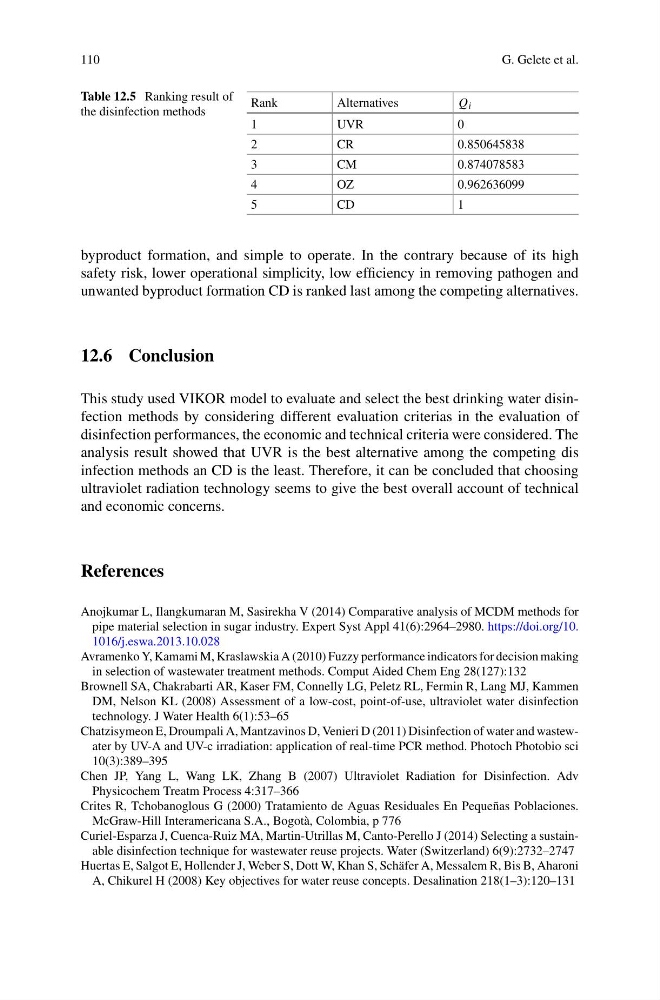
Table 12.5 Ranking result of
the disinfection methods
Rank
Alternatives
Q i
1
UVR
0
2
CR
0.850645838
3
CM
0.874078583
4
OZ
0.962636099
5
CD
1
byproduct formation, and simple to operate. In the contrary because of its high
safety risk, lower operational simplicity, low efficiency in removing pathogen and
unwanted byproduct formation CD is ranked last among the competing alternatives.
12.6 Conclusion
This study used VIKOR model to evaluate and select the best drinking water disinfection methods by considering different evaluation criterias in the evaluation of
disinfection performances, the economic and technical criteria were considered. The
analysis result showed that UVR is the best alternative among the competing dis
infection methods an CD is the least. Therefore, it can be concluded that choosing
ultraviolet radiation technology seems to give the best overall account of technical
and economic concerns.
References
Anojkumar L, Ilangkumaran M, Sasirekha V (2014) Comparative analysis of MCDM methods for
pipe material selection in sugar industry. Expert Syst Appl 41(6):2964–2980. https://doi.org/10.
1016/j.eswa.2013.10.028
Avramenko Y, Kamami M, Kraslawskia A (2010) Fuzzy performance indicators for decision making
in selection of wastewater treatment methods. Comput Aided Chem Eng 28(127):132
Brownell SA, Chakrabarti AR, Kaser FM, Connelly LG, Peletz RL, Fermin R, Lang MJ, Kammen
DM, Nelson KL (2008) Assessment of a low-cost, point-of-use, ultraviolet water disinfection
technology. J Water Health 6(1):53–65
Chatzisymeon E, Droumpali A, Mantzavinos D, Venieri D (2011) Disinfection of water and wastewater by UV-A and UV-c irradiation: application of real-time PCR method. Photoch Photobio sci
10(3):389–395
Chen JP, Yang L, Wang LK, Zhang B (2007) Ultraviolet Radiation for Disinfection. Adv
Physicochem Treatm Process 4:317–366
Crites R, Tchobanoglous G (2000) Tratamiento de Aguas Residuales En Pequeñas Poblaciones.
McGraw-Hill Interamericana S.A., Bogotà, Colombia, p 776
Curiel-Esparza J, Cuenca-Ruiz MA, Martin-Utrillas M, Canto-Perello J (2014) Selecting a sustainable disinfection technique for wastewater reuse projects. Water (Switzerland) 6(9):2732–2747
Huertas E, Salgot E, Hollender J, Weber S, Dott W, Khan S, Schäfer A, Messalem R, Bis B, Aharoni
A, Chikurel H (2008) Key objectives for water reuse concepts. Desalination 218(1–3):120–131
G. Gelete et al.
Table 12.5 Ranking result of
the disinfection methods
Rank
Alternatives
Q i
1
UVR
0
2
CR
0.850645838
3
CM
0.874078583
4
OZ
0.962636099
5
CD
1
byproduct formation, and simple to operate. In the contrary because of its high
safety risk, lower operational simplicity, low efficiency in removing pathogen and
unwanted byproduct formation CD is ranked last among the competing alternatives.
12.6 Conclusion
This study used VIKOR model to evaluate and select the best drinking water disinfection methods by considering different evaluation criterias in the evaluation of
disinfection performances, the economic and technical criteria were considered. The
analysis result showed that UVR is the best alternative among the competing dis
infection methods an CD is the least. Therefore, it can be concluded that choosing
ultraviolet radiation technology seems to give the best overall account of technical
and economic concerns.
References
Anojkumar L, Ilangkumaran M, Sasirekha V (2014) Comparative analysis of MCDM methods for
pipe material selection in sugar industry. Expert Syst Appl 41(6):2964–2980. https://doi.org/10.
1016/j.eswa.2013.10.028
Avramenko Y, Kamami M, Kraslawskia A (2010) Fuzzy performance indicators for decision making
in selection of wastewater treatment methods. Comput Aided Chem Eng 28(127):132
Brownell SA, Chakrabarti AR, Kaser FM, Connelly LG, Peletz RL, Fermin R, Lang MJ, Kammen
DM, Nelson KL (2008) Assessment of a low-cost, point-of-use, ultraviolet water disinfection
technology. J Water Health 6(1):53–65
Chatzisymeon E, Droumpali A, Mantzavinos D, Venieri D (2011) Disinfection of water and wastewater by UV-A and UV-c irradiation: application of real-time PCR method. Photoch Photobio sci
10(3):389–395
Chen JP, Yang L, Wang LK, Zhang B (2007) Ultraviolet Radiation for Disinfection. Adv
Physicochem Treatm Process 4:317–366
Crites R, Tchobanoglous G (2000) Tratamiento de Aguas Residuales En Pequeñas Poblaciones.
McGraw-Hill Interamericana S.A., Bogotà, Colombia, p 776
Curiel-Esparza J, Cuenca-Ruiz MA, Martin-Utrillas M, Canto-Perello J (2014) Selecting a sustainable disinfection technique for wastewater reuse projects. Water (Switzerland) 6(9):2732–2747
Huertas E, Salgot E, Hollender J, Weber S, Dott W, Khan S, Schäfer A, Messalem R, Bis B, Aharoni
A, Chikurel H (2008) Key objectives for water reuse concepts. Desalination 218(1–3):120–131