

Topics in Current Chemistry (2018) 376:44
1 3
One of the major challenges in ATRP commercialization is the large amount of
residual catalysts in the final products, which are usually removed by multifarious
post-purification methods, mainly including washing or extraction with aqueous precipitants, and passing the catalyst-containing polymer solution through aluminum
oxide column or silica gel. To avoid the laborious process, Zhu and coworkers
used silica-gel-supported copper bromide-hexamethyltriethylenetetramine (CuBrHMTETA) catalyst during the ATRP process, which proved effective to improve
catalytic efficiency both in batch and in continuous-flow reactor. They employed
tubular reactor for the continuous ATRP, and the steady operation for the MMA
polymerization with the monomer conversion of 80% at the flow rate of 8 ml/h was
achieved for more than 100 h before the loss of catalytic activity [138]. Besides,
the methyl methacrylate (MMA)/butyl methacrylate (BMA) block copolymers were
synthesized by connecting two tubular reactors in series [139].
Single electron transfer living radical polymerization (SET-LRP) possesses some
advantageous features compared to the conventional ATRP irrespective of unconfirmed reaction mechanisms [140]. Copper powder or wire can be easily used to
generate a heterogeneous system to simplify catalyst handling, removal, and recycling. Polymerization rates of acrylic systems are especially higher in SET-LRP than
other living radical polymerization processes, and therefore the corresponding fast
heat output should be concerned. While sufficient heat removal is extremely crucial in case of the reaction runaway, microreactor technology would be a good solution owing to its huge surface-to-volume ratio. Cunningham et al. employed cooper
tubular reactor to conduct the continuous SET-LRP of methyl acrylate (MA), with
copper tubing acting as the catalyst source. Monomer conversion over 67% was
obtained within 16 min of residence time. Since copper would continuously dissolve
from the reactor wall into the reaction mixture, a short copper tubing used for initiating the reaction was combined with a long stainless-steel tubular reactor [141].
Similarly, Chen et al. performed SET-LRP of acrylonitrile (AN) in an iron tubular
reactor with a piece of iron-tubing as the catalyst source [142]. Additionally, Burns
et al. demonstrated the SET-LRP of MA in a PTFE tubular reactor with a copper
wire threaded through the tube as the catalyst [143].
RAFT and NMP polymerization in heterogeneous systems are mainly realized
through emulsion or mini-emulsion polymerization, usually requiring the aid of surfactants addition and ultra-sonication [1]. Schork et al. conducted the RAFT miniemulsion polymerization of styrene (St) in a stainless-steel tubular mini-reactor
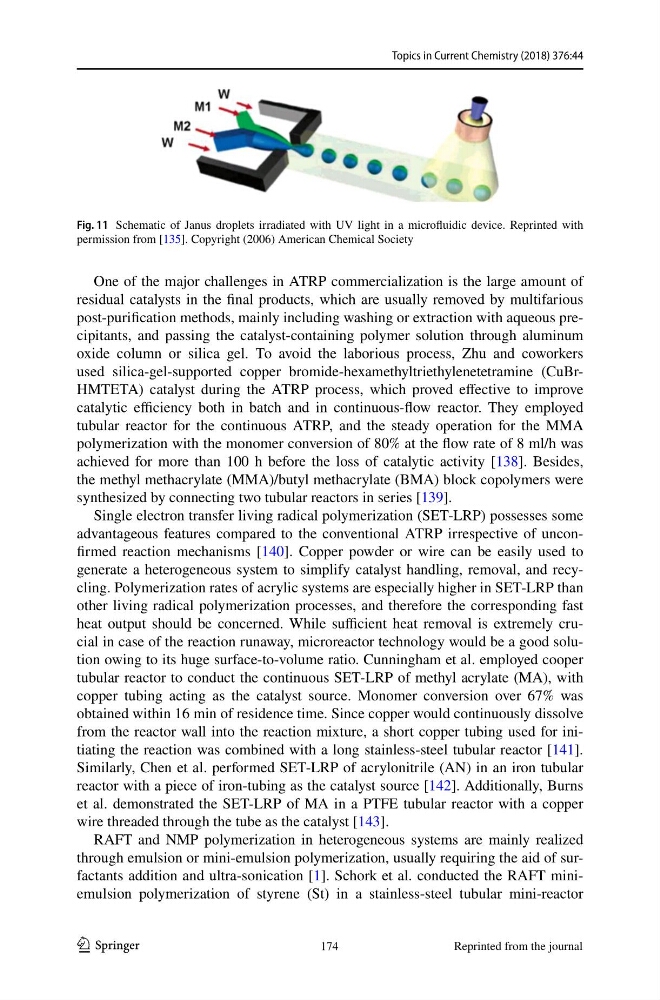
Fig. 11 Schematic of Janus droplets irradiated with UV light in a microfluidic device. Reprinted with
permission from [135]. Copyright (2006) American Chemical Society
174
Reprinted from the journal
1 3
One of the major challenges in ATRP commercialization is the large amount of
residual catalysts in the final products, which are usually removed by multifarious
post-purification methods, mainly including washing or extraction with aqueous precipitants, and passing the catalyst-containing polymer solution through aluminum
oxide column or silica gel. To avoid the laborious process, Zhu and coworkers
used silica-gel-supported copper bromide-hexamethyltriethylenetetramine (CuBrHMTETA) catalyst during the ATRP process, which proved effective to improve
catalytic efficiency both in batch and in continuous-flow reactor. They employed
tubular reactor for the continuous ATRP, and the steady operation for the MMA
polymerization with the monomer conversion of 80% at the flow rate of 8 ml/h was
achieved for more than 100 h before the loss of catalytic activity [138]. Besides,
the methyl methacrylate (MMA)/butyl methacrylate (BMA) block copolymers were
synthesized by connecting two tubular reactors in series [139].
Single electron transfer living radical polymerization (SET-LRP) possesses some
advantageous features compared to the conventional ATRP irrespective of unconfirmed reaction mechanisms [140]. Copper powder or wire can be easily used to
generate a heterogeneous system to simplify catalyst handling, removal, and recycling. Polymerization rates of acrylic systems are especially higher in SET-LRP than
other living radical polymerization processes, and therefore the corresponding fast
heat output should be concerned. While sufficient heat removal is extremely crucial in case of the reaction runaway, microreactor technology would be a good solution owing to its huge surface-to-volume ratio. Cunningham et al. employed cooper
tubular reactor to conduct the continuous SET-LRP of methyl acrylate (MA), with
copper tubing acting as the catalyst source. Monomer conversion over 67% was
obtained within 16 min of residence time. Since copper would continuously dissolve
from the reactor wall into the reaction mixture, a short copper tubing used for initiating the reaction was combined with a long stainless-steel tubular reactor [141].
Similarly, Chen et al. performed SET-LRP of acrylonitrile (AN) in an iron tubular
reactor with a piece of iron-tubing as the catalyst source [142]. Additionally, Burns
et al. demonstrated the SET-LRP of MA in a PTFE tubular reactor with a copper
wire threaded through the tube as the catalyst [143].
RAFT and NMP polymerization in heterogeneous systems are mainly realized
through emulsion or mini-emulsion polymerization, usually requiring the aid of surfactants addition and ultra-sonication [1]. Schork et al. conducted the RAFT miniemulsion polymerization of styrene (St) in a stainless-steel tubular mini-reactor
Fig. 11 Schematic of Janus droplets irradiated with UV light in a microfluidic device. Reprinted with
permission from [135]. Copyright (2006) American Chemical Society
174
Reprinted from the journal