

Topics in Current Chemistry (2018) 376:44
1 3
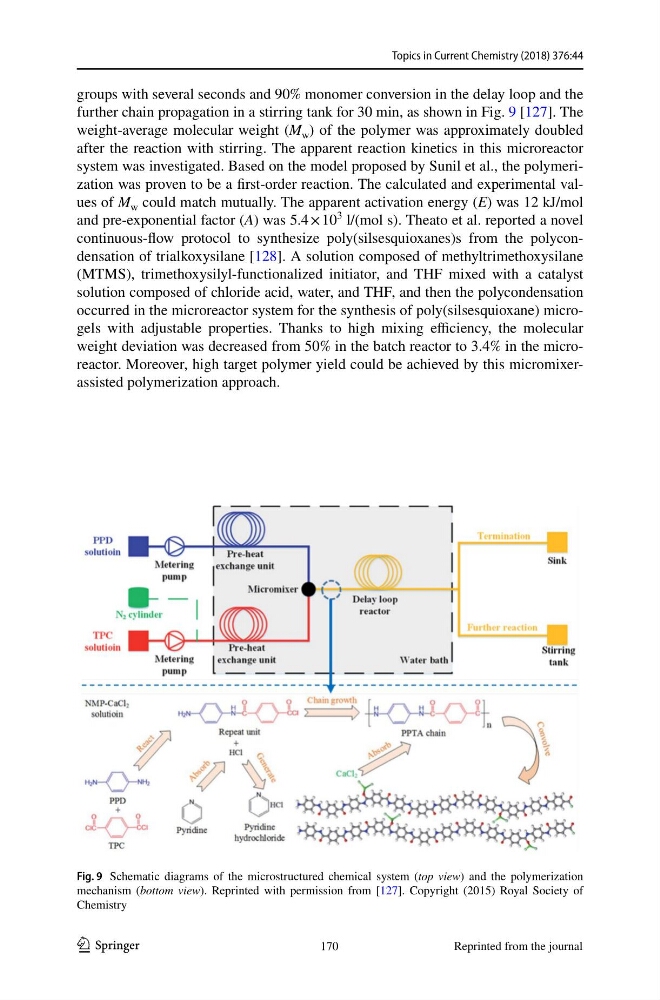
groups with several seconds and 90% monomer conversion in the delay loop and the
further chain propagation in a stirring tank for 30 min, as shown in Fig. 9 [127]. The
weight-average molecular weight (M w ) of the polymer was approximately doubled
after the reaction with stirring. The apparent reaction kinetics in this microreactor
system was investigated. Based on the model proposed by Sunil et al., the polymerization was proven to be a first-order reaction. The calculated and experimental values of M w could match mutually. The apparent activation energy (E) was 12 kJ/mol
and pre-exponential factor (A) was 5.4 × 10
3
l/(mol s). Theato et al. reported a novel
continuous-flow protocol to synthesize poly(silsesquioxanes)s from the polycondensation of trialkoxysilane [128]. A solution composed of methyltrimethoxysilane
(MTMS), trimethoxysilyl-functionalized initiator, and THF mixed with a catalyst
solution composed of chloride acid, water, and THF, and then the polycondensation
occurred in the microreactor system for the synthesis of poly(silsesquioxane) microgels with adjustable properties. Thanks to high mixing efficiency, the molecular
weight deviation was decreased from 50% in the batch reactor to 3.4% in the microreactor. Moreover, high target polymer yield could be achieved by this micromixerassisted polymerization approach.
Fig. 9 Schematic diagrams of the microstructured chemical system (top view) and the polymerization
mechanism (bottom view). Reprinted with permission from [127]. Copyright (2015) Royal Society of
Chemistry
170
Reprinted from the journal
1 3
groups with several seconds and 90% monomer conversion in the delay loop and the
further chain propagation in a stirring tank for 30 min, as shown in Fig. 9 [127]. The
weight-average molecular weight (M w ) of the polymer was approximately doubled
after the reaction with stirring. The apparent reaction kinetics in this microreactor
system was investigated. Based on the model proposed by Sunil et al., the polymerization was proven to be a first-order reaction. The calculated and experimental values of M w could match mutually. The apparent activation energy (E) was 12 kJ/mol
and pre-exponential factor (A) was 5.4 × 10
3
l/(mol s). Theato et al. reported a novel
continuous-flow protocol to synthesize poly(silsesquioxanes)s from the polycondensation of trialkoxysilane [128]. A solution composed of methyltrimethoxysilane
(MTMS), trimethoxysilyl-functionalized initiator, and THF mixed with a catalyst
solution composed of chloride acid, water, and THF, and then the polycondensation
occurred in the microreactor system for the synthesis of poly(silsesquioxane) microgels with adjustable properties. Thanks to high mixing efficiency, the molecular
weight deviation was decreased from 50% in the batch reactor to 3.4% in the microreactor. Moreover, high target polymer yield could be achieved by this micromixerassisted polymerization approach.
Fig. 9 Schematic diagrams of the microstructured chemical system (top view) and the polymerization
mechanism (bottom view). Reprinted with permission from [127]. Copyright (2015) Royal Society of
Chemistry
170
Reprinted from the journal