

1 3
Topics in Current Chemistry (2018) 376:44
characteristics [108]. The general concept of an ideal living polymerization process is that all polymer chains are initiated in a short period at the initial stage of
polymerization and then continue to grow at the same propagation rate without the
occurrence of irreversible transfer or termination reactions [5, 109, 110]. Notably,
the polymers synthesized through living polymerization usually have narrow molecular weight distributions and well-defined architectures [111]. The rapid initiation
characteristics of the living polymerization need fast and efficient mixing between
initiators and monomers, which can be provided by microreactors. Furthermore, the
microreactors offer sealed reaction conditions for the polymerization with keeping
chain ends “living”. With the aid of microreactor technology, living polymerization
can be realized in a facile and efficient way [34].
4.2 Cationic Polymerization
Yoshida et al. provided a powerful and straightforward way for synthesizing structurally well-defined linear-dendritic polymers via living cationic polymerization with
a continuous-flow method [112]. The polymerization of vinyl ethers was accomplished using dendritic diarylcarbenium ions as initiators and 2, 6-di-tert-butylpyridine as a proton trapping agent. Linear-dendritic polymers with narrow molecular
weight distribution (PDI = 1.0–1.2) could be obtained resulting from the efficient
mixing performance of the microreactor. The living polymer ends that were trapped
by nucleophiles such as trimethyl(1-phenylvinyloxy)silane and allyltrimethylsilane
could further react with other monomers to form block copolymers.
4.3 Anionic Polymerization
Living anionic polymerization of different methacrylates was realized in a microreactor system mainly constructed by two micromixers and two microtubes [113].
The monomer was dissolved in THF and 1,1-diphenylhexyllithium was dissolved
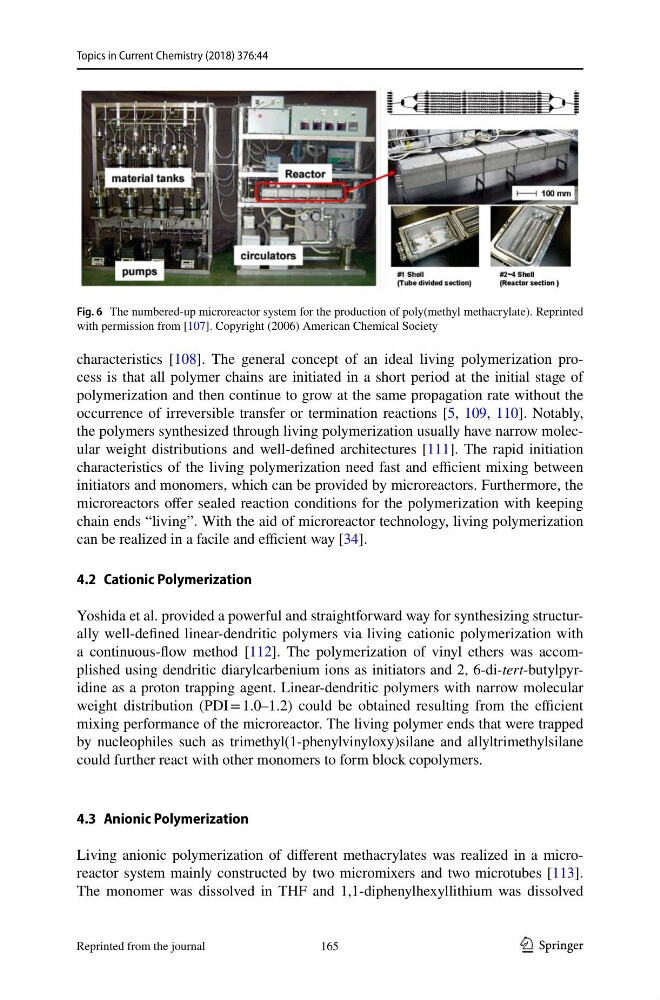
Fig. 6 The numbered-up microreactor system for the production of poly(methyl methacrylate). Reprinted
with permission from [107]. Copyright (2006) American Chemical Society
165
Reprinted from the journal
Topics in Current Chemistry (2018) 376:44
characteristics [108]. The general concept of an ideal living polymerization process is that all polymer chains are initiated in a short period at the initial stage of
polymerization and then continue to grow at the same propagation rate without the
occurrence of irreversible transfer or termination reactions [5, 109, 110]. Notably,
the polymers synthesized through living polymerization usually have narrow molecular weight distributions and well-defined architectures [111]. The rapid initiation
characteristics of the living polymerization need fast and efficient mixing between
initiators and monomers, which can be provided by microreactors. Furthermore, the
microreactors offer sealed reaction conditions for the polymerization with keeping
chain ends “living”. With the aid of microreactor technology, living polymerization
can be realized in a facile and efficient way [34].
4.2 Cationic Polymerization
Yoshida et al. provided a powerful and straightforward way for synthesizing structurally well-defined linear-dendritic polymers via living cationic polymerization with
a continuous-flow method [112]. The polymerization of vinyl ethers was accomplished using dendritic diarylcarbenium ions as initiators and 2, 6-di-tert-butylpyridine as a proton trapping agent. Linear-dendritic polymers with narrow molecular
weight distribution (PDI = 1.0–1.2) could be obtained resulting from the efficient
mixing performance of the microreactor. The living polymer ends that were trapped
by nucleophiles such as trimethyl(1-phenylvinyloxy)silane and allyltrimethylsilane
could further react with other monomers to form block copolymers.
4.3 Anionic Polymerization
Living anionic polymerization of different methacrylates was realized in a microreactor system mainly constructed by two micromixers and two microtubes [113].
The monomer was dissolved in THF and 1,1-diphenylhexyllithium was dissolved
Fig. 6 The numbered-up microreactor system for the production of poly(methyl methacrylate). Reprinted
with permission from [107]. Copyright (2006) American Chemical Society
165
Reprinted from the journal