

ℓ ei v
ð Þ ¼¼
1
8lnΛ
ℓ
R
90
ð2:4:20
0
Þ
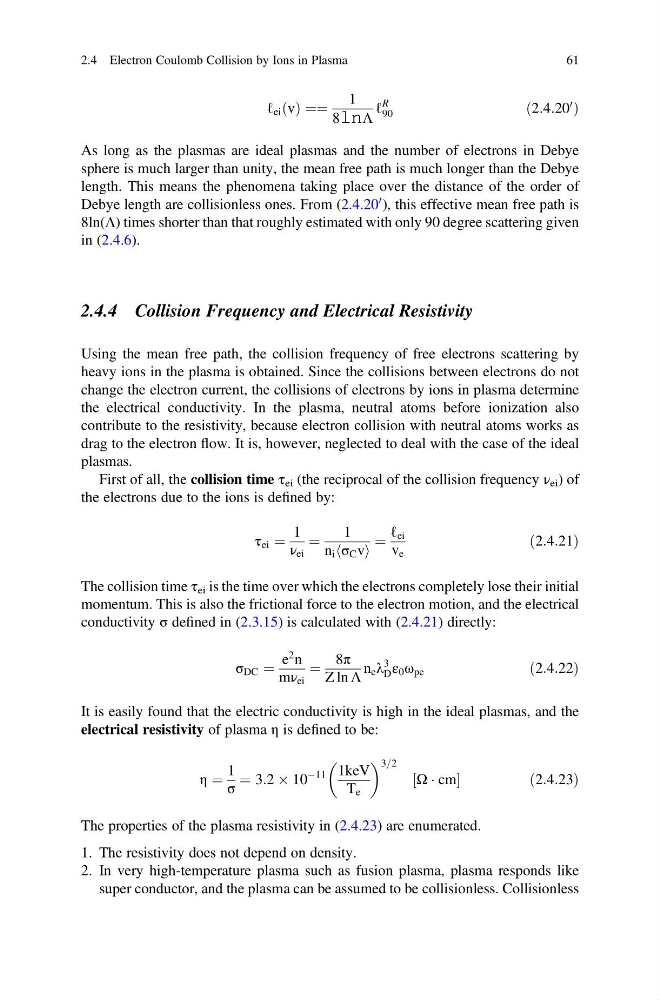
As long as the plasmas are ideal plasmas and the number of electrons in Debye
sphere is much larger than unity, the mean free path is much longer than the Debye
length. This means the phenomena taking place over the distance of the order of
Debye length are collisionless ones. From (2.4.20
0 ), this effective mean free path is
8ln(Λ) times shorter than that roughly estimated with only 90 degree scattering given
in (2.4.6).
2.4.4 Collision Frequency and Electrical Resistivity
Using the mean free path, the collision frequency of free electrons scattering by
heavy ions in the plasma is obtained. Since the collisions between electrons do not
change the electron current, the collisions of electrons by ions in plasma determine
the electrical conductivity. In the plasma, neutral atoms before ionization also
contribute to the resistivity, because electron collision with neutral atoms works as
drag to the electron flow. It is, however, neglected to deal with the case of the ideal
plasmas.
First of all, the collision time τ ei (the reciprocal of the collision frequency ν ei ) of
the electrons due to the ions is defined by:
τ ei ¼
1
ν ei
¼
1
n i σ C v
h
i
¼
ℓ ei
v e
ð2:4:21Þ
The collision time τ ei is the time over which the electrons completely lose their initial
momentum. This is also the frictional force to the electron motion, and the electrical
conductivity σ defined in (2.3.15) is calculated with (2.4.21) directly:
σ DC ¼
e
2 n
mν ei
¼
8π
Z ln Λ
n e λ
3
D ε 0 ω pe
ð2:4:22Þ
It is easily found that the electric conductivity is high in the ideal plasmas, and the
electrical resistivity of plasma η is defined to be:
η ¼
1
σ
¼ 3:2 Â 10
À11 1keV
T e
3=2
Ω Á cm
½
ð2:4:23Þ
The properties of the plasma resistivity in (2.4.23) are enumerated.
1. The resistivity does not depend on density.
2. In very high-temperature plasma such as fusion plasma, plasma responds like
super conductor, and the plasma can be assumed to be collisionless. Collisionless
2.4 Electron Coulomb Collision by Ions in Plasma
61
ð Þ ¼¼
1
8lnΛ
ℓ
R
90
ð2:4:20
0
Þ
As long as the plasmas are ideal plasmas and the number of electrons in Debye
sphere is much larger than unity, the mean free path is much longer than the Debye
length. This means the phenomena taking place over the distance of the order of
Debye length are collisionless ones. From (2.4.20
0 ), this effective mean free path is
8ln(Λ) times shorter than that roughly estimated with only 90 degree scattering given
in (2.4.6).
2.4.4 Collision Frequency and Electrical Resistivity
Using the mean free path, the collision frequency of free electrons scattering by
heavy ions in the plasma is obtained. Since the collisions between electrons do not
change the electron current, the collisions of electrons by ions in plasma determine
the electrical conductivity. In the plasma, neutral atoms before ionization also
contribute to the resistivity, because electron collision with neutral atoms works as
drag to the electron flow. It is, however, neglected to deal with the case of the ideal
plasmas.
First of all, the collision time τ ei (the reciprocal of the collision frequency ν ei ) of
the electrons due to the ions is defined by:
τ ei ¼
1
ν ei
¼
1
n i σ C v
h
i
¼
ℓ ei
v e
ð2:4:21Þ
The collision time τ ei is the time over which the electrons completely lose their initial
momentum. This is also the frictional force to the electron motion, and the electrical
conductivity σ defined in (2.3.15) is calculated with (2.4.21) directly:
σ DC ¼
e
2 n
mν ei
¼
8π
Z ln Λ
n e λ
3
D ε 0 ω pe
ð2:4:22Þ
It is easily found that the electric conductivity is high in the ideal plasmas, and the
electrical resistivity of plasma η is defined to be:
η ¼
1
σ
¼ 3:2 Â 10
À11 1keV
T e
3=2
Ω Á cm
½
ð2:4:23Þ
The properties of the plasma resistivity in (2.4.23) are enumerated.
1. The resistivity does not depend on density.
2. In very high-temperature plasma such as fusion plasma, plasma responds like
super conductor, and the plasma can be assumed to be collisionless. Collisionless
2.4 Electron Coulomb Collision by Ions in Plasma
61