

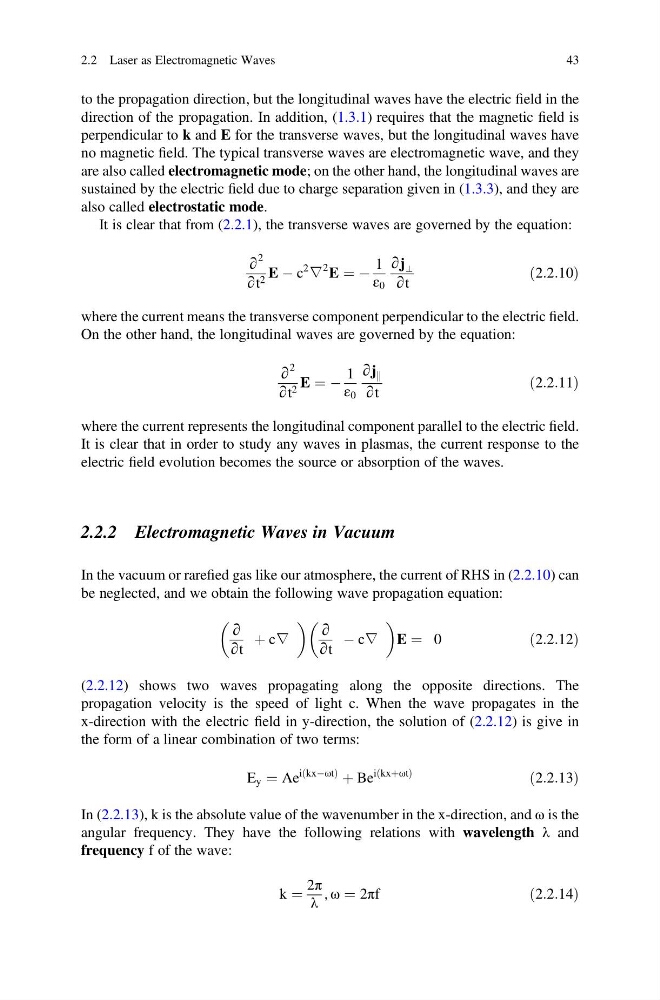
to the propagation direction, but the longitudinal waves have the electric field in the
direction of the propagation. In addition, (1.3.1) requires that the magnetic field is
perpendicular to k and E for the transverse waves, but the longitudinal waves have
no magnetic field. The typical transverse waves are electromagnetic wave, and they
are also called electromagnetic mode; on the other hand, the longitudinal waves are
sustained by the electric field due to charge separation given in (1.3.3), and they are
also called electrostatic mode.
It is clear that from (2.2.1), the transverse waves are governed by the equation:
∂
2
∂t 2 E À c
2
∇
2 E ¼ À
1
ε 0
∂j ⊥
∂t
ð2:2:10Þ
where the current means the transverse component perpendicular to the electric field.
On the other hand, the longitudinal waves are governed by the equation:
∂
2
∂t 2 E ¼ À
1
ε 0
∂j k
∂t
ð2:2:11Þ
where the current represents the longitudinal component parallel to the electric field.
It is clear that in order to study any waves in plasmas, the current response to the
electric field evolution becomes the source or absorption of the waves.
2.2.2 Electromagnetic Waves in Vacuum
In the vacuum or rarefied gas like our atmosphere, the current of RHS in (2.2.10) can
be neglected, and we obtain the following wave propagation equation:
∂
∂t
þ c∇
∂
∂t
À c∇
E ¼ 0
ð2:2:12Þ
(2.2.12) shows two waves propagating along the opposite directions. The
propagation velocity is the speed of light c. When the wave propagates in the
x-direction with the electric field in y-direction, the solution of (2.2.12) is give in
the form of a linear combination of two terms:
E y ¼ Ae
i kxÀωt
ð
Þ
þ Be
i kxþωt
ð
Þ
ð2:2:13Þ
In (2.2.13), k is the absolute value of the wavenumber in the x-direction, and ω is the
angular frequency. They have the following relations with wavelength λ and
frequency f of the wave:
k ¼
2π
λ
, ω ¼ 2πf
ð2:2:14Þ
2.2 Laser as Electromagnetic Waves
43
direction of the propagation. In addition, (1.3.1) requires that the magnetic field is
perpendicular to k and E for the transverse waves, but the longitudinal waves have
no magnetic field. The typical transverse waves are electromagnetic wave, and they
are also called electromagnetic mode; on the other hand, the longitudinal waves are
sustained by the electric field due to charge separation given in (1.3.3), and they are
also called electrostatic mode.
It is clear that from (2.2.1), the transverse waves are governed by the equation:
∂
2
∂t 2 E À c
2
∇
2 E ¼ À
1
ε 0
∂j ⊥
∂t
ð2:2:10Þ
where the current means the transverse component perpendicular to the electric field.
On the other hand, the longitudinal waves are governed by the equation:
∂
2
∂t 2 E ¼ À
1
ε 0
∂j k
∂t
ð2:2:11Þ
where the current represents the longitudinal component parallel to the electric field.
It is clear that in order to study any waves in plasmas, the current response to the
electric field evolution becomes the source or absorption of the waves.
2.2.2 Electromagnetic Waves in Vacuum
In the vacuum or rarefied gas like our atmosphere, the current of RHS in (2.2.10) can
be neglected, and we obtain the following wave propagation equation:
∂
∂t
þ c∇
∂
∂t
À c∇
E ¼ 0
ð2:2:12Þ
(2.2.12) shows two waves propagating along the opposite directions. The
propagation velocity is the speed of light c. When the wave propagates in the
x-direction with the electric field in y-direction, the solution of (2.2.12) is give in
the form of a linear combination of two terms:
E y ¼ Ae
i kxÀωt
ð
Þ
þ Be
i kxþωt
ð
Þ
ð2:2:13Þ
In (2.2.13), k is the absolute value of the wavenumber in the x-direction, and ω is the
angular frequency. They have the following relations with wavelength λ and
frequency f of the wave:
k ¼
2π
λ
, ω ¼ 2πf
ð2:2:14Þ
2.2 Laser as Electromagnetic Waves
43