

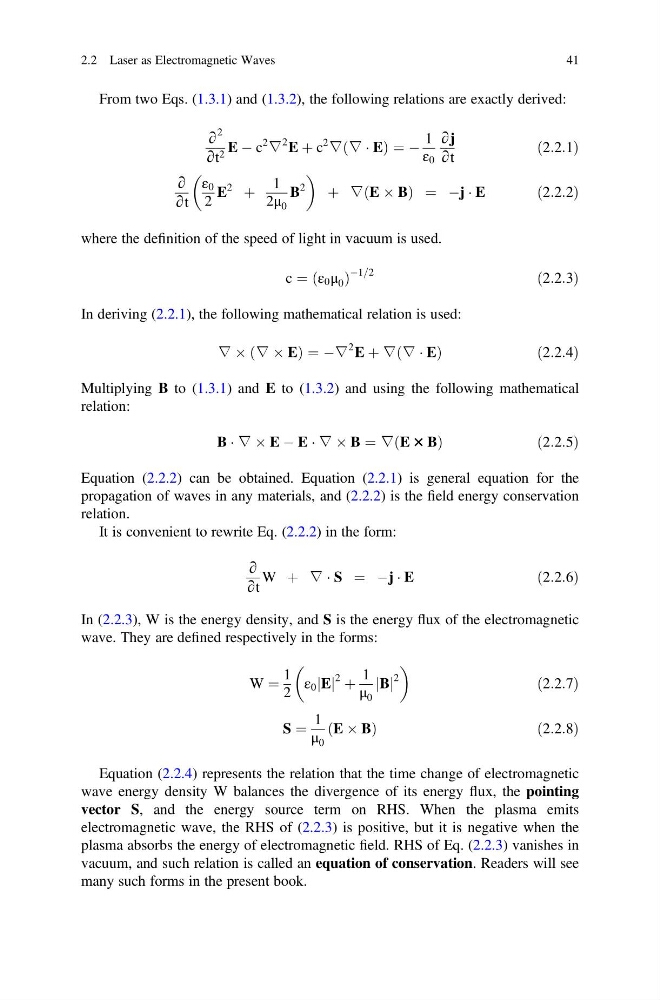
From two Eqs. (1.3.1) and (1.3.2), the following relations are exactly derived:
∂
2
∂t 2 E À c
2
∇
2 E þ c
2
∇ ∇ Á E
ð
޼1
ε 0
∂j
∂t
ð2:2:1Þ
∂
∂t
ε 0
2
E
2
þ
1
2μ 0
B
2
þ ∇ E Â B
ð
Þ ¼ Àj Á E
ð2:2:2Þ
where the definition of the speed of light in vacuum is used.
c ¼ ε 0 μ 0
ð
Þ
À1=2
ð2:2:3Þ
In deriving (2.2.1), the following mathematical relation is used:
∇ Â ∇ Â E
ð
Þ¼À∇
2 E þ ∇ ∇ Á E
ð
Þ
ð2:2:4Þ
Multiplying B to (1.3.1) and E to (1.3.2) and using the following mathematical
relation:
B Á ∇ Â E À E Á ∇ Â B ¼ ∇ E 3 B
ð
Þ
ð2:2:5Þ
Equation (2.2.2) can be obtained. Equation (2.2.1) is general equation for the
propagation of waves in any materials, and (2.2.2) is the field energy conservation
relation.
It is convenient to rewrite Eq. (2.2.2) in the form:
∂
∂t
W þ ∇ Á S ¼ Àj Á E
ð2:2:6Þ
In (2.2.3), W is the energy density, and S is the energy flux of the electromagnetic
wave. They are defined respectively in the forms:
W ¼
1
2
ε 0 E
j j
2 þ
1
μ 0
B
j j
2
ð2:2:7Þ
S ¼
1
μ 0
E Â B
ð
Þ
ð2:2:8Þ
Equation (2.2.4) represents the relation that the time change of electromagnetic
wave energy density W balances the divergence of its energy flux, the pointing
vector S, and the energy source term on RHS. When the plasma emits
electromagnetic wave, the RHS of (2.2.3) is positive, but it is negative when the
plasma absorbs the energy of electromagnetic field. RHS of Eq. (2.2.3) vanishes in
vacuum, and such relation is called an equation of conservation. Readers will see
many such forms in the present book.
2.2 Laser as Electromagnetic Waves
41
∂
2
∂t 2 E À c
2
∇
2 E þ c
2
∇ ∇ Á E
ð
޼1
ε 0
∂j
∂t
ð2:2:1Þ
∂
∂t
ε 0
2
E
2
þ
1
2μ 0
B
2
þ ∇ E Â B
ð
Þ ¼ Àj Á E
ð2:2:2Þ
where the definition of the speed of light in vacuum is used.
c ¼ ε 0 μ 0
ð
Þ
À1=2
ð2:2:3Þ
In deriving (2.2.1), the following mathematical relation is used:
∇ Â ∇ Â E
ð
Þ¼À∇
2 E þ ∇ ∇ Á E
ð
Þ
ð2:2:4Þ
Multiplying B to (1.3.1) and E to (1.3.2) and using the following mathematical
relation:
B Á ∇ Â E À E Á ∇ Â B ¼ ∇ E 3 B
ð
Þ
ð2:2:5Þ
Equation (2.2.2) can be obtained. Equation (2.2.1) is general equation for the
propagation of waves in any materials, and (2.2.2) is the field energy conservation
relation.
It is convenient to rewrite Eq. (2.2.2) in the form:
∂
∂t
W þ ∇ Á S ¼ Àj Á E
ð2:2:6Þ
In (2.2.3), W is the energy density, and S is the energy flux of the electromagnetic
wave. They are defined respectively in the forms:
W ¼
1
2
ε 0 E
j j
2 þ
1
μ 0
B
j j
2
ð2:2:7Þ
S ¼
1
μ 0
E Â B
ð
Þ
ð2:2:8Þ
Equation (2.2.4) represents the relation that the time change of electromagnetic
wave energy density W balances the divergence of its energy flux, the pointing
vector S, and the energy source term on RHS. When the plasma emits
electromagnetic wave, the RHS of (2.2.3) is positive, but it is negative when the
plasma absorbs the energy of electromagnetic field. RHS of Eq. (2.2.3) vanishes in
vacuum, and such relation is called an equation of conservation. Readers will see
many such forms in the present book.
2.2 Laser as Electromagnetic Waves
41