

The PIC codes have been developed soon after the invention of computer in the
1950s by Dawson et al. One of the first papers on laser plasma with PIC code was
published soon after the paper by Nuckolls in 1972. The PIC simulation has been
done with the code developed to study electron Weibel instability in
two-dimensional system. Due to the restriction of computer speed and memory at
that time, the space grid in x and y was 50 Â 50 and 10
5 giant particles, and the
calculation is 2000 times Δt. Even under such restriction of computer speed, the
physics are well obtained and compared to the corresponding theoretical results.
In order to study the physical phenomena with available computation time, giant
particles are used to represent N particles, each of which has a charge Nq and mass
Nm. For example, a solid foil with thickness 10 μm irradiated by laser with a
focusing diameter 10 μm contains 10
14 electrons and ions. This number is still a
big number for the top supercomputer today and a very huge number in the
beginning of PIC research in 1970–1980.
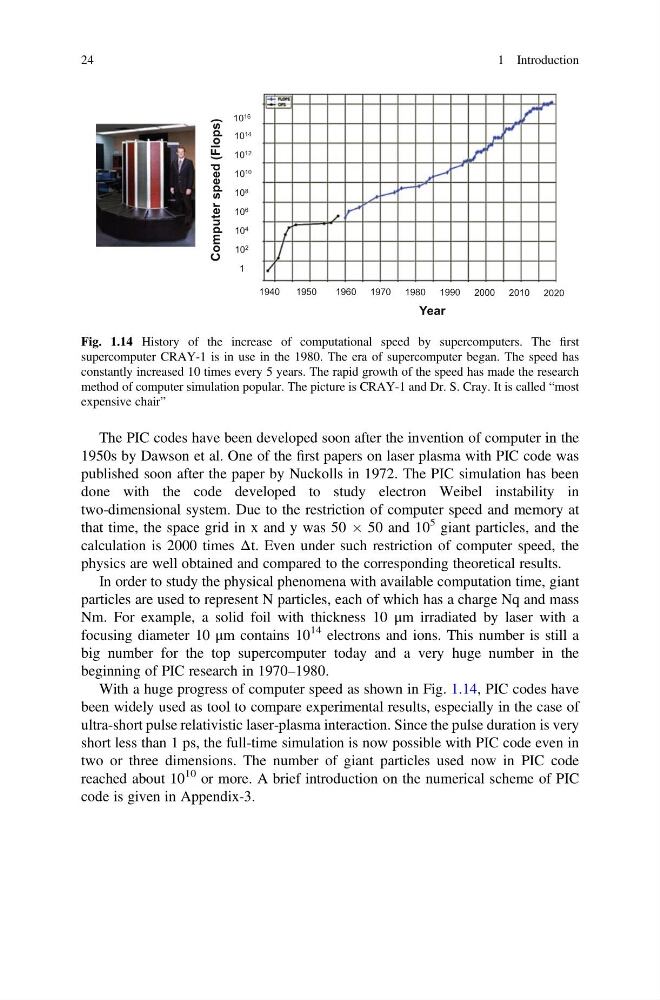
With a huge progress of computer speed as shown in Fig. 1.14, PIC codes have
been widely used as tool to compare experimental results, especially in the case of
ultra-short pulse relativistic laser-plasma interaction. Since the pulse duration is very
short less than 1 ps, the full-time simulation is now possible with PIC code even in
two or three dimensions. The number of giant particles used now in PIC code
reached about 10
10 or more. A brief introduction on the numerical scheme of PIC
code is given in Appendix-3.
2020
2010
2000
1990
1980
1970
1960
1940
1950
10 16
10 14
10 12
10 10
10 8
10 6
10 4
10 2
1
Computer speed (Flops)
Year
Fig. 1.14 History of the increase of computational speed by supercomputers. The first
supercomputer CRAY-1 is in use in the 1980. The era of supercomputer began. The speed has
constantly increased 10 times every 5 years. The rapid growth of the speed has made the research
method of computer simulation popular. The picture is CRAY-1 and Dr. S. Cray. It is called “most
expensive chair”
24
1 Introduction
1950s by Dawson et al. One of the first papers on laser plasma with PIC code was
published soon after the paper by Nuckolls in 1972. The PIC simulation has been
done with the code developed to study electron Weibel instability in
two-dimensional system. Due to the restriction of computer speed and memory at
that time, the space grid in x and y was 50 Â 50 and 10
5 giant particles, and the
calculation is 2000 times Δt. Even under such restriction of computer speed, the
physics are well obtained and compared to the corresponding theoretical results.
In order to study the physical phenomena with available computation time, giant
particles are used to represent N particles, each of which has a charge Nq and mass
Nm. For example, a solid foil with thickness 10 μm irradiated by laser with a
focusing diameter 10 μm contains 10
14 electrons and ions. This number is still a
big number for the top supercomputer today and a very huge number in the
beginning of PIC research in 1970–1980.
With a huge progress of computer speed as shown in Fig. 1.14, PIC codes have
been widely used as tool to compare experimental results, especially in the case of
ultra-short pulse relativistic laser-plasma interaction. Since the pulse duration is very
short less than 1 ps, the full-time simulation is now possible with PIC code even in
two or three dimensions. The number of giant particles used now in PIC code
reached about 10
10 or more. A brief introduction on the numerical scheme of PIC
code is given in Appendix-3.
2020
2010
2000
1990
1980
1970
1960
1940
1950
10 16
10 14
10 12
10 10
10 8
10 6
10 4
10 2
1
Computer speed (Flops)
Year
Fig. 1.14 History of the increase of computational speed by supercomputers. The first
supercomputer CRAY-1 is in use in the 1980. The era of supercomputer began. The speed has
constantly increased 10 times every 5 years. The rapid growth of the speed has made the research
method of computer simulation popular. The picture is CRAY-1 and Dr. S. Cray. It is called “most
expensive chair”
24
1 Introduction