

change the value of α much smaller than unity as clear from (1.5.2). Note that α ¼ 1
is the case of adiabatic interaction allowing the initial condition, p x (0) ¼ 0. In
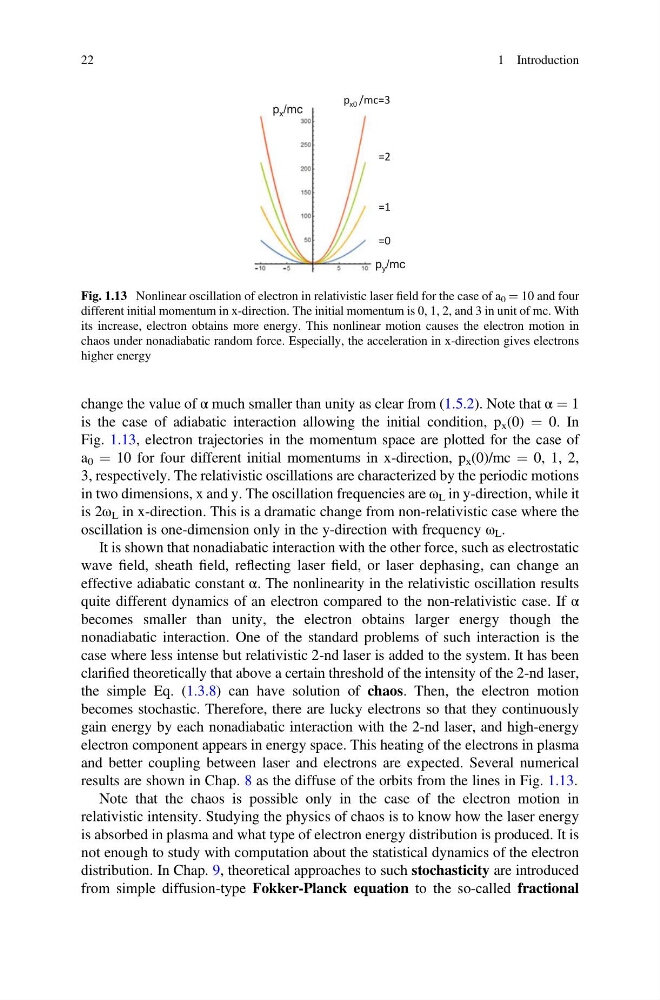
Fig. 1.13, electron trajectories in the momentum space are plotted for the case of
a 0 ¼ 10 for four different initial momentums in x-direction, p x (0)/mc ¼ 0, 1, 2,
3, respectively. The relativistic oscillations are characterized by the periodic motions
in two dimensions, x and y. The oscillation frequencies are ω L in y-direction, while it
is 2ω L in x-direction. This is a dramatic change from non-relativistic case where the
oscillation is one-dimension only in the y-direction with frequency ω L .
It is shown that nonadiabatic interaction with the other force, such as electrostatic
wave field, sheath field, reflecting laser field, or laser dephasing, can change an
effective adiabatic constant α. The nonlinearity in the relativistic oscillation results
quite different dynamics of an electron compared to the non-relativistic case. If α
becomes smaller than unity, the electron obtains larger energy though the
nonadiabatic interaction. One of the standard problems of such interaction is the
case where less intense but relativistic 2-nd laser is added to the system. It has been
clarified theoretically that above a certain threshold of the intensity of the 2-nd laser,
the simple Eq. (1.3.8) can have solution of chaos. Then, the electron motion
becomes stochastic. Therefore, there are lucky electrons so that they continuously
gain energy by each nonadiabatic interaction with the 2-nd laser, and high-energy
electron component appears in energy space. This heating of the electrons in plasma
and better coupling between laser and electrons are expected. Several numerical
results are shown in Chap. 8 as the diffuse of the orbits from the lines in Fig. 1.13.
Note that the chaos is possible only in the case of the electron motion in
relativistic intensity. Studying the physics of chaos is to know how the laser energy
is absorbed in plasma and what type of electron energy distribution is produced. It is
not enough to study with computation about the statistical dynamics of the electron
distribution. In Chap. 9, theoretical approaches to such stochasticity are introduced
from simple diffusion-type Fokker-Planck equation to the so-called fractional
p y /mc
p x0 /mc=3
=2
=1
=0
p x /mc
Fig. 1.13 Nonlinear oscillation of electron in relativistic laser field for the case of a 0 ¼ 10 and four
different initial momentum in x-direction. The initial momentum is 0, 1, 2, and 3 in unit of mc. With
its increase, electron obtains more energy. This nonlinear motion causes the electron motion in
chaos under nonadiabatic random force. Especially, the acceleration in x-direction gives electrons
higher energy
22
1 Introduction
is the case of adiabatic interaction allowing the initial condition, p x (0) ¼ 0. In
Fig. 1.13, electron trajectories in the momentum space are plotted for the case of
a 0 ¼ 10 for four different initial momentums in x-direction, p x (0)/mc ¼ 0, 1, 2,
3, respectively. The relativistic oscillations are characterized by the periodic motions
in two dimensions, x and y. The oscillation frequencies are ω L in y-direction, while it
is 2ω L in x-direction. This is a dramatic change from non-relativistic case where the
oscillation is one-dimension only in the y-direction with frequency ω L .
It is shown that nonadiabatic interaction with the other force, such as electrostatic
wave field, sheath field, reflecting laser field, or laser dephasing, can change an
effective adiabatic constant α. The nonlinearity in the relativistic oscillation results
quite different dynamics of an electron compared to the non-relativistic case. If α
becomes smaller than unity, the electron obtains larger energy though the
nonadiabatic interaction. One of the standard problems of such interaction is the
case where less intense but relativistic 2-nd laser is added to the system. It has been
clarified theoretically that above a certain threshold of the intensity of the 2-nd laser,
the simple Eq. (1.3.8) can have solution of chaos. Then, the electron motion
becomes stochastic. Therefore, there are lucky electrons so that they continuously
gain energy by each nonadiabatic interaction with the 2-nd laser, and high-energy
electron component appears in energy space. This heating of the electrons in plasma
and better coupling between laser and electrons are expected. Several numerical
results are shown in Chap. 8 as the diffuse of the orbits from the lines in Fig. 1.13.
Note that the chaos is possible only in the case of the electron motion in
relativistic intensity. Studying the physics of chaos is to know how the laser energy
is absorbed in plasma and what type of electron energy distribution is produced. It is
not enough to study with computation about the statistical dynamics of the electron
distribution. In Chap. 9, theoretical approaches to such stochasticity are introduced
from simple diffusion-type Fokker-Planck equation to the so-called fractional
p y /mc
p x0 /mc=3
=2
=1
=0
p x /mc
Fig. 1.13 Nonlinear oscillation of electron in relativistic laser field for the case of a 0 ¼ 10 and four
different initial momentum in x-direction. The initial momentum is 0, 1, 2, and 3 in unit of mc. With
its increase, electron obtains more energy. This nonlinear motion causes the electron motion in
chaos under nonadiabatic random force. Especially, the acceleration in x-direction gives electrons
higher energy
22
1 Introduction