

this wave is 180 degree dephasing to the laser field to prevent the penetration of laser
into the over region. In addition, the generated wave also propagates to the vacuum
as reflected wave from the cut-off density layer.
The fact that the plasma is a kind of resonator indicates that a resonant interaction
may happen at the point of the cut-off density in an inhomogeneous plasma. Then, it
is natural to expect that the laser energy is converted to the energy of plasma
oscillation due to resonant coupling. This is called resonant absorption and
discussed in Chap. 3. Resonantly excited plasma wave becomes large amplitude,
and the so-called wave-breaking happens to generate hot electrons.
In the laser-plasma interaction, nonlinear laser force should be taken into account
for the case where the laser intensity is high, and its energy density is comparable to
the plasma energy density. This effect is derived to be a form of pressure or force. It
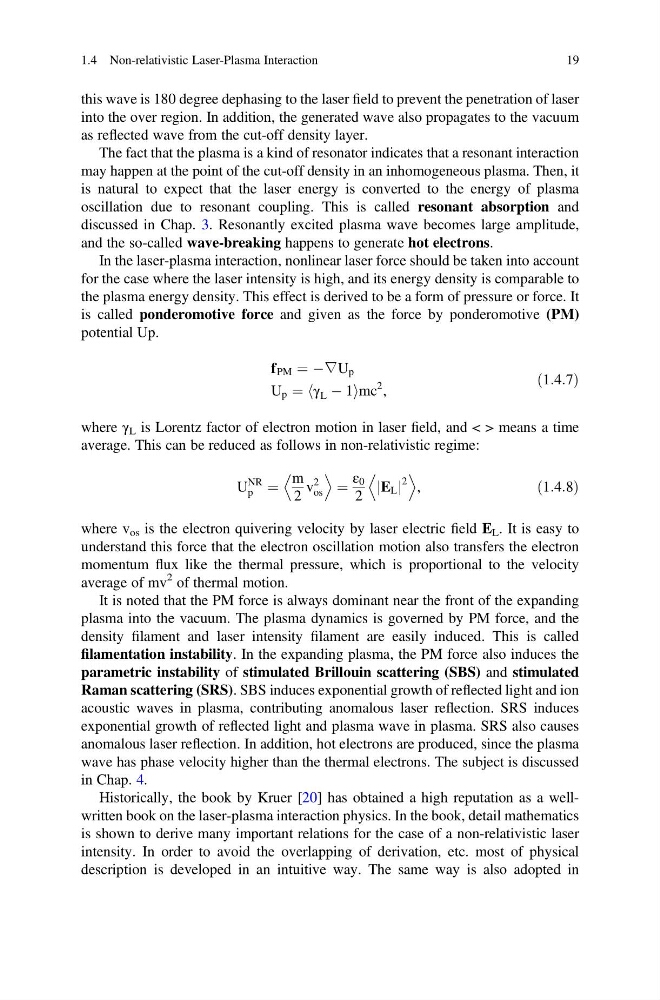
is called ponderomotive force and given as the force by ponderomotive (PM)
potential Up.
f PM ¼ À∇U p
U p ¼ γ L À 1
h
imc
2 ,
ð1:4:7Þ
where γ L is Lorentz factor of electron motion in laser field, and < > means a time
average. This can be reduced as follows in non-relativistic regime:
U
NR
p ¼
m
2
v
2
os
D
E
¼
ε 0
2
E L
j j
2
D
E
,
ð1:4:8Þ
where v os is the electron quivering velocity by laser electric field E L . It is easy to
understand this force that the electron oscillation motion also transfers the electron
momentum flux like the thermal pressure, which is proportional to the velocity
average of mv
2 of thermal motion.
It is noted that the PM force is always dominant near the front of the expanding
plasma into the vacuum. The plasma dynamics is governed by PM force, and the
density filament and laser intensity filament are easily induced. This is called
filamentation instability. In the expanding plasma, the PM force also induces the
parametric instability of stimulated Brillouin scattering (SBS) and stimulated
Raman scattering (SRS). SBS induces exponential growth of reflected light and ion
acoustic waves in plasma, contributing anomalous laser reflection. SRS induces
exponential growth of reflected light and plasma wave in plasma. SRS also causes
anomalous laser reflection. In addition, hot electrons are produced, since the plasma
wave has phase velocity higher than the thermal electrons. The subject is discussed
in Chap. 4.
Historically, the book by Kruer [20] has obtained a high reputation as a wellwritten book on the laser-plasma interaction physics. In the book, detail mathematics
is shown to derive many important relations for the case of a non-relativistic laser
intensity. In order to avoid the overlapping of derivation, etc. most of physical
description is developed in an intuitive way. The same way is also adopted in
1.4 Non-relativistic Laser-Plasma Interaction
19
into the over region. In addition, the generated wave also propagates to the vacuum
as reflected wave from the cut-off density layer.
The fact that the plasma is a kind of resonator indicates that a resonant interaction
may happen at the point of the cut-off density in an inhomogeneous plasma. Then, it
is natural to expect that the laser energy is converted to the energy of plasma
oscillation due to resonant coupling. This is called resonant absorption and
discussed in Chap. 3. Resonantly excited plasma wave becomes large amplitude,
and the so-called wave-breaking happens to generate hot electrons.
In the laser-plasma interaction, nonlinear laser force should be taken into account
for the case where the laser intensity is high, and its energy density is comparable to
the plasma energy density. This effect is derived to be a form of pressure or force. It
is called ponderomotive force and given as the force by ponderomotive (PM)
potential Up.
f PM ¼ À∇U p
U p ¼ γ L À 1
h
imc
2 ,
ð1:4:7Þ
where γ L is Lorentz factor of electron motion in laser field, and < > means a time
average. This can be reduced as follows in non-relativistic regime:
U
NR
p ¼
m
2
v
2
os
D
E
¼
ε 0
2
E L
j j
2
D
E
,
ð1:4:8Þ
where v os is the electron quivering velocity by laser electric field E L . It is easy to
understand this force that the electron oscillation motion also transfers the electron
momentum flux like the thermal pressure, which is proportional to the velocity
average of mv
2 of thermal motion.
It is noted that the PM force is always dominant near the front of the expanding
plasma into the vacuum. The plasma dynamics is governed by PM force, and the
density filament and laser intensity filament are easily induced. This is called
filamentation instability. In the expanding plasma, the PM force also induces the
parametric instability of stimulated Brillouin scattering (SBS) and stimulated
Raman scattering (SRS). SBS induces exponential growth of reflected light and ion
acoustic waves in plasma, contributing anomalous laser reflection. SRS induces
exponential growth of reflected light and plasma wave in plasma. SRS also causes
anomalous laser reflection. In addition, hot electrons are produced, since the plasma
wave has phase velocity higher than the thermal electrons. The subject is discussed
in Chap. 4.
Historically, the book by Kruer [20] has obtained a high reputation as a wellwritten book on the laser-plasma interaction physics. In the book, detail mathematics
is shown to derive many important relations for the case of a non-relativistic laser
intensity. In order to avoid the overlapping of derivation, etc. most of physical
description is developed in an intuitive way. The same way is also adopted in
1.4 Non-relativistic Laser-Plasma Interaction
19