

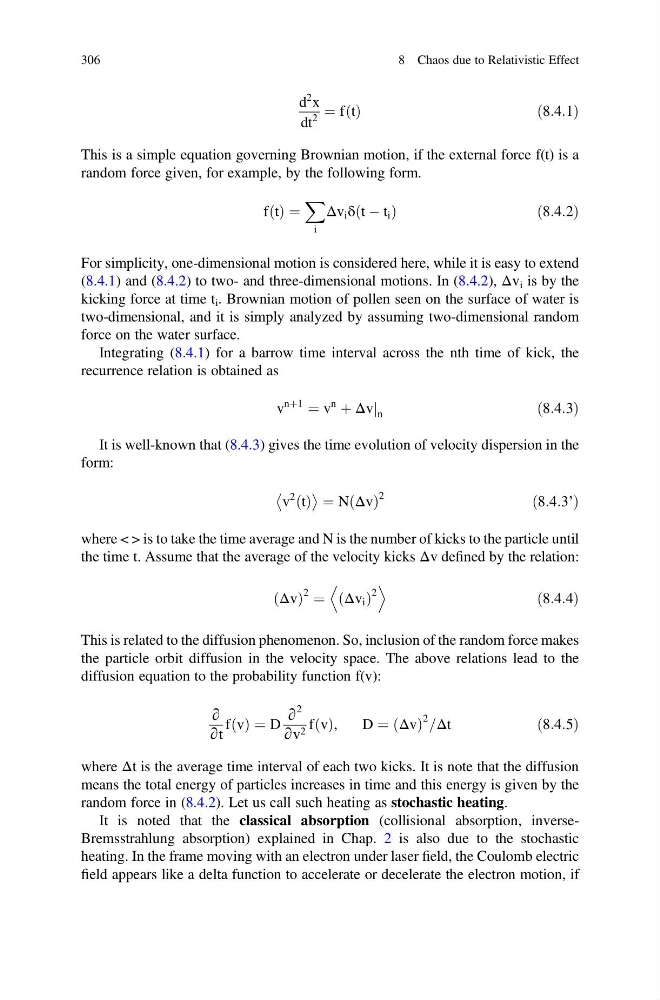
d
2 x
dt
2
¼ f t
ð Þ
ð8:4:1Þ
This is a simple equation governing Brownian motion, if the external force f(t) is a
random force given, for example, by the following form.
f t
ð Þ ¼
X
i
Δv i δ t À t i
ð
Þ
ð8:4:2Þ
For simplicity, one-dimensional motion is considered here, while it is easy to extend
(8.4.1) and (8.4.2) to two- and three-dimensional motions. In (8.4.2), Δv i is by the
kicking force at time t i . Brownian motion of pollen seen on the surface of water is
two-dimensional, and it is simply analyzed by assuming two-dimensional random
force on the water surface.
Integrating (8.4.1) for a barrow time interval across the nth time of kick, the
recurrence relation is obtained as
v
nþ1
¼ v
n
þ Δvj n
ð8:4:3Þ
It is well-known that (8.4.3) gives the time evolution of velocity dispersion in the
form:
v
2 t
ð Þ
¼ N Δv
ð Þ
2
ð8:4:3’Þ
where < > is to take the time average and N is the number of kicks to the particle until
the time t. Assume that the average of the velocity kicks Δv defined by the relation:
Δv
ð Þ
2 ¼ Δv i
ð Þ
2
D
E
ð8:4:4Þ
This is related to the diffusion phenomenon. So, inclusion of the random force makes
the particle orbit diffusion in the velocity space. The above relations lead to the
diffusion equation to the probability function f(v):
∂
∂t
f v
ð Þ ¼ D
∂
2
∂v 2 f v
ð Þ,
D ¼ Δv
ð Þ
2 =Δt
ð8:4:5Þ
where Δt is the average time interval of each two kicks. It is note that the diffusion
means the total energy of particles increases in time and this energy is given by the
random force in (8.4.2). Let us call such heating as stochastic heating.
It is noted that the classical absorption (collisional absorption, inverseBremsstrahlung absorption) explained in Chap. 2 is also due to the stochastic
heating. In the frame moving with an electron under laser field, the Coulomb electric
field appears like a delta function to accelerate or decelerate the electron motion, if
306
8 Chaos due to Relativistic Effect
2 x
dt
2
¼ f t
ð Þ
ð8:4:1Þ
This is a simple equation governing Brownian motion, if the external force f(t) is a
random force given, for example, by the following form.
f t
ð Þ ¼
X
i
Δv i δ t À t i
ð
Þ
ð8:4:2Þ
For simplicity, one-dimensional motion is considered here, while it is easy to extend
(8.4.1) and (8.4.2) to two- and three-dimensional motions. In (8.4.2), Δv i is by the
kicking force at time t i . Brownian motion of pollen seen on the surface of water is
two-dimensional, and it is simply analyzed by assuming two-dimensional random
force on the water surface.
Integrating (8.4.1) for a barrow time interval across the nth time of kick, the
recurrence relation is obtained as
v
nþ1
¼ v
n
þ Δvj n
ð8:4:3Þ
It is well-known that (8.4.3) gives the time evolution of velocity dispersion in the
form:
v
2 t
ð Þ
¼ N Δv
ð Þ
2
ð8:4:3’Þ
where < > is to take the time average and N is the number of kicks to the particle until
the time t. Assume that the average of the velocity kicks Δv defined by the relation:
Δv
ð Þ
2 ¼ Δv i
ð Þ
2
D
E
ð8:4:4Þ
This is related to the diffusion phenomenon. So, inclusion of the random force makes
the particle orbit diffusion in the velocity space. The above relations lead to the
diffusion equation to the probability function f(v):
∂
∂t
f v
ð Þ ¼ D
∂
2
∂v 2 f v
ð Þ,
D ¼ Δv
ð Þ
2 =Δt
ð8:4:5Þ
where Δt is the average time interval of each two kicks. It is note that the diffusion
means the total energy of particles increases in time and this energy is given by the
random force in (8.4.2). Let us call such heating as stochastic heating.
It is noted that the classical absorption (collisional absorption, inverseBremsstrahlung absorption) explained in Chap. 2 is also due to the stochastic
heating. In the frame moving with an electron under laser field, the Coulomb electric
field appears like a delta function to accelerate or decelerate the electron motion, if
306
8 Chaos due to Relativistic Effect