

3.5 μm in diameter, peak intensity 2 Â 10
20 W/cm
2 (a 0 ¼ 10). The linearly polarized
light is irradiated normally on the targets. The targets are a double-layer target with
nanometer thin diamond-like carbon coated with carbon nanotube foam with near
critical density. It is concluded that with use of near critical foam layer on a thin layer
solid target, the maximum energy of proton beam is significantly enhanced from
12 MeV to 30 MeV in the experiment. This values well coincide with the results
shown in Fig. 7.25, for example. Note that the laser and target conditions of the
simulation and experiment are very similar.
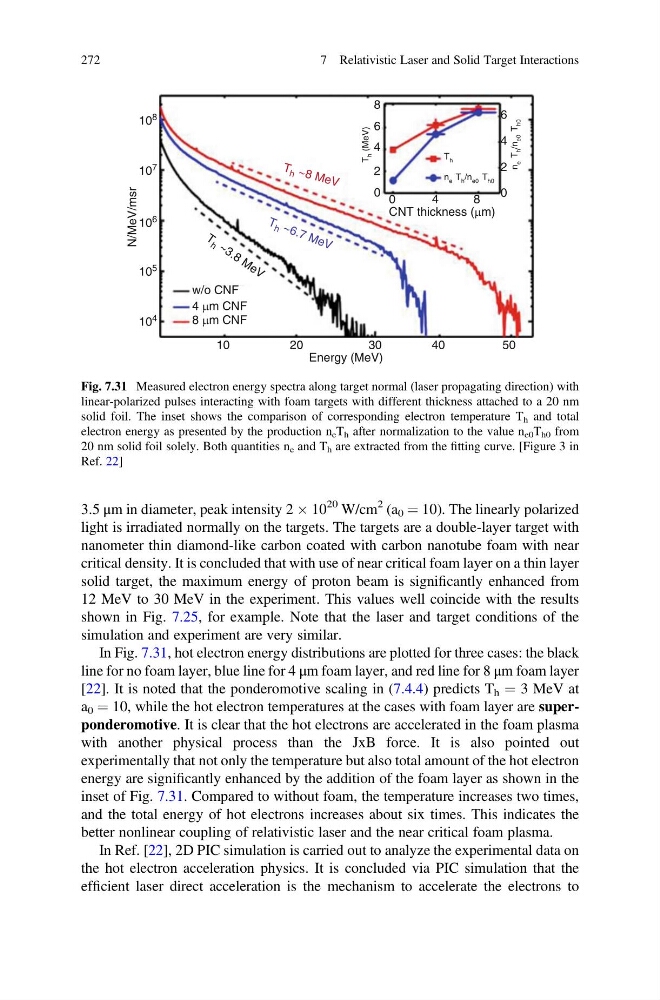
In Fig. 7.31, hot electron energy distributions are plotted for three cases: the black
line for no foam layer, blue line for 4 μm foam layer, and red line for 8 μm foam layer
[22]. It is noted that the ponderomotive scaling in (7.4.4) predicts T h ¼ 3 MeV at
a 0 ¼ 10, while the hot electron temperatures at the cases with foam layer are superponderomotive. It is clear that the hot electrons are accelerated in the foam plasma
with another physical process than the JxB force. It is also pointed out
experimentally that not only the temperature but also total amount of the hot electron
energy are significantly enhanced by the addition of the foam layer as shown in the
inset of Fig. 7.31. Compared to without foam, the temperature increases two times,
and the total energy of hot electrons increases about six times. This indicates the
better nonlinear coupling of relativistic laser and the near critical foam plasma.
In Ref. [22], 2D PIC simulation is carried out to analyze the experimental data on
the hot electron acceleration physics. It is concluded via PIC simulation that the
efficient laser direct acceleration is the mechanism to accelerate the electrons to
10 8
8
6
4
2
0
T h ~ 8 M e V
T h ~ 6 .7 M e V
T
h ~ 3 . 8 M e V
0
CNT thickness (μm)
T h
n e T h /n e0 T h0
n
e T
h /n
e0 T
h0
T
h (MeV)
4
8
0
2
4
6
10
7
10 6
10
5
10
4
10
w/o CNF
4 μm CNF
8 μm CNF
20
30
40
Energy (MeV)
N/MeV/msr
50
Fig. 7.31 Measured electron energy spectra along target normal (laser propagating direction) with
linear-polarized pulses interacting with foam targets with different thickness attached to a 20 nm
solid foil. The inset shows the comparison of corresponding electron temperature T h and total
electron energy as presented by the production n e T h after normalization to the value n e0 T h0 from
20 nm solid foil solely. Both quantities n e and T h are extracted from the fitting curve. [Figure 3 in
Ref. 22]
272
7 Relativistic Laser and Solid Target Interactions
20 W/cm
2 (a 0 ¼ 10). The linearly polarized
light is irradiated normally on the targets. The targets are a double-layer target with
nanometer thin diamond-like carbon coated with carbon nanotube foam with near
critical density. It is concluded that with use of near critical foam layer on a thin layer
solid target, the maximum energy of proton beam is significantly enhanced from
12 MeV to 30 MeV in the experiment. This values well coincide with the results
shown in Fig. 7.25, for example. Note that the laser and target conditions of the
simulation and experiment are very similar.
In Fig. 7.31, hot electron energy distributions are plotted for three cases: the black
line for no foam layer, blue line for 4 μm foam layer, and red line for 8 μm foam layer
[22]. It is noted that the ponderomotive scaling in (7.4.4) predicts T h ¼ 3 MeV at
a 0 ¼ 10, while the hot electron temperatures at the cases with foam layer are superponderomotive. It is clear that the hot electrons are accelerated in the foam plasma
with another physical process than the JxB force. It is also pointed out
experimentally that not only the temperature but also total amount of the hot electron
energy are significantly enhanced by the addition of the foam layer as shown in the
inset of Fig. 7.31. Compared to without foam, the temperature increases two times,
and the total energy of hot electrons increases about six times. This indicates the
better nonlinear coupling of relativistic laser and the near critical foam plasma.
In Ref. [22], 2D PIC simulation is carried out to analyze the experimental data on
the hot electron acceleration physics. It is concluded via PIC simulation that the
efficient laser direct acceleration is the mechanism to accelerate the electrons to
10 8
8
6
4
2
0
T h ~ 8 M e V
T h ~ 6 .7 M e V
T
h ~ 3 . 8 M e V
0
CNT thickness (μm)
T h
n e T h /n e0 T h0
n
e T
h /n
e0 T
h0
T
h (MeV)
4
8
0
2
4
6
10
7
10 6
10
5
10
4
10
w/o CNF
4 μm CNF
8 μm CNF
20
30
40
Energy (MeV)
N/MeV/msr
50
Fig. 7.31 Measured electron energy spectra along target normal (laser propagating direction) with
linear-polarized pulses interacting with foam targets with different thickness attached to a 20 nm
solid foil. The inset shows the comparison of corresponding electron temperature T h and total
electron energy as presented by the production n e T h after normalization to the value n e0 T h0 from
20 nm solid foil solely. Both quantities n e and T h are extracted from the fitting curve. [Figure 3 in
Ref. 22]
272
7 Relativistic Laser and Solid Target Interactions