

transition means rapid increase of free electrons. In high density, the electron wave
functions of the upper energy levels of bound state overlap with those of nearby
electrons; consequently such electrons become free electrons, and g(ε) of the bound
state consists of only the ground state and a few lower states. The number of bound
state becomes smaller than the number of electrons per an atom even at T ¼ 0, and
the other electrons become free. Such ionization at high pressure is called pressure
ionization as discussed in Volume 2.
In analyzing the plasma state, the local thermodynamic equilibrium (LTE)
assumption is usually employed as above. In LTE assumption, the thermodynamic
and transport properties of plasma are assumed to be only the function of
temperature and density. The advantage of LTE assumption is that it is appropriate
to describe simple plasma, and theoretical analysis is simple compared to the case of
non-LTE plasma. The readers are always careful about these differences in
considering the laser-produced plasmas. Non-LTE assumption becomes essential
for the laser plasma in low-density region such as expanding ablation plasma.
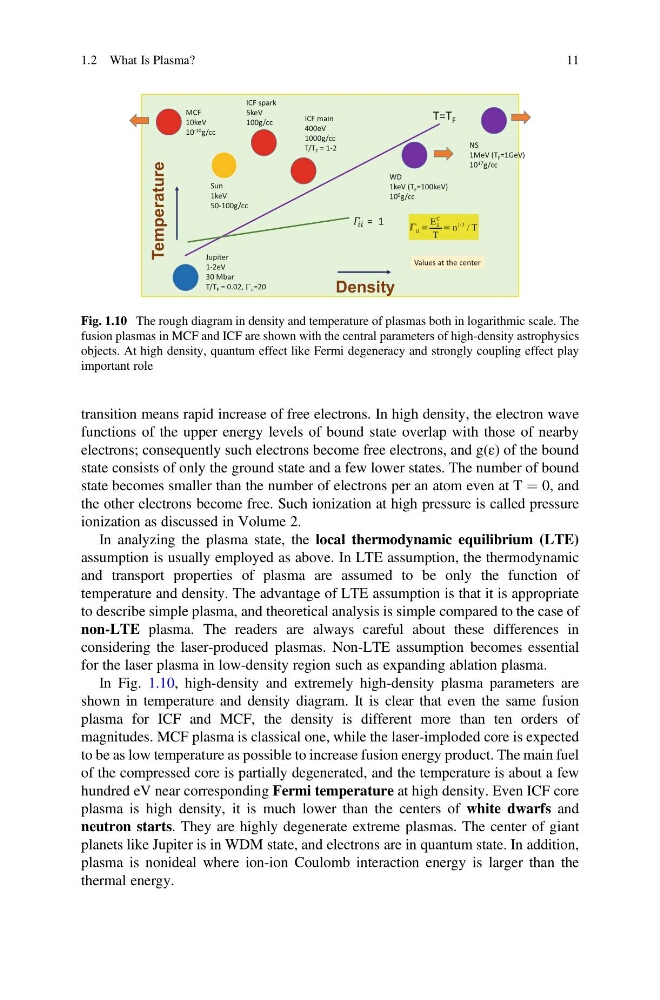
In Fig. 1.10, high-density and extremely high-density plasma parameters are
shown in temperature and density diagram. It is clear that even the same fusion
plasma for ICF and MCF, the density is different more than ten orders of
magnitudes. MCF plasma is classical one, while the laser-imploded core is expected
to be as low temperature as possible to increase fusion energy product. The main fuel
of the compressed core is partially degenerated, and the temperature is about a few
hundred eV near corresponding Fermi temperature at high density. Even ICF core
plasma is high density, it is much lower than the centers of white dwarfs and
neutron starts. They are highly degenerate extreme plasmas. The center of giant
planets like Jupiter is in WDM state, and electrons are in quantum state. In addition,
plasma is nonideal where ion-ion Coulomb interaction energy is larger than the
thermal energy.
Density
Temperature
Jupiter
1-2eV
30 Mbar
T/T F = 0.02, G ii =20
Sun
1keV
50-100g/cc
ICF spark
5keV
100g/cc
ICF main
400eV
1000g/cc
T/T F = 1-2
WD
1keV (T F =100keV)
10 9 g/cc
NS
1MeV (T F =1GeV)
10 17 g/cc
Values at the center
T=T F
= 1
C
1/3
ii
ii
E
n /T
T
1/3
ii
ii
E
n / T
T
MCF
10keV
10 -10 g/cc
Fig. 1.10 The rough diagram in density and temperature of plasmas both in logarithmic scale. The
fusion plasmas in MCF and ICF are shown with the central parameters of high-density astrophysics
objects. At high density, quantum effect like Fermi degeneracy and strongly coupling effect play
important role
1.2 What Is Plasma?
11
functions of the upper energy levels of bound state overlap with those of nearby
electrons; consequently such electrons become free electrons, and g(ε) of the bound
state consists of only the ground state and a few lower states. The number of bound
state becomes smaller than the number of electrons per an atom even at T ¼ 0, and
the other electrons become free. Such ionization at high pressure is called pressure
ionization as discussed in Volume 2.
In analyzing the plasma state, the local thermodynamic equilibrium (LTE)
assumption is usually employed as above. In LTE assumption, the thermodynamic
and transport properties of plasma are assumed to be only the function of
temperature and density. The advantage of LTE assumption is that it is appropriate
to describe simple plasma, and theoretical analysis is simple compared to the case of
non-LTE plasma. The readers are always careful about these differences in
considering the laser-produced plasmas. Non-LTE assumption becomes essential
for the laser plasma in low-density region such as expanding ablation plasma.
In Fig. 1.10, high-density and extremely high-density plasma parameters are
shown in temperature and density diagram. It is clear that even the same fusion
plasma for ICF and MCF, the density is different more than ten orders of
magnitudes. MCF plasma is classical one, while the laser-imploded core is expected
to be as low temperature as possible to increase fusion energy product. The main fuel
of the compressed core is partially degenerated, and the temperature is about a few
hundred eV near corresponding Fermi temperature at high density. Even ICF core
plasma is high density, it is much lower than the centers of white dwarfs and
neutron starts. They are highly degenerate extreme plasmas. The center of giant
planets like Jupiter is in WDM state, and electrons are in quantum state. In addition,
plasma is nonideal where ion-ion Coulomb interaction energy is larger than the
thermal energy.
Density
Temperature
Jupiter
1-2eV
30 Mbar
T/T F = 0.02, G ii =20
Sun
1keV
50-100g/cc
ICF spark
5keV
100g/cc
ICF main
400eV
1000g/cc
T/T F = 1-2
WD
1keV (T F =100keV)
10 9 g/cc
NS
1MeV (T F =1GeV)
10 17 g/cc
Values at the center
T=T F
= 1
C
1/3
ii
ii
E
n /T
T
1/3
ii
ii
E
n / T
T
MCF
10keV
10 -10 g/cc
Fig. 1.10 The rough diagram in density and temperature of plasmas both in logarithmic scale. The
fusion plasmas in MCF and ICF are shown with the central parameters of high-density astrophysics
objects. At high density, quantum effect like Fermi degeneracy and strongly coupling effect play
important role
1.2 What Is Plasma?
11