

1 À R
ð
Þ 1 À β p
I L ¼ γ h À 1
ð
Þm e n h c
3
þ γ i À 1
ð
ÞMn i β p c
3
ð7:6:1Þ
1 þ R
ð
Þ 1 À β p
I L
c
¼ γ h m e n h c
2
þ γ i Mn i u i c,
ð7:6:2Þ
where R, β p , I L , n h , n i , and u i are reflection fraction, hole-boring piston velocity
divided by c, incident laser intensity, hot electron density, ion density, and ion
velocity, respectively, and M ¼ m i + Zm e . In both relations, γ i and γ h are Lorentz
factors of hot electrons and ion motion, respectively. Equation (7.6.1) is the
conservation law of energy flux, where LHS is the absorbed laser energy flux, the
1st term in RHS is the hot electron energy flux, and the 2nd term is the ion energy
flux. Equation (7.6.2) represents the momentum flux conservation by these three
components.
It should be noted that the coupled relations (7.6.1) and (7.6.2) can be reduced to
the forms of energy conversion rates to the hole-boring ions (f i ) and hot electrons
(f h ), while they are given as functions of not only the incident laser intensity but also
the laser reflection fraction and the plasma densities. The absorption fraction
f abs ¼ f i + f h has been obtained for various target condition and is plotted in
Fig. 7.21, where the red and blue zones are forbidden region in the theory. In
addition, it is clarified in [16] that the energy conversion to the hole-boring ions is
enhanced at lower-density target. In addition, the energy conversion to the hot
electron is high as long as the laser intensity is high enough. Typical experimental
data and PIC simulation results summarized in [17] are also plotted in Fig. 7.21. In
this chapter, it is clarified that the absorption efficiency is very sensitive to the
n 0 >n c
z
ls=γ e
1/2 xc/ω pe
x
d n
0 / d x
>
0
y
Hole punching ions, γ i
Hot electrons, γ e
Reflected wave (1-f) I 1
Incident wave I 1
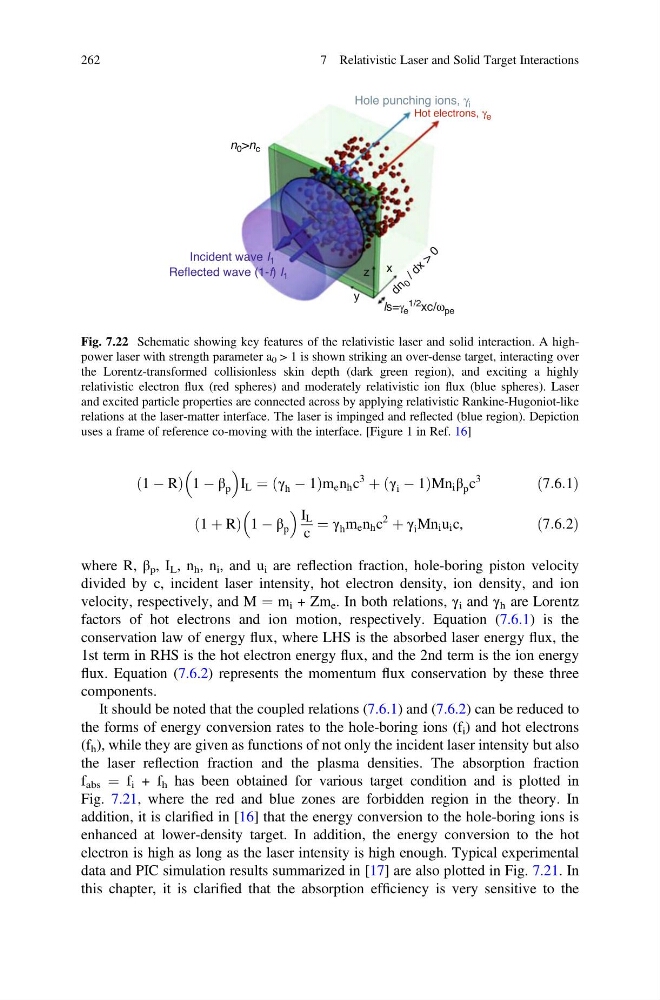
Fig. 7.22 Schematic showing key features of the relativistic laser and solid interaction. A highpower laser with strength parameter a 0 > 1 is shown striking an over-dense target, interacting over
the Lorentz-transformed collisionless skin depth (dark green region), and exciting a highly
relativistic electron flux (red spheres) and moderately relativistic ion flux (blue spheres). Laser
and excited particle properties are connected across by applying relativistic Rankine-Hugoniot-like
relations at the laser-matter interface. The laser is impinged and reflected (blue region). Depiction
uses a frame of reference co-moving with the interface. [Figure 1 in Ref. 16]
262
7 Relativistic Laser and Solid Target Interactions
ð
Þ 1 À β p
I L ¼ γ h À 1
ð
Þm e n h c
3
þ γ i À 1
ð
ÞMn i β p c
3
ð7:6:1Þ
1 þ R
ð
Þ 1 À β p
I L
c
¼ γ h m e n h c
2
þ γ i Mn i u i c,
ð7:6:2Þ
where R, β p , I L , n h , n i , and u i are reflection fraction, hole-boring piston velocity
divided by c, incident laser intensity, hot electron density, ion density, and ion
velocity, respectively, and M ¼ m i + Zm e . In both relations, γ i and γ h are Lorentz
factors of hot electrons and ion motion, respectively. Equation (7.6.1) is the
conservation law of energy flux, where LHS is the absorbed laser energy flux, the
1st term in RHS is the hot electron energy flux, and the 2nd term is the ion energy
flux. Equation (7.6.2) represents the momentum flux conservation by these three
components.
It should be noted that the coupled relations (7.6.1) and (7.6.2) can be reduced to
the forms of energy conversion rates to the hole-boring ions (f i ) and hot electrons
(f h ), while they are given as functions of not only the incident laser intensity but also
the laser reflection fraction and the plasma densities. The absorption fraction
f abs ¼ f i + f h has been obtained for various target condition and is plotted in
Fig. 7.21, where the red and blue zones are forbidden region in the theory. In
addition, it is clarified in [16] that the energy conversion to the hole-boring ions is
enhanced at lower-density target. In addition, the energy conversion to the hot
electron is high as long as the laser intensity is high enough. Typical experimental
data and PIC simulation results summarized in [17] are also plotted in Fig. 7.21. In
this chapter, it is clarified that the absorption efficiency is very sensitive to the
n 0 >n c
z
ls=γ e
1/2 xc/ω pe
x
d n
0 / d x
>
0
y
Hole punching ions, γ i
Hot electrons, γ e
Reflected wave (1-f) I 1
Incident wave I 1
Fig. 7.22 Schematic showing key features of the relativistic laser and solid interaction. A highpower laser with strength parameter a 0 > 1 is shown striking an over-dense target, interacting over
the Lorentz-transformed collisionless skin depth (dark green region), and exciting a highly
relativistic electron flux (red spheres) and moderately relativistic ion flux (blue spheres). Laser
and excited particle properties are connected across by applying relativistic Rankine-Hugoniot-like
relations at the laser-matter interface. The laser is impinged and reflected (blue region). Depiction
uses a frame of reference co-moving with the interface. [Figure 1 in Ref. 16]
262
7 Relativistic Laser and Solid Target Interactions