

experiment of nonlinear Compton scattering, while the paper’s title is multiphoton
Thomson scattering. This is the same as the experiment at SLAC, and the difference
is the laser and electron beam parameter. So, let us call it nonlinear Compton
scattering (NCS) experiment. The laser photon energy is 1.55 eV and the normalized
field strength a 0 ¼ 2 ~ 12. The electrons in helium gas jet are accelerated to the
energy of 200 ~ 300 MeV. This relativistic electron beam is irradiated with counter
directions by ultra-intense laser.
It is reported that for the case of a 0 ¼ 2, HH photon up to n ¼ 10 (10 MeV photon)
was observed, and for a 0 ¼ 10, HH photon of n ¼ 500 (20 MeV photon) has been
observed. Note that the laser photon is Doppler shifted downward by the drifting
motion of (5.3.24). Therefore, the fundamental frequency of the incident laser is
shifted to ħω
00 ~1 MeV for a 0 ¼ 2 case and ħω
00 ¼ 40keV for a 0 ¼ 12. The
experimental data is compared to PIC simulation, and it is reported that the experimental spectra are well reproduced in the simulation [12].
References
1. L.D. Landau, E.M. Lifshitz, The Classical Theory of Fields (Nauka, Moscow, 1973)
2. J.D. Jackson, Classical Electrodynamics, 3rd edn. (John Wiley & Sons, New York, 1999),
Chapter 11
3. A. Macchi, A Super Intense Laser-Plasma Interaction Theory Primer (Springer, Dordrecht,
2013)
4. P. Gibbon, Short Pulse Laser Interaction with Matter: An Introduction (Imperial College Press,
London, 2005)
5. D. Umstadter, J. Phys. D. Appl. Phys. 36, R151 (2003)
6. J.F. Ong et al., Phys. Plasmas 23, 053117 (2016)
7. Y. Xing et al., Astrophys. J. 823, 44 (2016)
10
6
n=1 multiple
scattering
electron yield per 1.0 GeV
n=1
n= 2
n = 3
n = 4
10
5
10
4
10 3
10
2
10
0
5
10 15 20 25
electron energy [GeV]
30 35 40 45 50
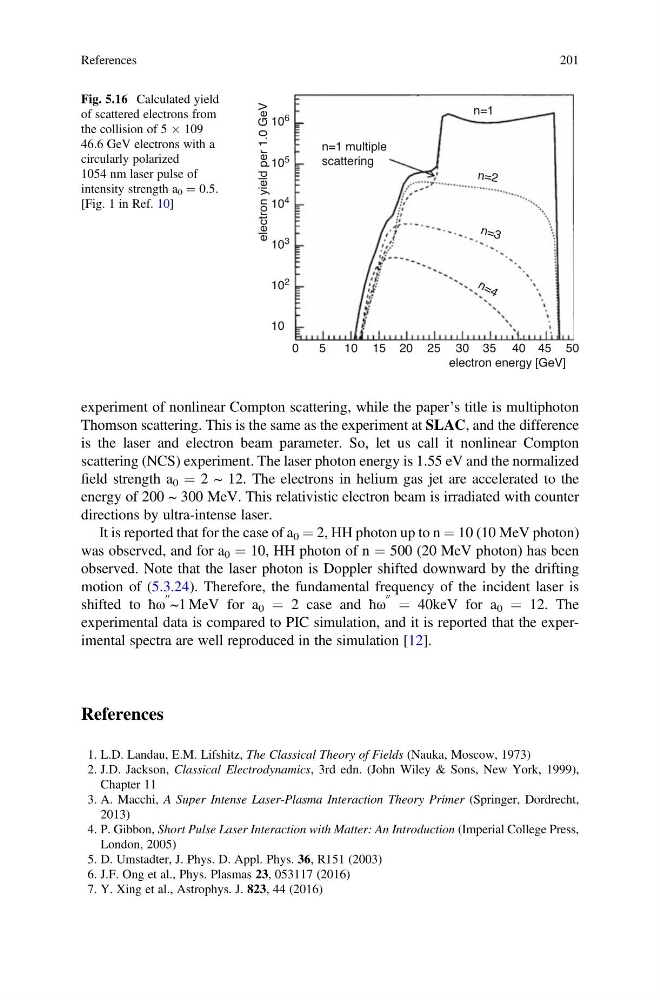
Fig. 5.16 Calculated yield
of scattered electrons from
the collision of 5 Â 109
46.6 GeV electrons with a
circularly polarized
1054 nm laser pulse of
intensity strength a 0 ¼ 0.5.
[Fig. 1 in Ref. 10]
References
201
Thomson scattering. This is the same as the experiment at SLAC, and the difference
is the laser and electron beam parameter. So, let us call it nonlinear Compton
scattering (NCS) experiment. The laser photon energy is 1.55 eV and the normalized
field strength a 0 ¼ 2 ~ 12. The electrons in helium gas jet are accelerated to the
energy of 200 ~ 300 MeV. This relativistic electron beam is irradiated with counter
directions by ultra-intense laser.
It is reported that for the case of a 0 ¼ 2, HH photon up to n ¼ 10 (10 MeV photon)
was observed, and for a 0 ¼ 10, HH photon of n ¼ 500 (20 MeV photon) has been
observed. Note that the laser photon is Doppler shifted downward by the drifting
motion of (5.3.24). Therefore, the fundamental frequency of the incident laser is
shifted to ħω
00 ~1 MeV for a 0 ¼ 2 case and ħω
00 ¼ 40keV for a 0 ¼ 12. The
experimental data is compared to PIC simulation, and it is reported that the experimental spectra are well reproduced in the simulation [12].
References
1. L.D. Landau, E.M. Lifshitz, The Classical Theory of Fields (Nauka, Moscow, 1973)
2. J.D. Jackson, Classical Electrodynamics, 3rd edn. (John Wiley & Sons, New York, 1999),
Chapter 11
3. A. Macchi, A Super Intense Laser-Plasma Interaction Theory Primer (Springer, Dordrecht,
2013)
4. P. Gibbon, Short Pulse Laser Interaction with Matter: An Introduction (Imperial College Press,
London, 2005)
5. D. Umstadter, J. Phys. D. Appl. Phys. 36, R151 (2003)
6. J.F. Ong et al., Phys. Plasmas 23, 053117 (2016)
7. Y. Xing et al., Astrophys. J. 823, 44 (2016)
10
6
n=1 multiple
scattering
electron yield per 1.0 GeV
n=1
n= 2
n = 3
n = 4
10
5
10
4
10 3
10
2
10
0
5
10 15 20 25
electron energy [GeV]
30 35 40 45 50
Fig. 5.16 Calculated yield
of scattered electrons from
the collision of 5 Â 109
46.6 GeV electrons with a
circularly polarized
1054 nm laser pulse of
intensity strength a 0 ¼ 0.5.
[Fig. 1 in Ref. 10]
References
201