

5.3.4 Free Electron Orbit
Let us consider the case of linearly polarized lasers to obtain the analytic solution of
electron orbits. We start with the case of a free electron:
α ¼ 1:
Then, (5.3.13) becomes
γ ¼ b p x þ 1
ð5:3:20Þ
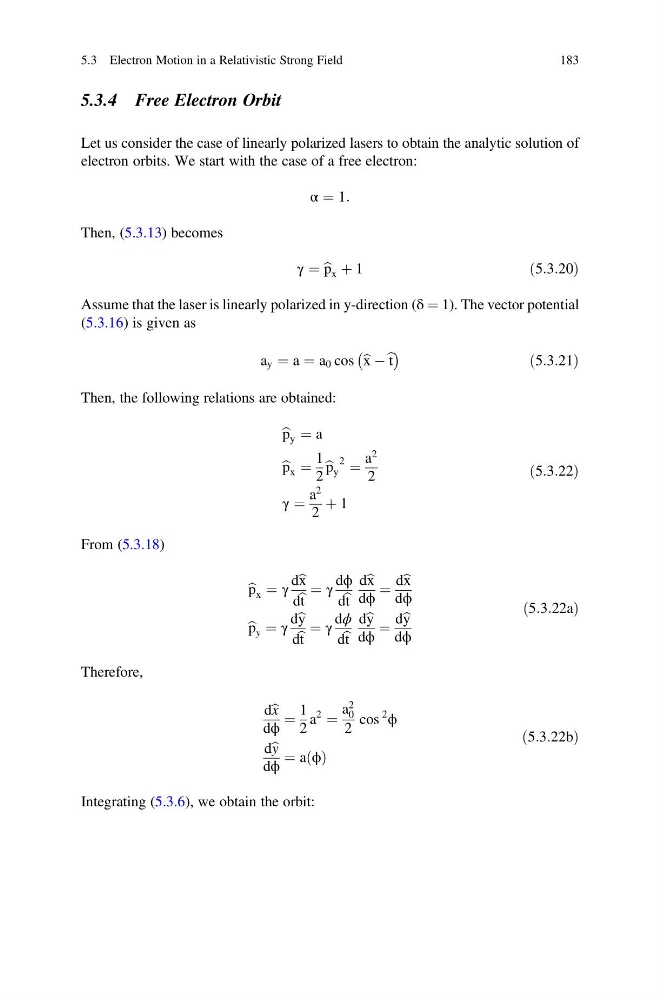
Assume that the laser is linearly polarized in y-direction (δ ¼ 1). The vector potential
(5.3.16) is given as
a y ¼ a ¼ a 0 cos b x À b t
À
Á
ð5:3:21Þ
Then, the following relations are obtained:
b p y ¼ a
b p x ¼
1
2
b p y
2 ¼
a
2
2
γ ¼
a
2
2
þ 1
ð5:3:22Þ
From (5.3.18)
b p x ¼ γ
db x
d b t
¼ γ
dϕ
d b t
db x
dϕ
¼
db x
dϕ
b p y ¼ γ
db y
d b t
¼ γ
dϕ
d b t
db y
dϕ
¼
db y
dϕ
ð5:3:22aÞ
Therefore,
db x
dϕ
¼
1
2
a
2
¼
a
2
0
2
cos
2
ϕ
db y
dϕ
¼ a ϕ
ð Þ
ð5:3:22bÞ
Integrating (5.3.6), we obtain the orbit:
5.3 Electron Motion in a Relativistic Strong Field
183
Let us consider the case of linearly polarized lasers to obtain the analytic solution of
electron orbits. We start with the case of a free electron:
α ¼ 1:
Then, (5.3.13) becomes
γ ¼ b p x þ 1
ð5:3:20Þ
Assume that the laser is linearly polarized in y-direction (δ ¼ 1). The vector potential
(5.3.16) is given as
a y ¼ a ¼ a 0 cos b x À b t
À
Á
ð5:3:21Þ
Then, the following relations are obtained:
b p y ¼ a
b p x ¼
1
2
b p y
2 ¼
a
2
2
γ ¼
a
2
2
þ 1
ð5:3:22Þ
From (5.3.18)
b p x ¼ γ
db x
d b t
¼ γ
dϕ
d b t
db x
dϕ
¼
db x
dϕ
b p y ¼ γ
db y
d b t
¼ γ
dϕ
d b t
db y
dϕ
¼
db y
dϕ
ð5:3:22aÞ
Therefore,
db x
dϕ
¼
1
2
a
2
¼
a
2
0
2
cos
2
ϕ
db y
dϕ
¼ a ϕ
ð Þ
ð5:3:22bÞ
Integrating (5.3.6), we obtain the orbit:
5.3 Electron Motion in a Relativistic Strong Field
183