

dt
p x Ç mcγ
ð
޼e
c
v y
∂
∂t
A y Æ c
∂
∂x
A y
þ v z
∂
∂t
A z Æ c
∂
∂x
A z
!
ð5:3:10Þ
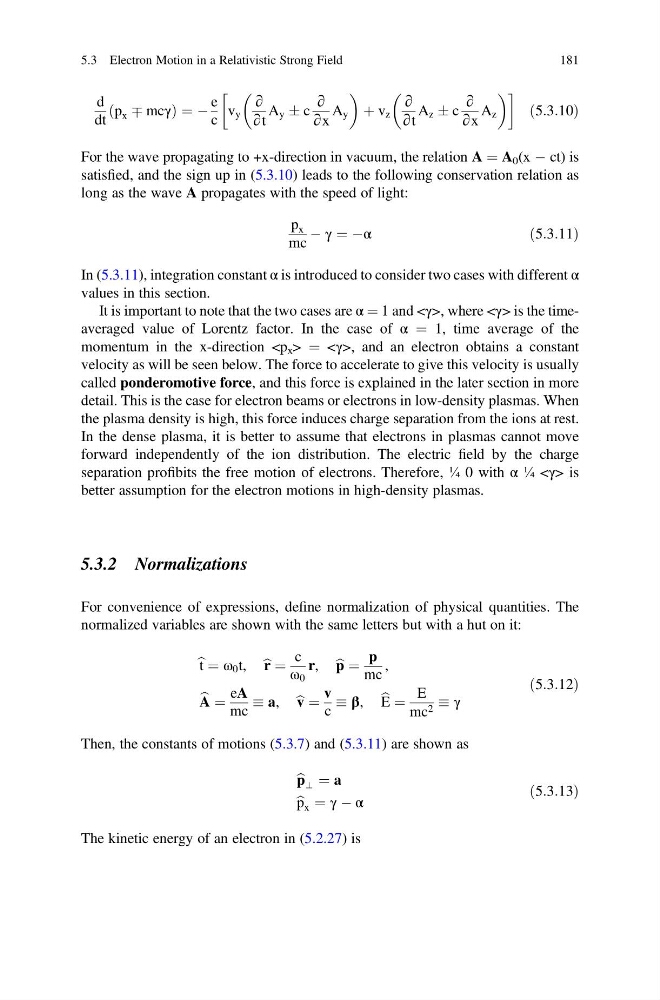
For the wave propagating to +x-direction in vacuum, the relation A ¼ A 0 (x À ct) is
satisfied, and the sign up in (5.3.10) leads to the following conservation relation as
long as the wave A propagates with the speed of light:
p x
mc
À γ ¼ Àα
ð5:3:11Þ
In (5.3.11), integration constant α is introduced to consider two cases with different α
values in this section.
It is important to note that the two cases are α ¼ 1 and <γ>, where <γ> is the timeaveraged value of Lorentz factor. In the case of α ¼ 1, time average of the
momentum in the x-direction
¼ <γ>, and an electron obtains a constant
velocity as will be seen below. The force to accelerate to give this velocity is usually
called ponderomotive force, and this force is explained in the later section in more
detail. This is the case for electron beams or electrons in low-density plasmas. When
the plasma density is high, this force induces charge separation from the ions at rest.
In the dense plasma, it is better to assume that electrons in plasmas cannot move
forward independently of the ion distribution. The electric field by the charge
separation profibits the free motion of electrons. Therefore, ¼ 0 with α ¼ <γ> is
better assumption for the electron motions in high-density plasmas.
5.3.2 Normalizations
For convenience of expressions, define normalization of physical quantities. The
normalized variables are shown with the same letters but with a hut on it:
b t ¼ ω 0 t, b r ¼
c
ω 0
r, b p ¼
p
mc
,
b
A ¼
eA
mc
a, b v ¼
v
c
β, b
E ¼
E
mc 2 γ
ð5:3:12Þ
Then, the constants of motions (5.3.7) and (5.3.11) are shown as
b p ⊥ ¼ a
b p x ¼ γ À α
ð5:3:13Þ
The kinetic energy of an electron in (5.2.27) is
5.3 Electron Motion in a Relativistic Strong Field
181