

plasma. In step 2, electrons oscillating in the laser electric field radiate light via
Thomson scattering that is Doppler shifted due to the collective electron motion. In
step 3, the beating of the laser wave and scattered light wave creates a
ponderomotive force, pushing the plasma particles into the troughs of the beatwave envelope, causing the particles to bunch into a wave. In step 4, if the wave
matches an electrostatic mode in the plasma, the three waves are then resonant and
grow exponentially.
4.6.1 Coupled Oscillator Model-1
Before solving three coupled equations, consider the property of such coupled
equations. Make the problem simpler and assume that the system is uniform so
that the amplitudes of three waves are uniform in space. Then, (4.6.4), (4.6.5), and
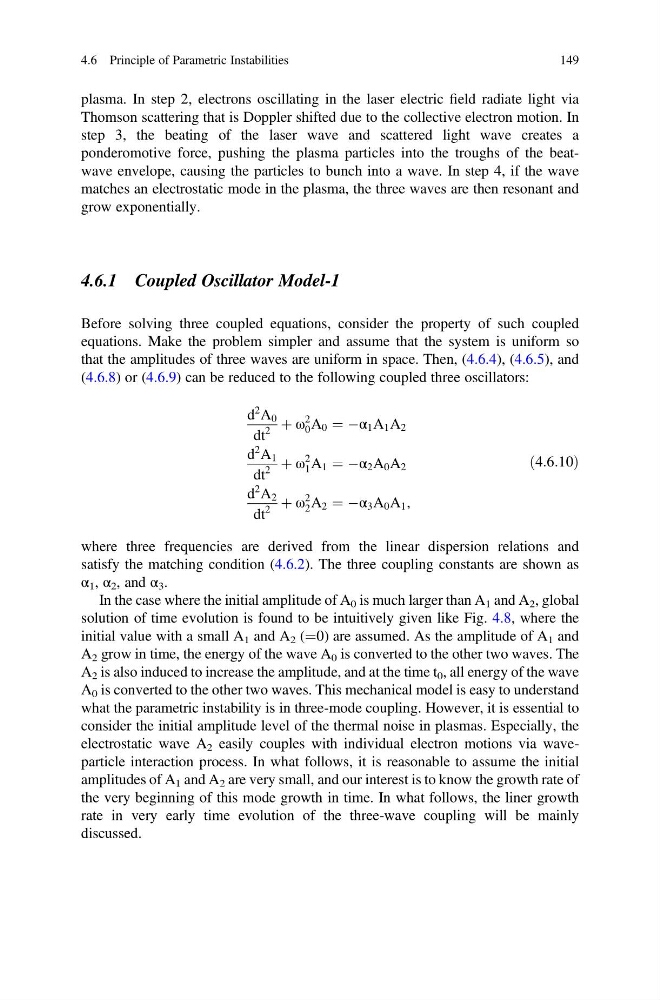
(4.6.8) or (4.6.9) can be reduced to the following coupled three oscillators:
d
2 A 0
dt
2
þ ω
2
0 A 0 ¼ Àα 1 A 1 A 2
d
2 A 1
dt
2
þ ω
2
1 A 1 ¼ Àα 2 A 0 A 2
d
2 A 2
dt
2
þ ω
2
2 A 2 ¼ Àα 3 A 0 A 1 ,
ð4:6:10Þ
where three frequencies are derived from the linear dispersion relations and
satisfy the matching condition (4.6.2). The three coupling constants are shown as
α 1 , α 2 , and α 3 .
In the case where the initial amplitude of A 0 is much larger than A 1 and A 2 , global
solution of time evolution is found to be intuitively given like Fig. 4.8, where the
initial value with a small A 1 and A 2 (¼0) are assumed. As the amplitude of A 1 and
A 2 grow in time, the energy of the wave A 0 is converted to the other two waves. The
A 2 is also induced to increase the amplitude, and at the time t 0 , all energy of the wave
A 0 is converted to the other two waves. This mechanical model is easy to understand
what the parametric instability is in three-mode coupling. However, it is essential to
consider the initial amplitude level of the thermal noise in plasmas. Especially, the
electrostatic wave A 2 easily couples with individual electron motions via waveparticle interaction process. In what follows, it is reasonable to assume the initial
amplitudes of A 1 and A 2 are very small, and our interest is to know the growth rate of
the very beginning of this mode growth in time. In what follows, the liner growth
rate in very early time evolution of the three-wave coupling will be mainly
discussed.
4.6 Principle of Parametric Instabilities
149
Thomson scattering that is Doppler shifted due to the collective electron motion. In
step 3, the beating of the laser wave and scattered light wave creates a
ponderomotive force, pushing the plasma particles into the troughs of the beatwave envelope, causing the particles to bunch into a wave. In step 4, if the wave
matches an electrostatic mode in the plasma, the three waves are then resonant and
grow exponentially.
4.6.1 Coupled Oscillator Model-1
Before solving three coupled equations, consider the property of such coupled
equations. Make the problem simpler and assume that the system is uniform so
that the amplitudes of three waves are uniform in space. Then, (4.6.4), (4.6.5), and
(4.6.8) or (4.6.9) can be reduced to the following coupled three oscillators:
d
2 A 0
dt
2
þ ω
2
0 A 0 ¼ Àα 1 A 1 A 2
d
2 A 1
dt
2
þ ω
2
1 A 1 ¼ Àα 2 A 0 A 2
d
2 A 2
dt
2
þ ω
2
2 A 2 ¼ Àα 3 A 0 A 1 ,
ð4:6:10Þ
where three frequencies are derived from the linear dispersion relations and
satisfy the matching condition (4.6.2). The three coupling constants are shown as
α 1 , α 2 , and α 3 .
In the case where the initial amplitude of A 0 is much larger than A 1 and A 2 , global
solution of time evolution is found to be intuitively given like Fig. 4.8, where the
initial value with a small A 1 and A 2 (¼0) are assumed. As the amplitude of A 1 and
A 2 grow in time, the energy of the wave A 0 is converted to the other two waves. The
A 2 is also induced to increase the amplitude, and at the time t 0 , all energy of the wave
A 0 is converted to the other two waves. This mechanical model is easy to understand
what the parametric instability is in three-mode coupling. However, it is essential to
consider the initial amplitude level of the thermal noise in plasmas. Especially, the
electrostatic wave A 2 easily couples with individual electron motions via waveparticle interaction process. In what follows, it is reasonable to assume the initial
amplitudes of A 1 and A 2 are very small, and our interest is to know the growth rate of
the very beginning of this mode growth in time. In what follows, the liner growth
rate in very early time evolution of the three-wave coupling will be mainly
discussed.
4.6 Principle of Parametric Instabilities
149