

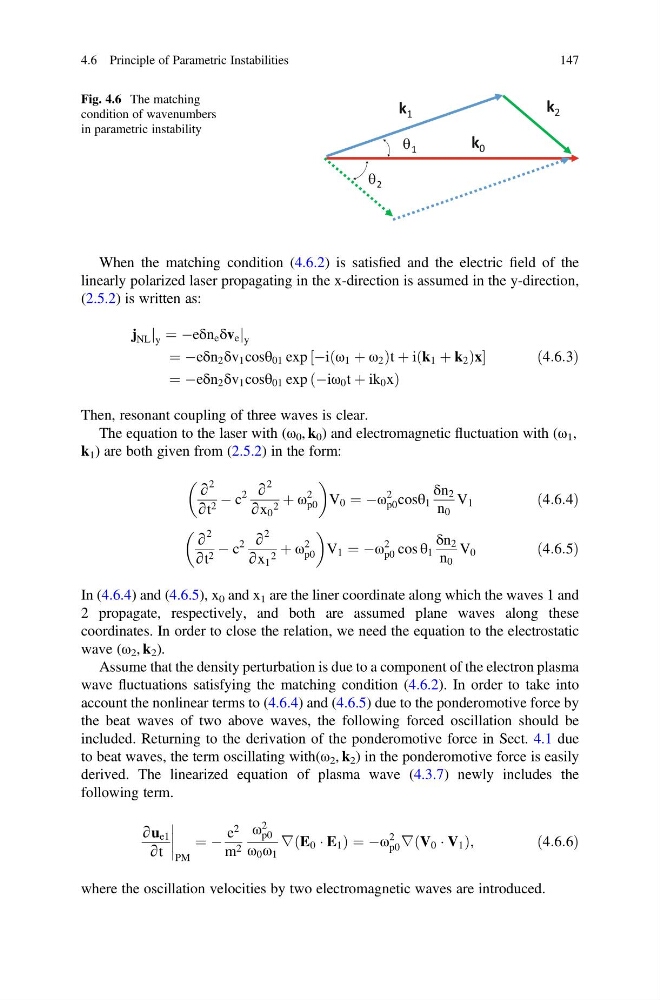
When the matching condition (4.6.2) is satisfied and the electric field of the
linearly polarized laser propagating in the x-direction is assumed in the y-direction,
(2.5.2) is written as:
j NL j y ¼ Àeδn e δv e j y
¼ Àeδn 2 δv 1 cosθ 01 exp Ài ω 1 þ ω 2
ð
Þ t þ i k 1 þ k 2
ð
Þ x
½
¼ Àeδn 2 δv 1 cosθ 01 exp Àiω 0 t þ ik 0 x
ð
Þ
ð4:6:3Þ
Then, resonant coupling of three waves is clear.
The equation to the laser with (ω 0 , k 0 ) and electromagnetic fluctuation with (ω 1 ,
k 1 ) are both given from (2.5.2) in the form:
∂
2
∂t 2 À c
2 ∂
2
∂x 0
2
þ ω
2
p0
V 0 ¼ Àω
2
p0 cosθ 1
δn 2
n 0
V 1
ð4:6:4Þ
∂
2
∂t 2 À c
2 ∂
2
∂x 1
2
þ ω
2
p0
V 1 ¼ Àω
2
p0 cos θ 1
δn 2
n 0
V 0
ð4:6:5Þ
In (4.6.4) and (4.6.5), x 0 and x 1 are the liner coordinate along which the waves 1 and
2 propagate, respectively, and both are assumed plane waves along these
coordinates. In order to close the relation, we need the equation to the electrostatic
wave (ω 2 , k 2 ).
Assume that the density perturbation is due to a component of the electron plasma
wave fluctuations satisfying the matching condition (4.6.2). In order to take into
account the nonlinear terms to (4.6.4) and (4.6.5) due to the ponderomotive force by
the beat waves of two above waves, the following forced oscillation should be
included. Returning to the derivation of the ponderomotive force in Sect. 4.1 due
to beat waves, the term oscillating with(ω 2 , k 2 ) in the ponderomotive force is easily
derived. The linearized equation of plasma wave (4.3.7) newly includes the
following term.
∂u e1
∂t
PM
¼ À
e
2
m 2
ω
2
p0
ω 0 ω 1
∇ E 0 Á E 1
ð
Þ¼Àω
2
p0 ∇ V 0 Á V 1
ð
Þ,
ð4:6:6Þ
where the oscillation velocities by two electromagnetic waves are introduced.
q 1
k 0
k 1
k 2
q 2
Fig. 4.6 The matching
condition of wavenumbers
in parametric instability
4.6 Principle of Parametric Instabilities
147
linearly polarized laser propagating in the x-direction is assumed in the y-direction,
(2.5.2) is written as:
j NL j y ¼ Àeδn e δv e j y
¼ Àeδn 2 δv 1 cosθ 01 exp Ài ω 1 þ ω 2
ð
Þ t þ i k 1 þ k 2
ð
Þ x
½
¼ Àeδn 2 δv 1 cosθ 01 exp Àiω 0 t þ ik 0 x
ð
Þ
ð4:6:3Þ
Then, resonant coupling of three waves is clear.
The equation to the laser with (ω 0 , k 0 ) and electromagnetic fluctuation with (ω 1 ,
k 1 ) are both given from (2.5.2) in the form:
∂
2
∂t 2 À c
2 ∂
2
∂x 0
2
þ ω
2
p0
V 0 ¼ Àω
2
p0 cosθ 1
δn 2
n 0
V 1
ð4:6:4Þ
∂
2
∂t 2 À c
2 ∂
2
∂x 1
2
þ ω
2
p0
V 1 ¼ Àω
2
p0 cos θ 1
δn 2
n 0
V 0
ð4:6:5Þ
In (4.6.4) and (4.6.5), x 0 and x 1 are the liner coordinate along which the waves 1 and
2 propagate, respectively, and both are assumed plane waves along these
coordinates. In order to close the relation, we need the equation to the electrostatic
wave (ω 2 , k 2 ).
Assume that the density perturbation is due to a component of the electron plasma
wave fluctuations satisfying the matching condition (4.6.2). In order to take into
account the nonlinear terms to (4.6.4) and (4.6.5) due to the ponderomotive force by
the beat waves of two above waves, the following forced oscillation should be
included. Returning to the derivation of the ponderomotive force in Sect. 4.1 due
to beat waves, the term oscillating with(ω 2 , k 2 ) in the ponderomotive force is easily
derived. The linearized equation of plasma wave (4.3.7) newly includes the
following term.
∂u e1
∂t
PM
¼ À
e
2
m 2
ω
2
p0
ω 0 ω 1
∇ E 0 Á E 1
ð
Þ¼Àω
2
p0 ∇ V 0 Á V 1
ð
Þ,
ð4:6:6Þ
where the oscillation velocities by two electromagnetic waves are introduced.
q 1
k 0
k 1
k 2
q 2
Fig. 4.6 The matching
condition of wavenumbers
in parametric instability
4.6 Principle of Parametric Instabilities
147