

1 3
Topics in Current Chemistry (2019) 377:37
reaction were carried out to well understand the effect of chiral phosphoric acid
OC-13 in the enantioselective induction process.
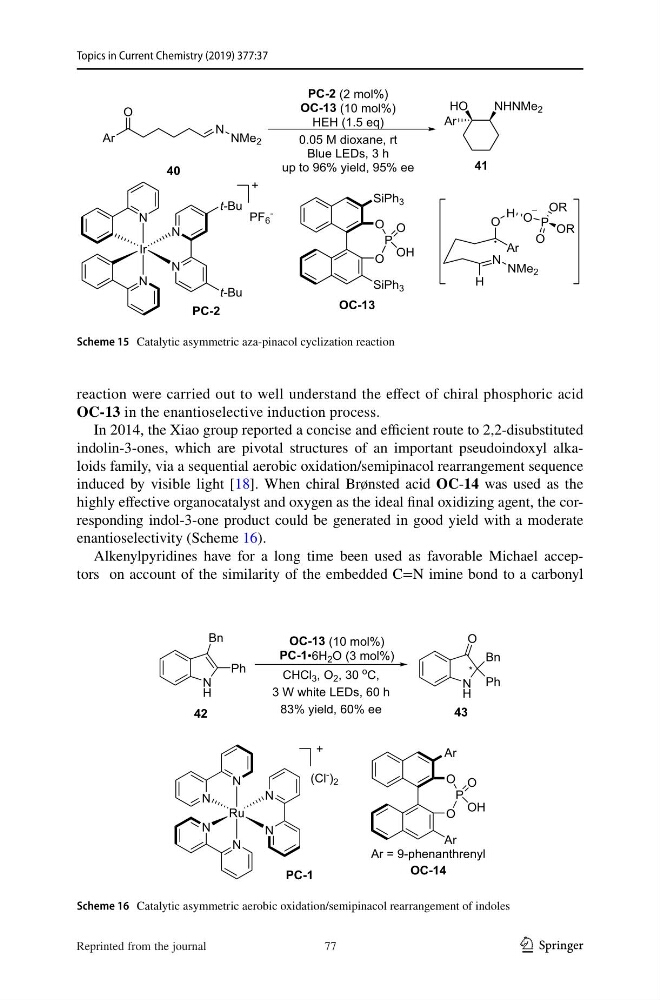
In 2014, the Xiao group reported a concise and efficient route to 2,2-disubstituted
indolin-3-ones, which are pivotal structures of an important pseudoindoxyl alkaloids family, via a sequential aerobic oxidation/semipinacol rearrangement sequence
induced by visible light [18]. When chiral Brønsted acid OC-14 was used as the
highly effective organocatalyst and oxygen as the ideal final oxidizing agent, the corresponding indol-3-one product could be generated in good yield with a moderate
enantioselectivity (Scheme 16).
Alkenylpyridines have for a long time been used as favorable Michael acceptors on account of the similarity of the embedded C=N imine bond to a carbonyl
O
Ar
N NMe 2
PC-2 (2 mol%)
OC-13 (10 mol%)
HEH (1.5 eq)
0.05 M dioxane, rt
Blue LEDs, 3 h
up to 96% yield, 95% ee
NHNMe 2
HO
Ar
SiPh 3
O
SiPh 3
O
P
O
OH
OC-13
40
41
+
N
N
N
N
Ir
t-Bu
t-Bu
PC-2
PF 6
-
O
Ar
H
N NMe 2
H O P
OR
O
OR
Scheme 15 Catalytic asymmetric aza-pinacol cyclization reaction
CHCl 3 , O 2 , 30
o C,
3 W white LEDs, 60 h
83% yield, 60% ee
Ar
O
Ar
O
P
O
OH
N
H
Bn
Ph
N
H
*
O
Ph
Bn
Ar = 9-phenanthrenyl
OC-14
42
43
OC-13 (10 mol%)
PC-1•6H 2 O (3 mol%)
+
N
N
N
N
N
N
Ru
PC-1
(Cl
- ) 2
Scheme 16 Catalytic asymmetric aerobic oxidation/semipinacol rearrangement of indoles
Reprinted from the journal
77
Topics in Current Chemistry (2019) 377:37
reaction were carried out to well understand the effect of chiral phosphoric acid
OC-13 in the enantioselective induction process.
In 2014, the Xiao group reported a concise and efficient route to 2,2-disubstituted
indolin-3-ones, which are pivotal structures of an important pseudoindoxyl alkaloids family, via a sequential aerobic oxidation/semipinacol rearrangement sequence
induced by visible light [18]. When chiral Brønsted acid OC-14 was used as the
highly effective organocatalyst and oxygen as the ideal final oxidizing agent, the corresponding indol-3-one product could be generated in good yield with a moderate
enantioselectivity (Scheme 16).
Alkenylpyridines have for a long time been used as favorable Michael acceptors on account of the similarity of the embedded C=N imine bond to a carbonyl
O
Ar
N NMe 2
PC-2 (2 mol%)
OC-13 (10 mol%)
HEH (1.5 eq)
0.05 M dioxane, rt
Blue LEDs, 3 h
up to 96% yield, 95% ee
NHNMe 2
HO
Ar
SiPh 3
O
SiPh 3
O
P
O
OH
OC-13
40
41
+
N
N
N
N
Ir
t-Bu
t-Bu
PC-2
PF 6
-
O
Ar
H
N NMe 2
H O P
OR
O
OR
Scheme 15 Catalytic asymmetric aza-pinacol cyclization reaction
CHCl 3 , O 2 , 30
o C,
3 W white LEDs, 60 h
83% yield, 60% ee
Ar
O
Ar
O
P
O
OH
N
H
Bn
Ph
N
H
*
O
Ph
Bn
Ar = 9-phenanthrenyl
OC-14
42
43
OC-13 (10 mol%)
PC-1•6H 2 O (3 mol%)
+
N
N
N
N
N
N
Ru
PC-1
(Cl
- ) 2
Scheme 16 Catalytic asymmetric aerobic oxidation/semipinacol rearrangement of indoles
Reprinted from the journal
77