

1 3
Topics in Current Chemistry (2019) 377:37
3 Nucleophilic Catalysis
In 2012, the Rovis group described an enantioselective α-acylation of tertiary
amines with a series of aldehydes mediated by a chiral N-heterocyclic carbene
(NHC) catalyst and a photoredox catalyst [15]. By employing PC-1 as the photocatalyst, m-dinitrobenzene (m-DNB) as the oxidant, and an N-heterocyclic carbene OC-11 as the chiral organocatalyst, they successfully converted aldehydes
and N-aryltetrahydroisoquinoline (THIQ) substrates into the corresponding chiral
α-amino ketone products with high enantioselectivities. Notably, electron-withdrawing groups of the isoquinoline derivatives led primarily to competing radical
dimerized products (Scheme 13).
In 2014, Xiao et al. accomplished an efficient sp
3
C–H acroleination of THIQs
via the combination of visible light photocatalysis and nucleophilic catalysis [16].
With Ir(ppy) 2 (dtbbpy)PF 6 as the photosensitizer and DABCO as the nucleophilic
catalysis, the C–H bond at the α-position of tertiary amines could be directly
functionalized with acrolein to afford the acroleination products in 50–91%
yields through a one-pot sequence of catalysis under extremely mild conditions
(Scheme 14). The catalytic system was also proved to be amenable to enantioselective catalysis by using β-ICD (OC-12) as the chiral catalyst.
O
R
1
O
O
R
2
n
n=0-3
O
R
1
n
O
O
R
2
+
OC-10 (20 mol%)
TBADT (5 mol%)
Single UV LED (365 nm)
Benzoic acid (40 mol%)
TBABF 4 (1 eq.)
MeCN, 35
o C
N
NH 2
N
R
3
Me
OC-10 (20 mol%)
PC-7 (1 mol%)
White LEDs strip
Benzoic acid (40 mol%)
Toluene, 15
o C
O
n
R
1
N
R
3
O
R
1
n
n=0-3
+
OC-10
+
N
N
N
N
Ir
t-Bu
t-Bu
PC-7
PF 6
-
CF 3
CF 3
F
F
F
F
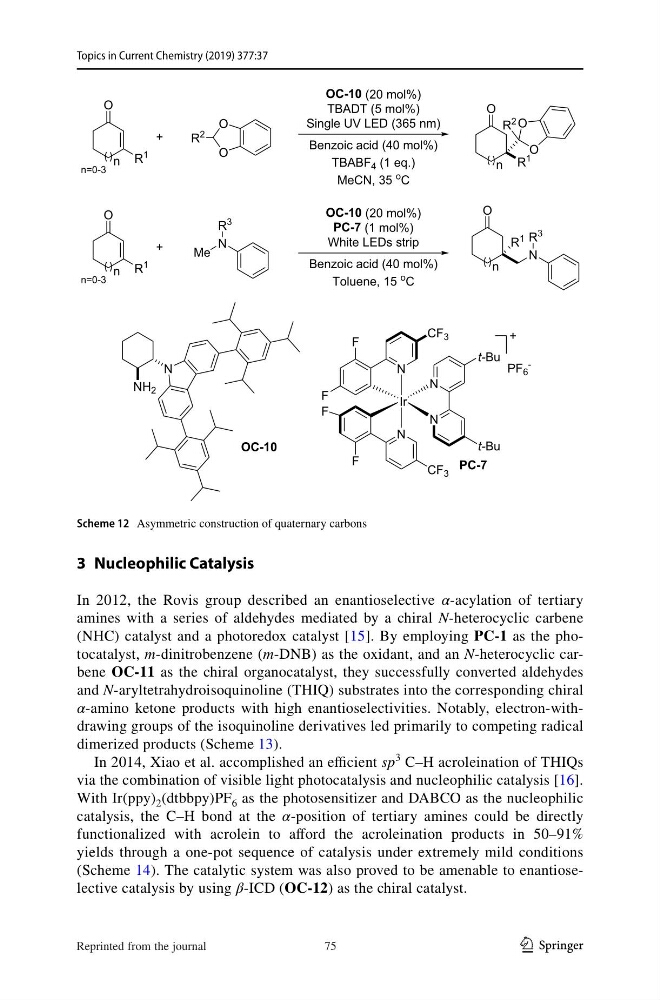
Scheme 12 Asymmetric construction of quaternary carbons
Reprinted from the journal
75
Topics in Current Chemistry (2019) 377:37
3 Nucleophilic Catalysis
In 2012, the Rovis group described an enantioselective α-acylation of tertiary
amines with a series of aldehydes mediated by a chiral N-heterocyclic carbene
(NHC) catalyst and a photoredox catalyst [15]. By employing PC-1 as the photocatalyst, m-dinitrobenzene (m-DNB) as the oxidant, and an N-heterocyclic carbene OC-11 as the chiral organocatalyst, they successfully converted aldehydes
and N-aryltetrahydroisoquinoline (THIQ) substrates into the corresponding chiral
α-amino ketone products with high enantioselectivities. Notably, electron-withdrawing groups of the isoquinoline derivatives led primarily to competing radical
dimerized products (Scheme 13).
In 2014, Xiao et al. accomplished an efficient sp
3
C–H acroleination of THIQs
via the combination of visible light photocatalysis and nucleophilic catalysis [16].
With Ir(ppy) 2 (dtbbpy)PF 6 as the photosensitizer and DABCO as the nucleophilic
catalysis, the C–H bond at the α-position of tertiary amines could be directly
functionalized with acrolein to afford the acroleination products in 50–91%
yields through a one-pot sequence of catalysis under extremely mild conditions
(Scheme 14). The catalytic system was also proved to be amenable to enantioselective catalysis by using β-ICD (OC-12) as the chiral catalyst.
O
R
1
O
O
R
2
n
n=0-3
O
R
1
n
O
O
R
2
+
OC-10 (20 mol%)
TBADT (5 mol%)
Single UV LED (365 nm)
Benzoic acid (40 mol%)
TBABF 4 (1 eq.)
MeCN, 35
o C
N
NH 2
N
R
3
Me
OC-10 (20 mol%)
PC-7 (1 mol%)
White LEDs strip
Benzoic acid (40 mol%)
Toluene, 15
o C
O
n
R
1
N
R
3
O
R
1
n
n=0-3
+
OC-10
+
N
N
N
N
Ir
t-Bu
t-Bu
PC-7
PF 6
-
CF 3
CF 3
F
F
F
F
Scheme 12 Asymmetric construction of quaternary carbons
Reprinted from the journal
75