

1 3
Topics in Current Chemistry (2020) 378:1
10 Miscellaneous
In the next examples, a Lewis acidic copper-mediated activation of substrates
has been reported. Even if the use of copper catalyst is mandatory to observe the
reaction, in these works the formation of new electrophilic copper species was
not observed. Due to the importance of molecules incorporating a trifluoromethyl
group (CF 3 ) in pharmaceutical, agrochemical, and materials science, the incorporation of such a group in an efficient way has been the subject of many synthetic
efforts [130]. In 2010, MacMillan reported the use of 3,3-dimethyl-1-trifluoromethyl-1,2-benziodoxole 53 (Togni’s reagent) in α-trifluoromethylation of aldehydes
through enamine catalysis (Scheme 23) [131].
Although 53 is an electrophilic reagent, in absence of a Lewis acid, the yields
obtained in the model reaction were quite low. After a survey of different Lewis
acids—such as Fe(III), Sc(III), Cu(II), and Zn(II)—Cu(I)Cl were found to be the
most suited ones. The Lewis acids are able to promote the I-O bond cleavage of
the Togni’s reagent to generate the highly electrophilic iodonium salt. A Cu(I)/
Cu(III) catalytic cycle could not be proposed due to the fact that an enantiomeric
excess was observed even employing Sc(III) (48% yields, 64% ee) and Zn(II)
52% yields, 66% ee), and because the reaction was observed even employing
FeCl 2 . The use of stronger Lewis acids gave lower enantiomeric excesses. Lewis
acidic copper catalysis was also employed in π-activation of multiple bonds. The
enantioselective α-oxidation of aldehydes was reported using the Lewis acidic
copper(II) in combination with TEMPO and the tryptophan derivative 2d as
organocatalyst (Scheme 24) [132].
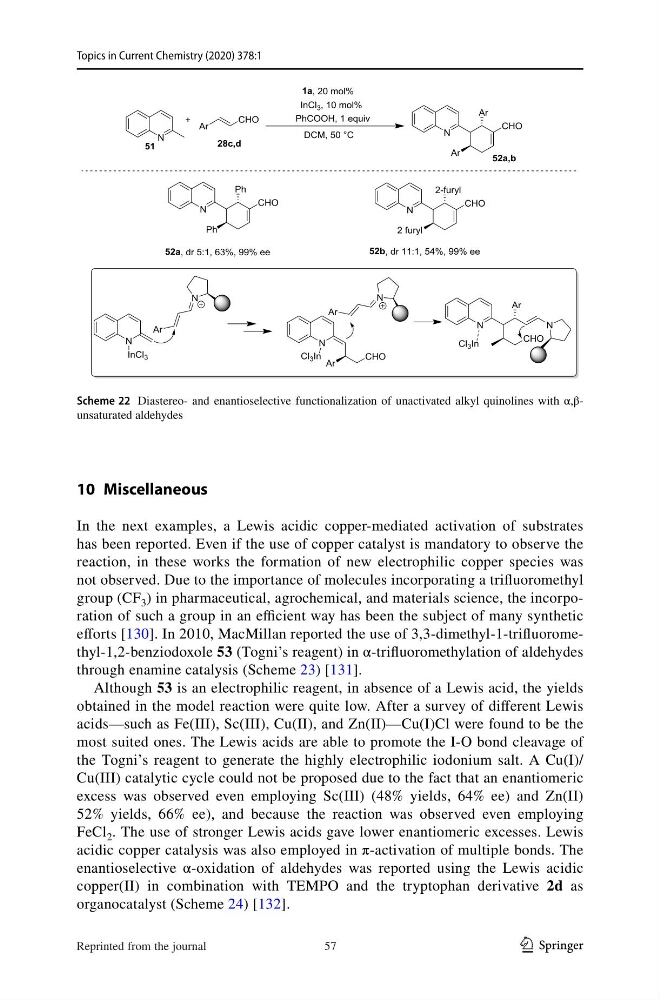
Scheme 22 Diastereo- and enantioselective functionalization of unactivated alkyl quinolines with α,βunsaturated aldehydes
Reprinted from the journal
57
Topics in Current Chemistry (2020) 378:1
10 Miscellaneous
In the next examples, a Lewis acidic copper-mediated activation of substrates
has been reported. Even if the use of copper catalyst is mandatory to observe the
reaction, in these works the formation of new electrophilic copper species was
not observed. Due to the importance of molecules incorporating a trifluoromethyl
group (CF 3 ) in pharmaceutical, agrochemical, and materials science, the incorporation of such a group in an efficient way has been the subject of many synthetic
efforts [130]. In 2010, MacMillan reported the use of 3,3-dimethyl-1-trifluoromethyl-1,2-benziodoxole 53 (Togni’s reagent) in α-trifluoromethylation of aldehydes
through enamine catalysis (Scheme 23) [131].
Although 53 is an electrophilic reagent, in absence of a Lewis acid, the yields
obtained in the model reaction were quite low. After a survey of different Lewis
acids—such as Fe(III), Sc(III), Cu(II), and Zn(II)—Cu(I)Cl were found to be the
most suited ones. The Lewis acids are able to promote the I-O bond cleavage of
the Togni’s reagent to generate the highly electrophilic iodonium salt. A Cu(I)/
Cu(III) catalytic cycle could not be proposed due to the fact that an enantiomeric
excess was observed even employing Sc(III) (48% yields, 64% ee) and Zn(II)
52% yields, 66% ee), and because the reaction was observed even employing
FeCl 2 . The use of stronger Lewis acids gave lower enantiomeric excesses. Lewis
acidic copper catalysis was also employed in π-activation of multiple bonds. The
enantioselective α-oxidation of aldehydes was reported using the Lewis acidic
copper(II) in combination with TEMPO and the tryptophan derivative 2d as
organocatalyst (Scheme 24) [132].
Scheme 22 Diastereo- and enantioselective functionalization of unactivated alkyl quinolines with α,βunsaturated aldehydes
Reprinted from the journal
57