

1 3
Topics in Current Chemistry (2020) 378:1
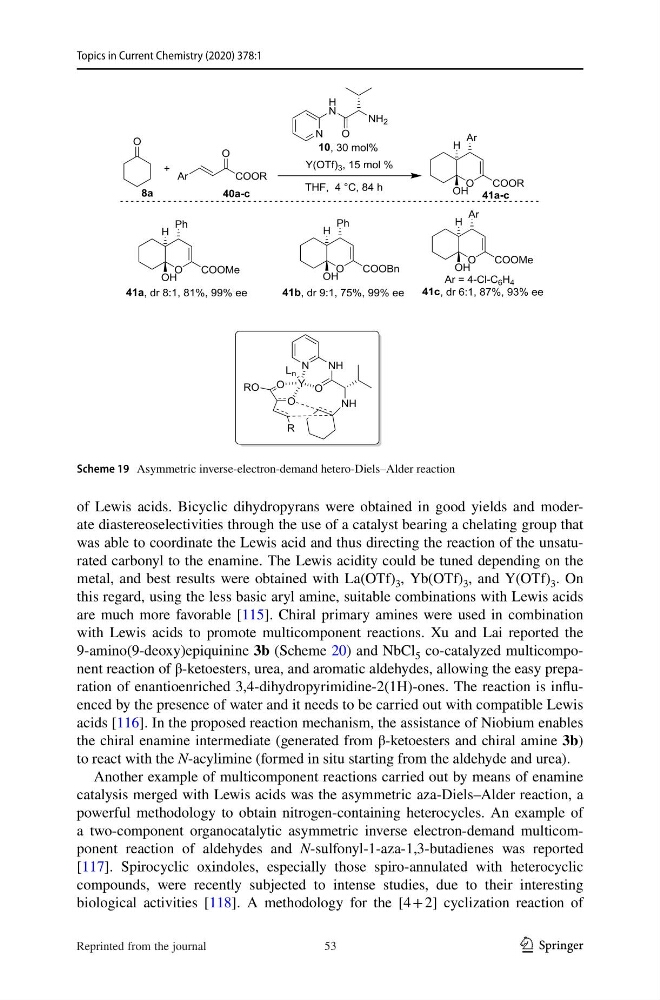
of Lewis acids. Bicyclic dihydropyrans were obtained in good yields and moderate diastereoselectivities through the use of a catalyst bearing a chelating group that
was able to coordinate the Lewis acid and thus directing the reaction of the unsaturated carbonyl to the enamine. The Lewis acidity could be tuned depending on the
metal, and best results were obtained with La(OTf) 3 , Yb(OTf) 3 , and Y(OTf) 3 . On
this regard, using the less basic aryl amine, suitable combinations with Lewis acids
are much more favorable [115]. Chiral primary amines were used in combination
with Lewis acids to promote multicomponent reactions. Xu and Lai reported the
9-amino(9-deoxy)epiquinine 3b (Scheme 20) and NbCl 5 co-catalyzed multicomponent reaction of β-ketoesters, urea, and aromatic aldehydes, allowing the easy preparation of enantioenriched 3,4-dihydropyrimidine-2(1H)-ones. The reaction is influenced by the presence of water and it needs to be carried out with compatible Lewis
acids [116]. In the proposed reaction mechanism, the assistance of Niobium enables
the chiral enamine intermediate (generated from β-ketoesters and chiral amine 3b)
to react with the N-acylimine (formed in situ starting from the aldehyde and urea).
Another example of multicomponent reactions carried out by means of enamine
catalysis merged with Lewis acids was the asymmetric aza-Diels–Alder reaction, a
powerful methodology to obtain nitrogen-containing heterocycles. An example of
a two-component organocatalytic asymmetric inverse electron-demand multicomponent reaction of aldehydes and N-sulfonyl-1-aza-1,3-butadienes was reported
[117]. Spirocyclic oxindoles, especially those spiro-annulated with heterocyclic
compounds, were recently subjected to intense studies, due to their interesting
biological activities [118]. A methodology for the [4 + 2] cyclization reaction of
Scheme 19 Asymmetric inverse-electron-demand hetero-Diels–Alder reaction
Reprinted from the journal
53
Topics in Current Chemistry (2020) 378:1
of Lewis acids. Bicyclic dihydropyrans were obtained in good yields and moderate diastereoselectivities through the use of a catalyst bearing a chelating group that
was able to coordinate the Lewis acid and thus directing the reaction of the unsaturated carbonyl to the enamine. The Lewis acidity could be tuned depending on the
metal, and best results were obtained with La(OTf) 3 , Yb(OTf) 3 , and Y(OTf) 3 . On
this regard, using the less basic aryl amine, suitable combinations with Lewis acids
are much more favorable [115]. Chiral primary amines were used in combination
with Lewis acids to promote multicomponent reactions. Xu and Lai reported the
9-amino(9-deoxy)epiquinine 3b (Scheme 20) and NbCl 5 co-catalyzed multicomponent reaction of β-ketoesters, urea, and aromatic aldehydes, allowing the easy preparation of enantioenriched 3,4-dihydropyrimidine-2(1H)-ones. The reaction is influenced by the presence of water and it needs to be carried out with compatible Lewis
acids [116]. In the proposed reaction mechanism, the assistance of Niobium enables
the chiral enamine intermediate (generated from β-ketoesters and chiral amine 3b)
to react with the N-acylimine (formed in situ starting from the aldehyde and urea).
Another example of multicomponent reactions carried out by means of enamine
catalysis merged with Lewis acids was the asymmetric aza-Diels–Alder reaction, a
powerful methodology to obtain nitrogen-containing heterocycles. An example of
a two-component organocatalytic asymmetric inverse electron-demand multicomponent reaction of aldehydes and N-sulfonyl-1-aza-1,3-butadienes was reported
[117]. Spirocyclic oxindoles, especially those spiro-annulated with heterocyclic
compounds, were recently subjected to intense studies, due to their interesting
biological activities [118]. A methodology for the [4 + 2] cyclization reaction of
Scheme 19 Asymmetric inverse-electron-demand hetero-Diels–Alder reaction
Reprinted from the journal
53