

Topics in Current Chemistry (2020) 378:1
1 3
(enamines or others), speeding up the reaction, or in the case of prochiral substrates,
enhancing the simple diastereoselectivity of the process. While the aldol reaction
was reported when organocatalysis was rediscovered [3], the admission of Lewis
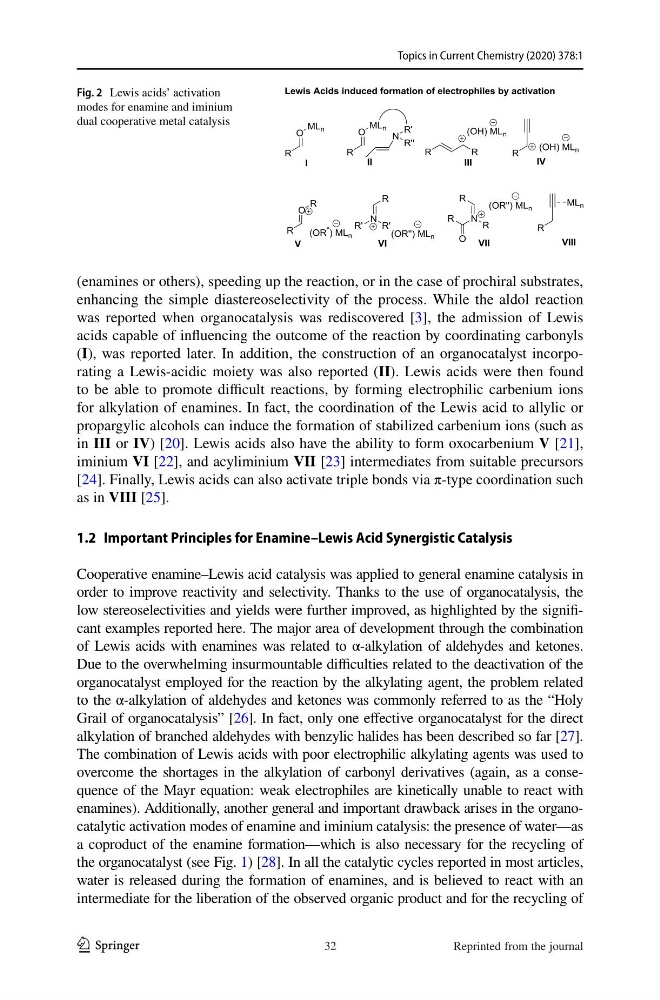
acids capable of influencing the outcome of the reaction by coordinating carbonyls
(I), was reported later. In addition, the construction of an organocatalyst incorporating a Lewis-acidic moiety was also reported (II). Lewis acids were then found
to be able to promote difficult reactions, by forming electrophilic carbenium ions
for alkylation of enamines. In fact, the coordination of the Lewis acid to allylic or
propargylic alcohols can induce the formation of stabilized carbenium ions (such as
in III or IV) [20]. Lewis acids also have the ability to form oxocarbenium V [21],
iminium VI [22], and acyliminium VII [23] intermediates from suitable precursors
[24]. Finally, Lewis acids can also activate triple bonds via π-type coordination such
as in VIII [25].
1.2 Important Principles for Enamine–Lewis Acid Synergistic Catalysis
Cooperative enamine–Lewis acid catalysis was applied to general enamine catalysis in
order to improve reactivity and selectivity. Thanks to the use of organocatalysis, the
low stereoselectivities and yields were further improved, as highlighted by the significant examples reported here. The major area of development through the combination
of Lewis acids with enamines was related to α-alkylation of aldehydes and ketones.
Due to the overwhelming insurmountable difficulties related to the deactivation of the
organocatalyst employed for the reaction by the alkylating agent, the problem related
to the α-alkylation of aldehydes and ketones was commonly referred to as the “Holy
Grail of organocatalysis” [26]. In fact, only one effective organocatalyst for the direct
alkylation of branched aldehydes with benzylic halides has been described so far [27].
The combination of Lewis acids with poor electrophilic alkylating agents was used to
overcome the shortages in the alkylation of carbonyl derivatives (again, as a consequence of the Mayr equation: weak electrophiles are kinetically unable to react with
enamines). Additionally, another general and important drawback arises in the organocatalytic activation modes of enamine and iminium catalysis: the presence of water—as
a coproduct of the enamine formation—which is also necessary for the recycling of
the organocatalyst (see Fig. 1) [28]. In all the catalytic cycles reported in most articles,
water is released during the formation of enamines, and is believed to react with an
intermediate for the liberation of the observed organic product and for the recycling of
Fig. 2 Lewis acids’ activation
modes for enamine and iminium
dual cooperative metal catalysis
Reprinted from the journal
32
1 3
(enamines or others), speeding up the reaction, or in the case of prochiral substrates,
enhancing the simple diastereoselectivity of the process. While the aldol reaction
was reported when organocatalysis was rediscovered [3], the admission of Lewis
acids capable of influencing the outcome of the reaction by coordinating carbonyls
(I), was reported later. In addition, the construction of an organocatalyst incorporating a Lewis-acidic moiety was also reported (II). Lewis acids were then found
to be able to promote difficult reactions, by forming electrophilic carbenium ions
for alkylation of enamines. In fact, the coordination of the Lewis acid to allylic or
propargylic alcohols can induce the formation of stabilized carbenium ions (such as
in III or IV) [20]. Lewis acids also have the ability to form oxocarbenium V [21],
iminium VI [22], and acyliminium VII [23] intermediates from suitable precursors
[24]. Finally, Lewis acids can also activate triple bonds via π-type coordination such
as in VIII [25].
1.2 Important Principles for Enamine–Lewis Acid Synergistic Catalysis
Cooperative enamine–Lewis acid catalysis was applied to general enamine catalysis in
order to improve reactivity and selectivity. Thanks to the use of organocatalysis, the
low stereoselectivities and yields were further improved, as highlighted by the significant examples reported here. The major area of development through the combination
of Lewis acids with enamines was related to α-alkylation of aldehydes and ketones.
Due to the overwhelming insurmountable difficulties related to the deactivation of the
organocatalyst employed for the reaction by the alkylating agent, the problem related
to the α-alkylation of aldehydes and ketones was commonly referred to as the “Holy
Grail of organocatalysis” [26]. In fact, only one effective organocatalyst for the direct
alkylation of branched aldehydes with benzylic halides has been described so far [27].
The combination of Lewis acids with poor electrophilic alkylating agents was used to
overcome the shortages in the alkylation of carbonyl derivatives (again, as a consequence of the Mayr equation: weak electrophiles are kinetically unable to react with
enamines). Additionally, another general and important drawback arises in the organocatalytic activation modes of enamine and iminium catalysis: the presence of water—as
a coproduct of the enamine formation—which is also necessary for the recycling of
the organocatalyst (see Fig. 1) [28]. In all the catalytic cycles reported in most articles,
water is released during the formation of enamines, and is believed to react with an
intermediate for the liberation of the observed organic product and for the recycling of
Fig. 2 Lewis acids’ activation
modes for enamine and iminium
dual cooperative metal catalysis
Reprinted from the journal
32