

Topics in Current Chemistry (2020) 378:1
1 3
Keywords Enamine · Lewis acid · Catalysis · Activation · Concerted reactions ·
Synergistic catalysis
1 Introduction: The Activation Modes in Organocatalysis
Organocatalysis has nowadays obtained an outstanding level of development and
sophistication [1]. The key publications were reported by MacMillan [2], Barbas and
List [3] in the 1990s, and other important papers considerably expanded the field
soon after. The activation mode involved in the organocatalytic reactions is considered as the best rationalization of the many reported examples [4]. This rationale
has been a crucial step to classifying, understanding, and developing organocatalytic reactions [5]. The formation of electrophilic (iminium) or nucleophilic (enamine) key intermediates is recognized as a crucial event for further development of
organocatalytic reactions [2, 3]. In these activation modes, the organocatalyst is
covalently involved in the formation of a stable species acting as a nucleophile (in
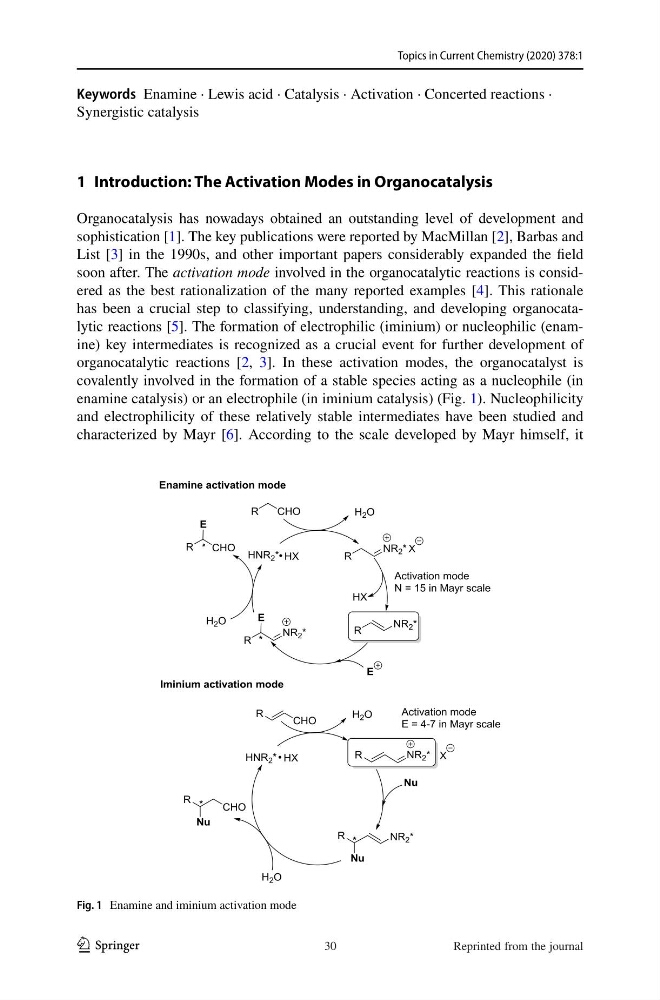
enamine catalysis) or an electrophile (in iminium catalysis) (Fig. 1). Nucleophilicity
and electrophilicity of these relatively stable intermediates have been studied and
characterized by Mayr [6]. According to the scale developed by Mayr himself, it
Fig. 1 Enamine and iminium activation mode
Reprinted from the journal
30
1 3
Keywords Enamine · Lewis acid · Catalysis · Activation · Concerted reactions ·
Synergistic catalysis
1 Introduction: The Activation Modes in Organocatalysis
Organocatalysis has nowadays obtained an outstanding level of development and
sophistication [1]. The key publications were reported by MacMillan [2], Barbas and
List [3] in the 1990s, and other important papers considerably expanded the field
soon after. The activation mode involved in the organocatalytic reactions is considered as the best rationalization of the many reported examples [4]. This rationale
has been a crucial step to classifying, understanding, and developing organocatalytic reactions [5]. The formation of electrophilic (iminium) or nucleophilic (enamine) key intermediates is recognized as a crucial event for further development of
organocatalytic reactions [2, 3]. In these activation modes, the organocatalyst is
covalently involved in the formation of a stable species acting as a nucleophile (in
enamine catalysis) or an electrophile (in iminium catalysis) (Fig. 1). Nucleophilicity
and electrophilicity of these relatively stable intermediates have been studied and
characterized by Mayr [6]. According to the scale developed by Mayr himself, it
Fig. 1 Enamine and iminium activation mode
Reprinted from the journal
30