

1 3
Topics in Current Chemistry (2019) 377:38
β-ketocarbonyls through an α-amination step [103]. The reaction showed a favored
N-selectivity and ensue through the enamine XXI addition to the oxidized intermediate XXII (Scheme 28). The chemical transformation tolerated a wide range
of functionalities and provided the α-aminated products 138 with moderate-tohigh yields and enantioselectivities (Scheme 28). Continuing this subject, a similar
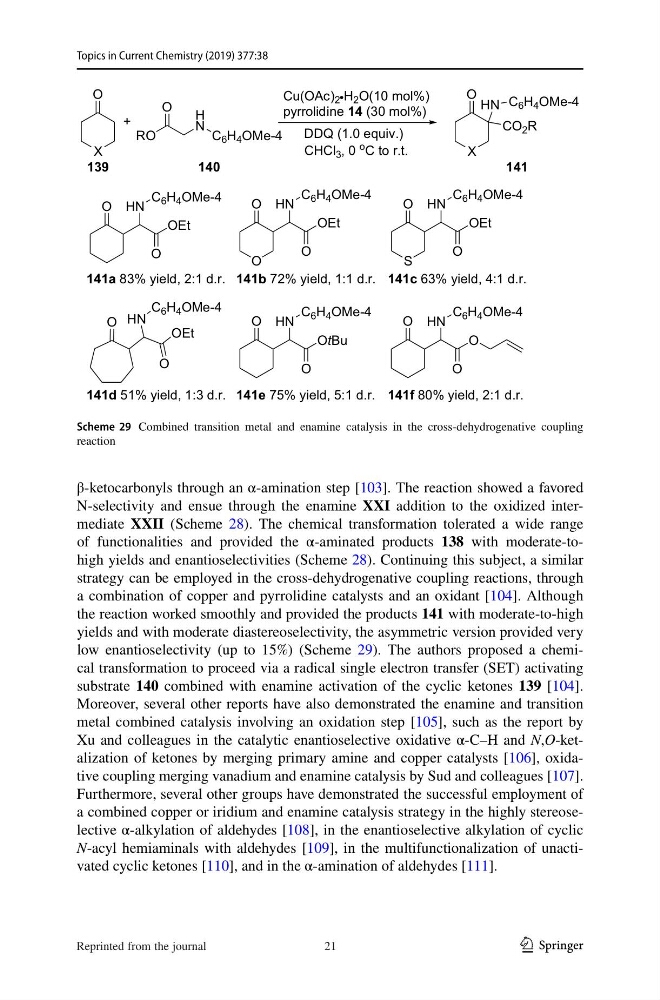
strategy can be employed in the cross-dehydrogenative coupling reactions, through
a combination of copper and pyrrolidine catalysts and an oxidant [104]. Although
the reaction worked smoothly and provided the products 141 with moderate-to-high
yields and with moderate diastereoselectivity, the asymmetric version provided very
low enantioselectivity (up to 15%) (Scheme 29). The authors proposed a chemical transformation to proceed via a radical single electron transfer (SET) activating
substrate 140 combined with enamine activation of the cyclic ketones 139 [104].
Moreover, several other reports have also demonstrated the enamine and transition
metal combined catalysis involving an oxidation step [105], such as the report by
Xu and colleagues in the catalytic enantioselective oxidative α-C–H and N,O-ketalization of ketones by merging primary amine and copper catalysts [106], oxidative coupling merging vanadium and enamine catalysis by Sud and colleagues [107].
Furthermore, several other groups have demonstrated the successful employment of
a combined copper or iridium and enamine catalysis strategy in the highly stereoselective α-alkylation of aldehydes [108], in the enantioselective alkylation of cyclic
N-acyl hemiaminals with aldehydes [109], in the multifunctionalization of unactivated cyclic ketones [110], and in the α-amination of aldehydes [111].
X
O
+
X
O HN
CO 2 R
C 6 H 4 OMe-4
Cu(OAc) 2 H 2 O(10 mol%)
pyrrolidine 14 (30 mol%)
DDQ (1.0 equiv.)
CHCl 3 , 0
o
C to r.t.
RO
O
H
N C 6 H 4 OMe-4
O HN
OEt
O
C 6 H 4 OMe-4
139
1 40
141
141a 83% yield, 2:1 d.r.
O
O HN
OEt
O
C 6 H 4 OMe-4
141b 72% yield, 1:1 d.r.
S
O HN
OEt
O
C 6 H 4 OMe-4
141c 63% yield, 4:1 d.r.
141d 51% yield, 1:3 d.r.
O HN
OEt
O
C 6 H 4 OMe-4
O HN
O
O
C 6 H 4 OMe-4
141f 80% yield, 2:1 d.r.
O HN
OtBu
O
C 6 H 4 OMe-4
141e 75% yield, 5:1 d.r.
Scheme 29 Combined transition metal and enamine catalysis in the cross-dehydrogenative coupling
reaction
Reprinted from the journal
21
Topics in Current Chemistry (2019) 377:38
β-ketocarbonyls through an α-amination step [103]. The reaction showed a favored
N-selectivity and ensue through the enamine XXI addition to the oxidized intermediate XXII (Scheme 28). The chemical transformation tolerated a wide range
of functionalities and provided the α-aminated products 138 with moderate-tohigh yields and enantioselectivities (Scheme 28). Continuing this subject, a similar
strategy can be employed in the cross-dehydrogenative coupling reactions, through
a combination of copper and pyrrolidine catalysts and an oxidant [104]. Although
the reaction worked smoothly and provided the products 141 with moderate-to-high
yields and with moderate diastereoselectivity, the asymmetric version provided very
low enantioselectivity (up to 15%) (Scheme 29). The authors proposed a chemical transformation to proceed via a radical single electron transfer (SET) activating
substrate 140 combined with enamine activation of the cyclic ketones 139 [104].
Moreover, several other reports have also demonstrated the enamine and transition
metal combined catalysis involving an oxidation step [105], such as the report by
Xu and colleagues in the catalytic enantioselective oxidative α-C–H and N,O-ketalization of ketones by merging primary amine and copper catalysts [106], oxidative coupling merging vanadium and enamine catalysis by Sud and colleagues [107].
Furthermore, several other groups have demonstrated the successful employment of
a combined copper or iridium and enamine catalysis strategy in the highly stereoselective α-alkylation of aldehydes [108], in the enantioselective alkylation of cyclic
N-acyl hemiaminals with aldehydes [109], in the multifunctionalization of unactivated cyclic ketones [110], and in the α-amination of aldehydes [111].
X
O
+
X
O HN
CO 2 R
C 6 H 4 OMe-4
Cu(OAc) 2 H 2 O(10 mol%)
pyrrolidine 14 (30 mol%)
DDQ (1.0 equiv.)
CHCl 3 , 0
o
C to r.t.
RO
O
H
N C 6 H 4 OMe-4
O HN
OEt
O
C 6 H 4 OMe-4
139
1 40
141
141a 83% yield, 2:1 d.r.
O
O HN
OEt
O
C 6 H 4 OMe-4
141b 72% yield, 1:1 d.r.
S
O HN
OEt
O
C 6 H 4 OMe-4
141c 63% yield, 4:1 d.r.
141d 51% yield, 1:3 d.r.
O HN
OEt
O
C 6 H 4 OMe-4
O HN
O
O
C 6 H 4 OMe-4
141f 80% yield, 2:1 d.r.
O HN
OtBu
O
C 6 H 4 OMe-4
141e 75% yield, 5:1 d.r.
Scheme 29 Combined transition metal and enamine catalysis in the cross-dehydrogenative coupling
reaction
Reprinted from the journal
21